Mailing Lists | Direct Mail Journal - Part 2
 

Direct Mail Journal

Direct Mail and Marketing Tips

Archive for category: Mailing Lists

USPS Household Mail Survey Insights: What Marketers Need to Know in 2026

In a world dominated by digital noise, understanding how people truly engage with physical mail has never been more valuable. For marketers looking to cut through the clutter and connect in more meaningful ways, one resource stands out: the United States Postal Service’s Household Mail Survey (HMS).

A Long-Standing Source of Truth

Since 1987, the USPS has funded and conducted the Household Mail Survey, one of the most comprehensive, longitudinal studies on mail behavior in the United States. Each year, around 5,200 households participate, documenting every piece of mail they send and receive over the course of a week.

This is not just surface-level data. It is a real-world, behavior-based snapshot of how mail moves through homes, how it is interacted with, and how it is perceived.

Why This Data Matters

For businesses and marketers, especially those leveraging direct mail, the HMS offers something rare: consistent, reliable insights over time. While digital metrics can fluctuate rapidly, this study reveals long-term patterns that help guide smarter strategy.

Here is what you can uncover:

1. Evolving Mail Trends
Understand how different industries are using mail and how those trends shift year after year. From transactional mail to marketing campaigns, the data reveals what is growing, what is declining, and where opportunities lie.

2. Mail Class & Content Insights
Dive into how various types of mail such as First-Class, Marketing Mail, and packages are used and received. This helps businesses refine formats, messaging, and delivery strategies.

3. Household Attitudes Toward Mail
Not all mail is treated equally. The survey highlights how recipients feel about different types of mail, what gets opened, what gets saved, and what gets ignored.

4. Demographic Targeting Opportunities
With demographic breakdowns, marketers can better understand which audiences are most responsive to mail and tailor campaigns accordingly.

What’s New: The 2025 Report

The 2025 Household Mail Survey report is now available and packed with fresh insights into how mail continues to play a role in modern households. As consumer behaviors evolve, especially in a hybrid digital and physical world, these findings help businesses stay ahead of the curve.

You can explore the full report here:
https://postalpro.usps.com/node/15133

What to Expect 

Data collection for the 2026 study is already underway, with the next report expected in March 2027. This ongoing research ensures that marketers have access to up-to-date insights that reflect real consumer behavior, not assumptions.

For businesses, this means a continuous stream of reliable data to refine strategies, test new approaches, and stay aligned with how consumers actually engage with mail in their daily lives.

What This Means for Your Direct Mail Strategy

If you are investing in direct mail, or considering it, this survey reinforces a key point: mail remains a powerful, measurable, and evolving channel.

At Zairmail, we believe that the most effective campaigns are built on data, not guesswork. Insights from studies like the HMS help businesses:

  • Design more relevant and engaging mail pieces
  • Target the right audiences with precision
  • Optimize timing, format, and messaging
  • Integrate mail seamlessly into omnichannel strategies

Key Insights

The USPS Household Mail Survey is not just a report, it is a strategic advantage. In an era where attention is scarce, understanding how people interact with physical mail can give your brand the edge it needs.

The Power of Direct Mail in a Digital World with Wilson Zehr

Episode Details

Podcast: He Said, She Said: Razor Branding™ Podcast
Episode: The Power of Direct Mail in a Digital World with Wilson Zehr
Published: October 30, 2024
Guest: Wilson Zehr
Guest’s business: Zairmail
Guest’s title: Founder & CEO
Hosts: Jaci Russo and Michael Russo
Duration: Approximately 36 minutes (35:38)

Apple Podcast: https://podcasts.apple.com/us/podcast/the-power-of-direct-mail-in-a-digital-world-with-wilson-zehr/id1211830371?i=1000675066592

Why Physical Mail Is Still One of the Strongest Marketing Channels

In today’s digital-first landscape, businesses are constantly competing for attention in crowded inboxes, endless social feeds, and over-saturated ad platforms. Yet despite the rise of new tools and technologies, one channel continues to quietly outperform expectations: direct mail.

In the podcast episode “The Power of Direct Mail in a Digital World”, entrepreneur and Zairmail founder Dr. Wilson Zehr explains why physical mail remains one of the most effective ways to reach, engage, and convert customers—even in an era dominated by digital marketing.

Why Direct Mail Still Works in a Digital World

One of the biggest misconceptions in modern marketing is that direct mail is outdated. Wilson Zehr challenges this idea with a simple truth: attention has become more valuable than ever—and direct mail still earns it.

Unlike email or digital ads that can be ignored, deleted, or blocked, physical mail arrives in a real, tangible space—the mailbox. This creates what marketers call a “mail moment,” a point in the day where people naturally pause and engage with what they receive.

Direct mail also avoids one of the biggest problems in digital marketing today: noise. While online channels are saturated, physical mail offers a more focused and less competitive environment for brand messaging.

Precision Targeting Has Changed Everything

Modern direct mail is no longer a spray-and-pray channel. According to Zehr, today’s systems allow businesses to target audiences with remarkable precision.

Campaigns can now be segmented based on:

  • Demographics
  • Purchase behavior
  • Geographic location
  • Life events
  • Industry or profession

This level of targeting transforms direct mail into a performance marketing channel, not just a branding tool. Businesses can now reach the exact people most likely to respond.

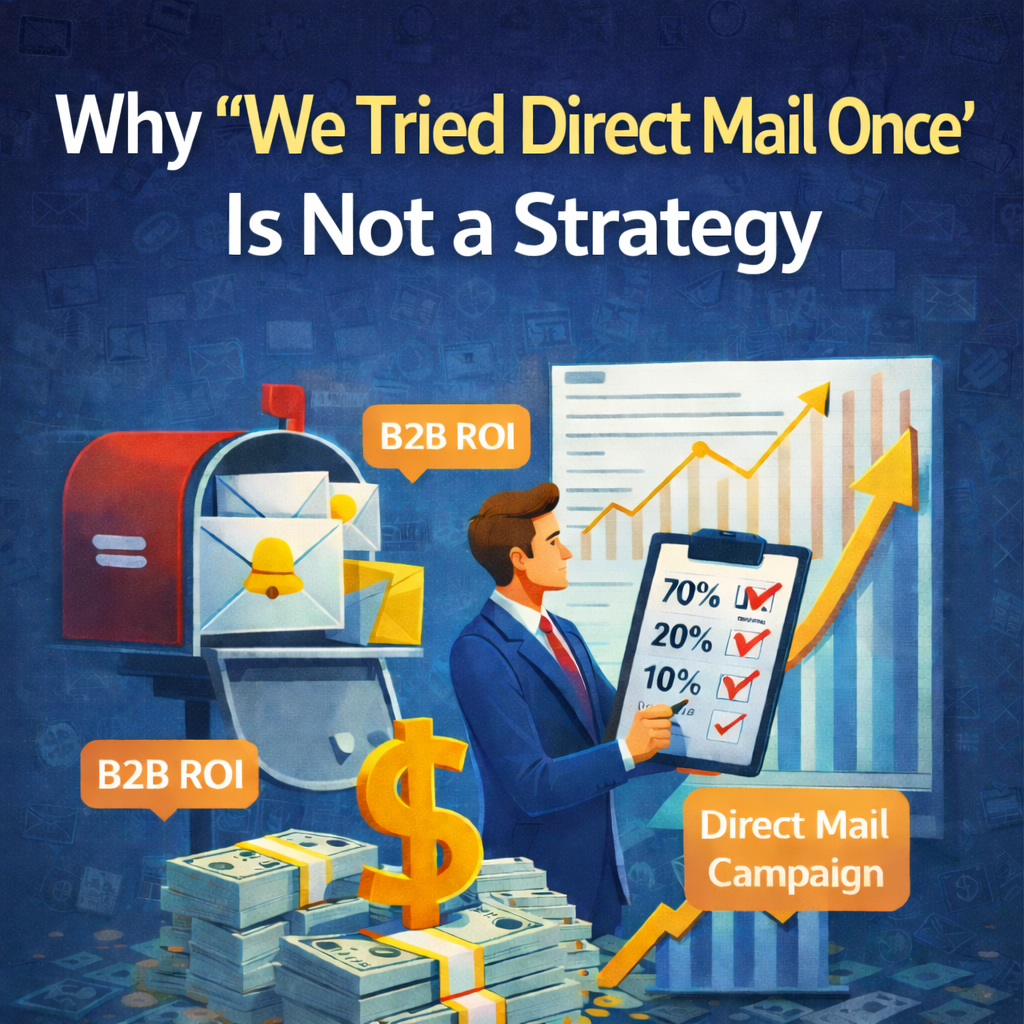
The 70-20-10 Rule of Direct Mail Success

Wilson Zehr introduces a simple but powerful framework for understanding what actually drives results in direct mail:

  • 70% – List and Targeting: Success depends primarily on reaching the right audience
  • 20% – Offer: A compelling message or value proposition
  • 10% – Creative: Design supports the message but does not drive results alone

This shifts traditional thinking. Instead of focusing heavily on design, businesses should prioritize who they are speaking to and why it matters to them.

Direct Mail + Digital = Maximum Impact

One of the strongest takeaways from the podcast is not choosing between digital and direct mail—but combining them.

The most effective modern marketing strategies are omnichannel, using direct mail to:

  • Reinforce digital campaigns
  • Warm up cold leads
  • Re-engage inactive prospects
  • Strengthen brand recall

When paired with tools like email, retargeting, and CRM automation, direct mail becomes part of a powerful multi-touch system that significantly improves conversion rates.

Speed and Automation Have Changed the Game

Platforms like Zairmail have transformed direct mail entirely.

What once required printing, packaging, and manual mailing can now be done in minutes:

  • Upload a document
  • Select a mailing list
  • Send physical mail instantly

This removes traditional friction and makes direct mail as easy as sending an email—while still delivering the impact of physical communication.

Real Results: Why Businesses Still Invest in Direct Mail

Across industries—from real estate to nonprofits to B2B services—direct mail continues to deliver strong ROI when executed properly.

The reasons are clear:

  • People trust physical communication more
  • Mail is harder to ignore than email
  • It creates stronger emotional and cognitive impact

When combined with proper targeting and consistent follow-up, direct mail becomes a predictable revenue driver, not just a marketing experiment.

Key Insight

The biggest takeaway from Wilson Zehr’s insights is that marketing success is not about choosing between old and new channels—it’s about using the right tools in the right way.

Direct mail is not a relic of the past. It is a modern, data-driven, highly targeted channel that becomes even more powerful when integrated into today’s digital ecosystems.

With platforms like Zairmail enabling speed and scalability, businesses can now combine physical impact with digital efficiency.

In a world where attention is fragmented, direct mail stands out because it is simple, tangible, and personal—and that may be exactly why it continues to work so well.

Apple Podcast: https://podcasts.apple.com/us/podcast/the-power-of-direct-mail-in-a-digital-world-with-wilson-zehr/id1211830371?i=1000675066592

👉 Book on Calendly

Free Direct Mail Sample Kit

See direct mail before you send it

Get samples of direct mail postcards and letters, plus service details to help you launch your first campaign. Your kit ships free by USPS.

Request Your Free Sample Kit →
Click to View Full Episode Transcript

Podcast: He Said, She Said: Razor Branding™ Podcast
Episode: The Power of Direct Mail in a Digital World
Hosts: Jaci Russo and Michael Russo
Guest: Wilson Zehr (Seasoned Entrepreneur, Academic & Founder of Zairmail)


[00:00:00] What am I to do? Welcome to He Said She Said Razor Branding Podcast with Michael Russo and Jackie Russo. To learn more about how to improve your brand, visit BrandRusso.com. Michael, today’s interview, I would call it… Old school back to basics traditional in the trenches marketing. I know the kids today love to talk about digital stuff, but we have Wilson’s there and he was talking to us about direct mail. Old school. Old school man. I mean, we kind of cut our teeth on that. And really, we’re revolutionary when we were doing Pearl campaigns, things like that. Do you remember that? I do. I love that you just called us. Like, I don’t think you can call yourself revolutionary. I think other people have to pay you that honor. Well, you’re right. Yes, we were doing it when it wasn’t.

[00:00:51] You know, it was really when digital was really coming online. It was the ability to, oh my God, I have my own personal URL. And the success rates were huge. I remember correctly. Huge. Yeah. A lot of success with that. And then, you know, it’s just we haven’t done. I don’t know when’s last time. I mean, we do direct mail as part of General Pearl campaigns and of content, that kind of thing, but it’s usually associated with a digital email campaign as well as several other touch points within the marketing, you know, universe. We’re going all-in on digital mail, on direct mail. It doesn’t happen that often these days.

[00:01:30] It really does and I think people got away from it because shiny new things happen in the digital space. But what I love that Wilson really kind of gave us a 101 on is the foundations of it, how it’s important, the joy people still get from getting mail, how using, what do you call it, thick mail, which we call 3D. mailers all of these things are useful tools and it gets us back to basics and it’s never bad to start back at the beginning. Yeah, and he’s right. I mean, there is there is something about getting home and going through your mail or being at the office and getting a stack of mail and going through it. Some people hate it because there’s bills and things you don’t want to get. But every, every once in a while there’s something fun, you know, and if you can stand out in that crowd and make something interesting and memorable and eye catching, you know, there’s an opportunity there just like

[00:02:18] Like we talked about radio, there’s, I love radio advertising. It’s a great way to, for not a lot of money, you know? It’s cause you can tell a story. Yes, absolutely. It’s a great vehicle for that. And there is room for that because if you listen to the radio at all or Spotify or whatever, the ads are generally annoying to some degree and they’re selling hard and. They’re just not great. Every once in a while something comes on and it’s entertaining and fun and emotional or something along those lines and you are. Hooked, you know, it stays with you. It sticks. So there’s an opportunity for that to happen. And what I call the age of mediocrity, which is everything produced by AI in general. And, you know, yeah, I can go in there and get, get, get some quick content out on the web or. Online or whatever, but.

[00:03:02] Does it have any stickiness to it? Does it resonate? Will it make you remember them after it’s come and gone? Yeah, it’s nice. Like I said, it’s definitely still part of our toolkit. Um, we use it from time to time. Uh, a lot of times it’s easier to go with the digital because there’s more tracking, there’s more analytics and things like that. But at the same time, you know, it is an opportunity to get in front of people. Well, without further ado, let’s talk to the expert Wilson. Welcome to the show, Wilson. Thank you. Thank you for having me. Appreciate it. Well, thanks for being here. Michael and I love talking to people who have real world practical experience because they’re out in the fields doing things. No offense against my academics and my authors. I think they bring great information too, but people who are out there really getting it done.

[00:03:55] That’s my favorite. And so I love that we’re going to get to talk about direct mail because I think it is an often overlooked occasionally maligned and completely disrespected yet important part of the touch point series that we should be considering when we look at all the places where people should market. So tell us a little bit about your background with direct mail and your kind of thoughts around where it stands today. Let me start out by saying, yeah, I do. I’ve spent a lot of years on the practical side, implementing as a marketing person, mostly in high technology. But I’ve also been a professor at the university level for 10 or 15 years as well. So I have…

[00:04:42] I can see both sides put it that way. In terms of this company, the company I run today is called ZairMail. It’s like air mail with the Z on the front. And what we do is we automate direct mail campaigns. So client comes in, they upload their document, they upload a list to see a proof of what will be produced in real time. They like what they see. They push the button in a mail today or the next day at a big savings. And it makes a whole thought process faster and easier. That was our whole the idea was to make direct mail as fast and easy or easier than email. as a marketing tool. The question comes up oftentimes, as you’ve alluded to, why direct mail? I mean, why is that relevant? Why is it important? I mean, a lot of times, I mean, in the spectrum of marketing, we have lots of tools that we can work with. And if we’re doing direct response, we want somebody rather than

[00:05:46] brand advertising, direct response, where you want people to respond and buy something, it’s important to be able to touch them. And we have tools that are less expensive, stuff like email and some SEO, kinds of things. But there are things about mail that are very unique. First of all, it’s proactive, so you- you don’t have to wait for people to find you. You can reach out and grab them, and you can grab them where they live, where they work. The U.S. Postal Service has the charter to deliver mail to every household and business in America six days a week. So the reach is kind of unparalleled.

[00:06:35] Thirdly, it’s a demographics. If I want to find, you know, the lists are very well developed and if in a direct response model, you know, when we’re looking at the elements that lead to success, it’s usually about 70% list, 20% offer, 10% creative. or whatever’s left is creative. But when we talk about the mail, if I want to reach a Jewish dentist in New Jersey that purchased a car in the last six months, I can buy that list and I can reach out and touch those people. It’d be very difficult to do that with email. other kinds of digital tools. And I guess the final thing, or the final high-level thing, there are lots of other ancillary reasons, but it’s just built into American psyche. The U.S. Postal Service talks about something called the mail moment, right? When people come home, and they pull the stuff out of the mailbox, and they

[00:07:35] go through it. And, you know, that might be a moment of excitement. And I, I feel like they romanticize it a little bit. The fact remains that most people, it’s just part of their daily routine. They come home, they get the mail, they sort through it. If something’s interesting, maybe they put it on the fridge or come back to it later. But people don’t react to it the same way they might react to spam or to, you know, cold call. You know, if you’re making cold calls today, that is a really hard job. People are not nice. No, you’re absolutely right. One of the. Right. One of the things that I think, and to your and the post office’s point about the joy of getting mail, we don’t have joy at email anymore. You know, I’m wading through anywhere from four to 600 emails a day and two thirds of those are unsolicited. I’m not going

[00:08:31] call him spam but I didn’t ask for it and so when I think about the mail that I’m going through and I don’t know about anybody else’s postal worker but my person his name is Scotty when where he brings his mail to me there is the stack of mail that he has deemed as good and then the stack of mail that he has deemed as unsolicited and he’s bound that up with a rubber band. So it makes it really easy for me just to put that right in the trash. And the good stuff sticks out and gets my attention. So one of the things that we’ve used Wilson in the past is whether glared around that and making sure people don’t just toss it in the round filing cabinet. Yeah, there is a will you touch on an important subject to let me I’m not avoiding your question. I will address it directly. But the other thing is deliverability. I mean if something like

[00:09:30] One third, almost 30% of even legitimate email is never delivered today. It’s just caught up in spam filters and R. to the wayside. But if you’re sending something through the mail, it’s pretty likely it’s going to get there. But going back to your point about dimensional mailing, that’s what they call it, or lumpy mail. I’ve written a couple articles about lumpy mail. If you can do something that makes it stand out, then… it will get additional attention. I mean, we could take a step further on this topic. So when you, you know, a little bit depends on the format that you’re mailing. So if you’re mailing, you know,

[00:10:14] If we look at the kinds of things we’re mailing today, it’s common to do postcards, letters, snapbacks, things like that. If I’m mailing a postcard, a postcard is basically a little billboard in the mail, so I’m going to get an impression right away. If it’s provoking and if somebody feels not good about it, it may actually make it on the fridge. It’ll stick around for six months or a year, and that’s a good. thing. But if we go to something like a letter. The reason why we might letter actually cost a little bit more the reason why we do that though is that we maybe we have we need more space to develop our offer or maybe there’s some private information in there that we don’t want other people to be able to see. But as soon as I put it in a letter, then I’ve got this issue of open right I need to get an open,

[00:10:59] before I get an impression. And with any kind of a lumpy male or dimensional male, it increases your likelihood of an open. And in fact, things like color, things like use of a real stamp, a handwriting font, those are all just techniques to increase the open rate. because unless I can get it opened, I can’t get a response. And that’s why, you know, you’ve seen in the past, I know you’ve probably seen these too, where somebody used to be they’d put a penny in, now they put a buck, they can’t get your attention with a penny. But that also invokes a sense of reciprocity, right? If somebody’s giving you something, you feel like you should give back, or a lot of people do anyway. So just techniques to get noticed and get opened and get responses to your offer.

[00:11:51] Now, the flip side to that is that it does add to the cost too. So, whenever we’re using a technique like that, we have to assure that the response rates, the R- And so how do you guide people on testing? Is there a recommendation that you have around peeling off a specific small segment of the audience to test different options when it comes to gauging open rates? Yeah, we always suggest testing. And with mail, it’s going to be relatively easy to do. I mean, the break point for mail is right about 500 pieces. And the reason for that is because the US Postal Service provides discounts. Well, If you think about the economics of direct mail, about 70% of the cost is postage, right? So that’s always a concern. And people can opt for first class or standard A. First class is going to give you faster, you know, it’s going to give you faster delivery. Right now, it’s three days anywhere in the US, give or take.

[00:13:01] And if they can’t deliver it, the Postal Service will give you a return service so you can update your database. If you look at Standard A, it’s seven to 10 days. roughly, and if they can’t deliver it, they just recycle it. But you do say if there is a significant savings on postage. When we’re testing, we would almost always do first class. First class can produce an uplIft. But if we do 500 pieces or more, we qualify for pre-sort discounts. So typically, we would test with 500 more piece. Oh, and the other thing with a test, of course, is we have to use enough records to get a significant result.

[00:13:41] so we can see if we have an impact or not. But we would do a few different types of treatments. Maybe we might do a life stamp. Maybe we might do a handwritten font. Sometimes people would do a different color envelope or a teaser on the outside, something like that. And look at the response rates. And we could find a formula. where we’re getting traction, then we’ll step on the gas and we start increasing the size. For a mailer, like we used to, long ago we did some work for GE Medical, they’re doing millions of pieces of mail. For those guys, standard A, even though the response rates tend to be lower, standard A,

[00:14:21] Just to relate that to. kind of normal terminology is what we used to call bulk mail, or even junk mail, right? So if you’re GE medical, you’re doing millions of pieces a week, then you’re going to do standard A because postage is a big deal, right? And so saving you know, a nickel on each letter or dime on each letter is important. It turns out to be a lot of money. But if you’re and the quicker response rates are, well worth the extra money. So we actually do a lot of first-class mailing these days. If I will look back, you know, 10 plus years ago, most of it was standard A, and today, most of what we do is first-class mail. Wow. And how much of a difference? Sorry, Michael.

[00:15:13] No, no, Jackie, you’re kind of running every question, so keep going. No, no, I’ll let you have a chat. I like it when you lead. No i just think that you know when in the scope of things to like i love writing for radio for example because there’s so much bad radio out you know, buy one one get one free kind of thing and it’s really just at the moment kind of transitional transactional marketing, you know, the branding world would try to form more emotional connections. So I think there’s a room to stand out by having something really creative or really impactful or a great headline, something that that is.

[00:15:54] refrigerator worthy, you know, that you want to put up and save. It’s hard to throw away. You have R that moment of memorability to it somehow, and it’s hard. It’s not easy. But when you’re able to accomplish that, I think you can really cut through the clutter because again, There is still out there and generally it’s not that great as far as from a creative or even thought process. It’s like, hey, just pay attention to me right now. Use this offer. It’s immediate response, right? But when you’re able to dig in and maybe have a multiple series of things where you receive something and a few days later, maybe you see something else. A week later, you receive something else and it’s more of a drip campaign through direct mail. I think you can have an impact, you know, and just having that creative ability to stand out from all the noise out there.

[00:16:38] I agree. We tend to look to your point. We tend to look at advertising. on a continuum you know so at one end there’s brand which is Nike just do it right there’s no role there’s no phone number because they know that you’re going to buy something in the retail environment they just want to make sure when you’re reaching for the shelf you’re reaching for a Nike box. And the other end of the continuum is direct response. I mean, there’s just a big 800 number that’s flashing, dial me now, or a website URL. But most campaigns are somewhere in between, right? They, you know, more or less brand, more or less response, depending on what we’re trying to accomplish.

[00:17:20] And I will say that these days, too, it’s more common to have omnichannel, you know, to be able to use a multiple variety of tools. I can give you an example. We worked on a… We worked on a school bond initiative here locally, and so they wanted us to help with the mail, but they wanted us to help with the overall campaign. So as we put this campaign together, and the school had done a very good job of managing their debt, and it looked like they were able to pass this bond, they got a matching grant from the state of another $4 billion, which is a big deal in the small community. So we did what a lot of companies we did. We built a website. We had a blog. We went out, did videos. We put videos on the website. We engaged with the Parent-Teacher Association. We had to use social media.

[00:18:13] to get to engage with them, but to get them to engage with their friends. We actually bought the voter roll and looked at… people, you know, the who’s registered to vote. And then we did an overlay on the voter file. And then we picked out those who were homeowners and those who are renters because homeowners are actually going to pay the tax property tax levy. And then we divided those further to those who had kids in school and who’s those who didn’t. thinking that those who had kids in school and paid the tax, those were the ones we needed to convince that the extra expense was going to be a good deal for their kids. With the ones that…

[00:18:53] that that were paying the tax were homeowners but didn’t have kids in schools. We needed a message around community, community involvement, doing the right thing for your neighbor, a lot, you know, a different kind of spend. And on the other side, you know, just renters, of course, they’re getting, in most cases, something for nothing. So that’s a little easier still. So just information. So we went out with a couple pieces like that, differentiate it. Then of course we did, like a lot of companies, we did yard signs. We did door hangers. We went to coffees and PTA meetings and engaged people personally. And then here in Oregon, it’s all vote by mail. It has been for…

[00:19:34] 30 years now. And so we know when those ballots are getting mailed. We also know that some people, when they get a ballot, they vote right away. Some people hang on to it until the due date, you know, give themselves some time to gather information, think about it. So we set up a piece that arrived in mailboxes the day before. before ballots arrived to get those early voters. And then we had a reminder piece, go out just before ballots are due. But using all of these different tools, we were able to get a successful outcome and the margin of success was… four times greater than anything they’ve seen in the past. But we did use a variety of these different tools in different ways to accomplish different things for the campaign.

[00:20:23] Well, that goes back to what we talked about is, you know, just a branding perspective or a brand planning perspective, understanding who your audience is, you know, know, and knowing what’s going to motivate them, where to find them, where to, you know, you can have a great message, but if nobody sees it, it doesn’t matter. You can have a great delivery system. But if the message is bad, it doesn’t matter. They all have to kind of work together as part of the symmetry of it all, you know. which brings me to the question of Businesses you think of direct mail you mainly think of consumer based you know opportunities but when it comes to we do a lot of work in the b2b space and you know for businesses how would you talk about them benefiting from the use of direct mail i mean are the list harder to find when you start to dig a little deeper when you’re trying to talk to business.

[00:21:06] instead of just people that are, you have their home addresses. I think the business lists are pretty well-developed these days too. I mean, if you look on our site, most of our customers come with their own list or their own data. But for those who don’t, we actually supply data as well. We provide a way to buy Axiom, consumer data through Axiom, but we also have a direct link through Dun & Bradstreet. And you could find businesses based on region, size, number of employees, verticals that they’re involved in. So the lists are just about in lists in that space.  The trick with B2B, and I know I’m always preaching to the choir here, but the trick with B2B is that the decision-making process is a little bit different. When we’re talking about a consumer, we’re talking about somebody who maybe you have

[00:22:07] to. you know, two partners who are interested in taking an offer or just one person and they can pick up the phone and call. But in the business, we usually deal with something called a buying center and especially with something that’s more expensive, so we might have multiple people involved in that process. the CEO, the CFO, the operating manager, the person who’s actually running the program. And so in a B2B sales process, we often have to address, it’s a more analytical, not really… impulse purchase, and we have to help the customer work through the objections with all of those parties to

[00:22:57] The way we’ve seen direct mail used in business to business is we’ll go out with an introduction. We’ll introduce a product or service and try to get as high as we can in the organization. And then we’ll follow up with a phone call and start the dialogue. The advantage in that case is that it’s not a cold call at that point. It’s a warm call. I’m just following up on my letter to see if you have any questions. How can I help? Sales, in that case, and B2B, we use a lot more direct sales than a consumer. And the sales is a process of solving problems. solving problems for customers. So to the extent that I have an invitation to engage with that customer, understand their problem and help them solve it, that’s a really good thing for a B2B application. For sure.

[00:23:52] do you ever incorporate, um, personalized URLs or pearls into your direct mails? We do. We have customers that use, um, how to use pearls. And these days I have customers that are using personalized QR codes as well. And we have, historically in our system, we actually have another kind of link too, where we can do personalized response portals and give customers a link that’ll actually pull up a database. or a data screen allow them to augment that, request additional, additional information. So we’ve gone one step further in Tell me more about the augmentation. How does that work? The application we first put this together was for in mortgage marketing. So we reach out to the consumer and say basically, we see you have a

[00:25:01] Well, let me back up a second. The clients I’m talking about are using credit score data. Okay. So they can see, we can see you have a mortgage of X, you have a payment of Y, and interest rates now or look like they’re at this rate. So if you did a cash out refi, you might get this much money out that you could use home repairs or pay off debt or other purposes and you would have a new amount mortgage about it this much you know with these kind of payments you know with the APR etc so we can do all of that variable data in the piece and then we provide a link and so when the customer gets that they can go to the link and they can say oh yeah that’s my address

[00:25:41] that’s my rate. Here’s my phone number. Yeah, I’d like to learn more. Here, call me. And they click another button. And so the agent will get the updated information, you know, update their database, they’ll get the updated information, and they can call the customer and have a conversation based on that information. it actually provides kind of a middle step. Some people, when you reach out to people, some people are a little reticent to call, they pick up the phone. And if there’s a middle step where they can go to a website and request information, or they can request a sample kit, or they could do whatever. They can engage with you, but they’re not ready yet to have, to have a live conversation. This is a tool that helps move them to the next step. I love that. I think that’s awesome.

[00:26:35] . more than almost any industry. What do you see as the trends that really help them make the most impact with direct mail campaigns. You’re right. We do see a lot of mail-in campaigns. You know, what I’m seeing I guess what I’ve seen a lot more of this election cycle is a lot more text messaging and things of that nature. I have no idea how effective that is. In my case, it’s not very effective because if I haven’t requested it and arrives, I just delete it and I block the number. But I know a lot of people are using it in conduction with direct mail. A lot of what people campaigns have done in the past is really just carpet bombing, right?

[00:27:36] And I don’t know how effective that really is. I mean I guess it’s a form of awareness and if you can and stickers and yard signs and stuff that may make a difference from a branding standpoint. But in terms of the actual vote, I’m not sure. What I do know is that our service is very fast response. So when campaigns engage us, usually what they’re looking to do is deal with an issue, you know, respond to an issue, respond to something in the press, remind people that the vote is tomorrow or, you know, being able to do those things. things are very timely, and we’re very good at that. And it seems like we get very good response rates as long as we get there with the right timing. Once again, the model I was sharing earlier was this idea of 70% list, 20% offer, whatever’s left is creative. And so the trick is finding out

[00:28:36] the you know the right people in this case in a lot of in most counties they they actually sell the voter files so so that’s a good thing I can find those people. But the question is, how am I going to come up with an offer or a message that’s going to resonate and add? you know, drive a response. And that’s the trick in political mail. Absolutely. Well, and not just supply the list from the registrar voters, which I think is helpful, but what I’m always fascinated by the frequency of voting. And so obviously we don’t know who they cast a vote for or what issues they voted for. They could have signed in.

[00:29:17] into the booth, checked nothing, and walked out, but they showed up. And so I think that’s amazing that you can see how chronic they are. Did they vote in three of the last five, five of the last 10, 10 of the last 10. And I would imagine that’s going to alter in some ways the messaging if you know that they are a more chronic voter than someone who is sporadic. Yes, it’s true. I mean, some large percentage of registered voters never vote. Right. And it’s hard for us to tell exactly who those are. So there’s a little bit of waste there. And we don’t know. Somebody just because they didn’t participate in the last election doesn’t mean they won’t participate in this one.

[00:29:58] But I think part of the key is to build that emotional connection to people so that they want to get a out and do that. I think as I watch the national campaigns right now, I see that the messaging around the Harris campaign is they want to make sure that people, they want to position themselves as the underdog, right? Because they don’t want people to lay back and relax and not vote. So they want to create that sense of urgency. We’re the underdog. You’ve got to get out and vote. And you see the same on the other side, too, but in a little different way. So it’s how do you make that emotional connection and motivate people to vote?

[00:30:47] But vote in the way that you’re hoping they will. Right, right. I mean, I would imagine part of that’s maybe utilizing a series. And so if you’re sending someone three, four, five different pieces, then you can leverage different steps along the path for different messaging to compel different actions. Right. That’s a really good point. So we could have, we can have a series of messaging. I mean, oftentimes when fundraising, they’ll do that. They’ll start out with a real general message, and then they’ll go to, you know, follow-up ones. They’ll do pieces. They’ll do very specific points. You know, here’s what your donation did here. Here’s what it does here.

[00:31:25] what else it could do. And we could vary the donation amounts. Yeah, there’s a lot of strategies like that. Do you remember, do you remember Burma Shave? Yes. I mean, that was before my time, but I’ve read about it in some advertising textbooks, to be clear. They would do those road signs. My dad would talk about it, you know. They’d drive in the car, and as a family, they’d read these signs. Rght. And it’s a really funny story. I sometimes use it in a marketing class. We’ll talk about it. But you can do something similar in direct mail, too, building, set a foundation, and then build on the message. I mean, in the ideal world, you’d get people so- so they’re trying to anticipate your next message. When’s it going to come? The story’s not complete.

[00:32:18] Thank you. Absolutely. So I know. This is a little off topic, but you might have some expertise that you can loan to me. Who. Who do you recommend when it comes to postage? I mean, is it about going straight to the post office or the some of these like postage in your office tools that you kind of like again? I know we’re off topic, but we’ve been doing research on it and I’m always. curious to hear expert opinions. So what is particularly? You know, like stamps dot com or some of those places where you don’t have to go to the post post office anymore. Who do you like in that arena? You know, I like ZairMail best. Honestly, we actually have a new application we rolled out called Speedy. There you go. www.zairmail.com slash Speedy. You can download the application there. It’s a desktop icon, basically. And so if you have a piece of mail you want to send, you just drop it on the icon. We’ll ask you for

[00:33:11] address, you push the button, out it goes, even if it’s just one letter. That’s awesome. I love those tools, you know, the tools like stamps that are, you know, that I think they’re going in the right direction, but they don’t really solve the biggest part of the problem. So the biggest part of the problem for most people is not that they can’t find postage, because these days they sell postage and, you know, safely in the grocery store. But if you want to do a letter, you have to compose a letter, you have to print it out, you have to fold it, you have to insert it, you have to dress the envelope. If you want to use…

[00:33:49] some of those tools, you have to be able to print on an envelope, which most people don’t know how to do. And then once I do do all that, I still have to get it in a mailbox, you know, in a post in. you know, get it to the postal service so they can deliver it. And this just cuts through all that. You just take a letter and just drop it on the icon. So it just makes it, you know, once again, as fast as easy as email. That’s awesome. I love that. Wilson, I cannot thank you enough for your time and your expertise. We’ll put the links to XAML in our show notes so that people know how to find you. How do you want them to connect with you on social media? Are you a LinkedIn guy? Yes, I’m on LinkedIn.

[00:34:30] www.linkedin.in.wilsonzare directly, email. I think you put up the email too. We will. We’ll give them all the ways. We have a 800 number as well. So, we’re happy to talk. I mean, even if you don’t do mail with us, you just want to talk about branding or advertising. I mentioned I’m a university professor, so I’m always happy to talk about different problems that you’re trying to solve. And I’ll try to point you in the right direction if we can’t solve your problem. I’m happy to help. So helpful. Wilson, thank you for your time and for everybody who’s listened today. Thank you. And be sure to reach out to Wilson for all of your direct mail questions. The other thing I didn’t mention is that, you know, with that speedy launch right now, we’ve got a promotion where the first two letters are free. Oh, awesome.

[00:35:19] So if anybody wants to give it a try, it’s on us. Okay, cool. Well, yeah, we’ll include that in the show notes too. Thank you so much. Take care. Thank you. You too. All right. Bye.

Personalized Direct Mail: A Strategic Advantage for Modern Businesses

Personalized direct mail gives business owners a powerful way to connect with customers in a crowded marketing landscape. Unlike generic advertising, personalized mail speaks directly to an individual recipient—by name, behavior, location, or purchase history—making it more relevant and more likely to drive action.

That’s where Zairmail comes in. With over 25 years of direct mail experience and a platform built to handle everything from a single letter to campaigns of 100,000 pieces, Zairmail gives business owners the infrastructure to make personalized mail fast, trackable, and scalable without the logistical headache.

In a world saturated with emails, push notifications, and social ads, physical mail stands out. It lands in a person’s hands. It gets noticed. And when it’s tailored to the recipient, it feels intentional rather than intrusive.

What This Means for Your Business

  • Personalized direct mail increases response rates compared to untargeted campaigns.
  • Physical mail often experiences less competition than digital channels.
  • Customization strengthens customer relationships and brand recall.
  • Direct mail can integrate seamlessly with digital marketing efforts.
  • Automation tools now make personalization scalable and measurable.

If you’re a business owner seeking dependable, trackable marketing performance, personalized mail deserves serious consideration.

Why Personalization Works

The Core Problem

Digital fatigue is real. Inboxes overflow. Social feeds scroll endlessly. Attention spans shrink.

The Solution

Send relevant, tangible communication that feels curated—not mass-produced.

The Result

Higher engagement, stronger brand recognition, and improved conversion rates.

Personalized direct mail allows you to segment your audience by demographics, purchasing behavior, or lifecycle stage. A new customer might receive a welcome package. A long-time client might get a loyalty reward. A lapsed buyer could receive a reactivation offer.

That level of targeting turns mail from a broadcast message into a conversation.

Comparing Traditional vs. Personalized Mail

FeatureGeneric Direct MailPersonalized Direct Mail
Recipient TargetingBroad audienceSegmented and data-driven
Engagement LevelModerateHigh
Message RelevanceOne-size-fits-allTailored to individual needs
Brand PerceptionPromotionalRelationship-focused
ROI PotentialVariableTypically stronger when executed well

Personalization increases perceived value. When customers feel understood, they’re more likely to respond.

Designing Custom Mailing Materials That Stand Out

Design is not decoration—it’s strategy. Custom mailing materials should immediately capture attention and communicate value. Consider bold headlines, high-quality paper stock, textured finishes, and compelling visuals. 

Zairmail supports letters, postcards, and snap packs, and businesses can upload ready-to-print artwork, work from templates, or get design help for new campaigns. Variable data printing allows you to customize names, offers, and even imagery for different segments, and Zairmail’s automated workflows handle printing, addressing, and entry into the mail stream once your proof is approved. Many campaigns enter the mail stream within 48 hours of approval, with delivery in as little as three days for local campaigns.

After printing, many businesses convert campaign materials into digital assets for internal records or multi-channel distribution. You can convert any mailings to PDFs for digital purposes later. If you need to trim pages, adjust margins, or resize layouts, you can easily crop a PDFusing Adobe’s online tool.

Checklist: Launching a Personalized Direct Mail Campaign

1. Define your goal – Are you generating leads, driving sales, or building loyalty?

2. Segment your audience – Use customer data to tailor messaging.

3. Craft a compelling offer – Make the value obvious and time-sensitive.

4. Design with clarity – Focus on readability and strong visuals.

5. Track performance – Zairmail uses postal barcoding and real-time delivery signals so you know when mail enters the stream and when it lands, making follow-up timing and ROI reporting straightforward.

6. Integrate digitally – Reinforce your mail with email or social campaigns.

Treat direct mail as part of a system—not a standalone effort.

How Postcards Fit Into a Broader Strategy

Businesses can use postcards as a cost-effective and highly visible way to promote special offers, announce new products or services, drive traffic to a website, or re-engage past customers. Because postcards are concise by nature, they force clarity—making them ideal for time-sensitive promotions or local outreach campaigns. 

When creating a marketing postcard, keep your message brief and focused on one primary goal, such as redeeming a discount or visiting a landing page. Start with a compelling headline that immediately captures attention and communicates the main benefit, then support it with a short, persuasive message and a clear call to action. With strong design, targeted mailing lists, and consistent follow-up, postcards can become a powerful component of an integrated marketing strategy.

Zairmail’s small and medium business tools make postcard campaigns especially accessible: upload your list, approve a proof, and mail, with no minimums, no long-term contracts, and tracking built in from the start.

How Zairmail Elevates Direct Mail Performance

Zairmail was founded by direct mail specialist Wilson Zehr and has spent more than 25 years helping organizations of all sizes send mail reliably, accurately, and at competitive rates. As an authorized USPS Affiliate Merchant, Zairmail combines postal-compliant processing with a distributed, multi-site production network that maintains 100 percent uptime, so campaigns stay on schedule even during peak periods.

For small and medium businesses, Zairmail’s online tools make it possible to design, upload, and mail in minutes, with all-in-one pricing that keeps costs predictable. For high-volume mailers, automated workflows integrate lists, creative, and schedules for consistent output at any scale. And for business professionals who need to send a single letter immediately, the Speedy app handles printing, addressing, and USPS delivery with a drag, drop, and send workflow, no stamps, no post office, and no postal meter required. Your first two letters are free.

Across all of these options, real-time tracking lets you see when mail is processed, printed, and delivered, giving you the visibility to time follow-ups and measure results with confidence.

FAQ

Is direct mail still effective for small businesses?

Yes. When targeted and personalized, direct mail can produce strong response rates and build lasting customer relationships.

How can I measure ROI from direct mail?

Use trackable elements like QR codes, custom URLs, phone numbers, or discount codes tied to specific campaigns.

Is personalized mail expensive?

Costs vary, but automation platforms and bulk printing options make it more affordable and scalable than many business owners assume.

How often should I send direct mail?

Consistency matters. Quarterly or monthly campaigns often work well, depending on your industry and customer lifecycle.

Final Thoughts

For deeper insights into data-driven marketing standards and best practices, explore the Direct Marketing Association. The organization provides research, compliance guidance, and educational materials that help businesses run responsible and effective direct marketing campaigns.

Personalized direct mail offers business owners a rare advantage: attention in a distracted world. When thoughtfully designed, strategically segmented, and properly tracked, it becomes more than advertising, it becomes relationship-building. Zairmail makes that possible at every scale, with the speed, reliability, and transparency modern businesses need to make direct mail a dependable part of their marketing strategy. Ready to mail smarter? Talk to a Zairmail Mail Solution Specialist, send your first campaign now, or download the Speedy app and send your first two letters free.

Article written by: Kylie Eckerd
Email: keckerd@livepassive.info
Website: https://livepassive.info

👉 Book on Calendly

Wilson Zehr is a Direct Mail Industry Expert, Direct Marketing Specialist, and CEO of Cendix (www.cendix.com), the leading provider of web-to-print solutions. He is also the founder of Zairmail (www.zairmail.com), responsible for many industry firsts in direct mail.

Direct Mail in the Digital Era

Episode Details

Podcast: Exploring Growth Podcast
Episode: Direct Mail in the Digital Era with Wilson Zehr
Guest: Wilson Zehr
Guest’s businesses: Zairmail and Cendix
Guest’s title: CEO of Zairmail and Cendix; Direct Mail Industry Expert
Host: Lee Murray
Published: July 3, 2024
Duration: 50 minutes

Apple Podcasts: https://podcasts.apple.com/us/podcast/direct-mail-in-the-digital-era-with-wilson-zehr/id1618287367?i=1000661070912

Join our host, Lee Murray in the latest episode of the CEO series as he sits down with Wilson Zehr, CEO of Zairmail.com. They explore the effectiveness of direct mail for business growth and highlight its role in targeted marketing strategies through personalized messaging and audience segmentation. Despite challenges such as rising postage rates, Wilson underscores the enduring relevance of direct mail and its potential for continued evolution in marketing practices. 

(00:00:00) Intro
(00:01:03) Introduction of Wilson Zehr
(00:02:15) Overview of Airmail and its services.
(00:04:01) Zairmail’s parent company and technology.
(00:06:04) The relevance of direct mail over the past 20 years.
(00:07:11) The unique advantages of direct mail.
(00:09:26) Types of companies gravitating towards direct mail.
(00:20:23) Importance of audience targeting and messaging in direct mail.
(00:22:44) Context and impact of direct mail on homeowners.
(00:23:45) Demographic relevance.
(00:25:37) Role of direct mail.
(00:26:19) Mix of marketing channels.
(00:29:30) Use of video in direct mail outreach.
(00:31:55) Segmented messaging for bond measure.
(00:41:21) Innovation and future of direct mail.
(00:46:23) The speedy app experience.
(00:47:39) The effectiveness of direct mail.
(00:48:49) Atypical ways to grow.
(00:49:24) Closing remarks and contact information.

Get in Touch with Lee!

Website: https://www.harvardmurray.com/exploring-growth-podcast
Connect on LinkedIn: Lee – https://www.linkedin.com/in/leehmurray

Get in Touch with Wilson!

LinkedIn: https://www.linkedin.com/in/wilsonzehr/
Website: https://www.zairmail.com/
Book a call: https://calendly.com/cendix
Email: wilson@zairmail.com

Apple Podcasts: https://podcasts.apple.com/us/podcast/direct-mail-in-the-digital-era-with-wilson-zehr/id1618287367?i=1000661070912

Youtube: https://www.youtube.com/watch?v=DQPaJdiYLaI

👉 Book on Calendly

Wilson Zehr is a Direct Mail Industry Expert, Direct Marketing Specialist, and CEO of Cendix (www.cendix.com), the leading provider of web-to-print solutions. He is also the founder of Zairmail (www.zairmail.com), responsible for many industry firsts in direct mail.

Free Direct Mail Sample Kit

See direct mail before you send it

Get samples of direct mail postcards and letters, plus service details to help you launch your first campaign. Your kit ships free by USPS.

Request Your Free Sample Kit →
Click to View Full Episode Transcript

Podcast: Exploring Growth Podcast
Episode: Direct Mail in the Digital Era 
Host: Lee Murray
Guest: Wilson Zehr (Seasoned Entrepreneur, Academic & Founder of Zairmail)


[00:00:00] Wilson: …but there is a class of advertising that is just brand awareness. So you think Nike is the classic, right? If you open a magazine—or, I mean, well, magazines are harder to find these days, too, yeah, right?

[00:00:18] Lee: Okay, welcome back to Exploring Growth. My philosophy really when it comes to marketing mediums—if you’ve been listening to this podcast for any time, you’ve probably heard me say it at least two or three times—and that is: you probably shouldn’t start with the medium or the platform. You should probably start with your audience and their needs, and then of course your messaging or your vision and how all that maps together. And then think about where that messaging can be most effective, which medium would be most effective. So, you know, you don’t look at the side of a bus and say, “Hey, could we put our logo there, or could we put our message there?” There’s a lot more thinking that has to go into the side of the bus before you end up picking the side of the bus if you want your marketing to be effective.

[00:01:06] Lee: So with all that said, today we have the opportunity to explore the effectiveness of direct mail as a means for growth, and my guest today is Wilson Zehr, founder of Zairmail. Welcome to Exploring Growth.

[00:01:13] Wilson: Thank you, Lee. Thank you for having me. I really appreciate it.

[00:01:21] Lee: Yeah, for sure. I mean, when our paths crossed, I thought, hey, this is a great opportunity to have this discussion about direct mail. I’ve been wanting to have this conversation more directly—no pun intended. I’ve talked about it kind of loosely with other guests, you know, as an anecdote, but I thought, hey, let’s talk about direct mail in 2024 and is it a thing? Is it effective? Is it… you know, I don’t see a lot of my clients using it. I mean, I do have clients that use it, but I don’t look out there and see a lot of companies that are itching to get back to direct mail. So as we kind of get into that discussion, let’s first start with: tell us about Zairmail and kind of your typical client. What do you guys do? And that should give us a little context to your thoughts.

[00:02:11] Wilson: Okay, yeah. Zairmail’s been around… we just did a—there was just an article in the Daily Journal of Commerce here in Oregon talking about Zairmail. It’s been around for… we’re in our 25th year now. Started pre-bubble on the internet. The company was jointly funded by Hewlett-Packard and Draper Fisher Jurvetson. And DFJ is… it was like they were the guys who funded Skype, and Efax, and Hotmail, and a bunch of things. So Zairmail is… you know, the purpose of Zairmail is to make sending direct mail easier. And back to your comment, I mean, there’s a—there are almost two levels to the discussion: there’s direct response, and then there’s direct mail, and direct mail is a segment of direct response. We can do direct response with many different mediums, but we’re pretty focused on mail, right?

[00:03:08] Wilson: So the idea with Zairmail is you can come to the site, you can upload your document, you can upload a list, you see a preview of what’s going to be produced in real-time. You like what you see, you hit the button, you’re in the mail tomorrow or the next day at a fraction of the cost.

[00:03:24] Lee: Love it.

[00:03:24] Wilson: Yeah, and for us, we’re a software company. Zairmail is powered by the Cendix platform, which is a web-to-print solution. Basically what we do is automate the ordering of print products. So when you push that button, we’ve got a network of production partners around the country. The document is routed electronically to the most efficient place to be produced, at which point it becomes paper and it’s folded, inserted, put in an envelope, and mailed. And so we kind of get the best of both worlds: we get the efficiency on the frontend of being able to deal with electronic documents and the way those can be manipulated and transported, but at the same time, we turn them into physical documents that are optimized for the mailstream. Everything is the right size, it’s addressed correctly, it’s got a barcode on it. They don’t go in a mailbox—they go to the business mail entry unit where everything’s all bundled and sorted and trayed and ready to go out for delivery. So, I mean, not only is it a lot faster solution, but it’s less expensive as well, for sure.

[00:04:40] Lee: Gotcha. And as a sort of a side note, we were talking about this a little bit ago, you have the kind of the parent company or the behind-the-scenes company, Cendix. Is more of a technology company, is that correct?

[00:04:51] Wilson: Exactly. Cendix is a software company—it builds the software behind Zairmail and a number of other sites as well. I mean, the Cendix software is generic web-to-print. We created the category in 2004, and basically what we do is we automate the ordering of print products. But we do have the specialty in direct mail given that we started Zairmail long ago, and we know an awful lot about it at this point.

[00:05:18] Lee: Yeah, that’s great. I think it’s interesting—you’ve got kind of like… did a lot of digital technology creating something that’s analog, right? I think there’s a kind of interesting juxtaposition there. But you know, of course it’s needed. I personally think that direct mail still has a place for certain businesses, certain brands. In your opinion, if you look back over the course of, let’s say, the last 20 years really of kind of the internet coming on and everything kind of going digital, would you say that direct mail was broken at that point, or it just lost its value in the market?

[00:06:09] Wilson: Yeah, I wouldn’t—I wouldn’t say it’s broken, really. I mean, if we look at the… the mail stats are a little more complicated than they’re kind of made out to be usually. There are lots of different classes of mail, but the two primary classes of mail we talk about usually are first-class mail—which is what you get if you go down to the post office and buy a retail postage stamp—and the other is called… well, they’re calling it marketing mail these days, they’re trying to rebrand it again, but before that it was Standard A, and before that we used to call it bulk mail or even junk mail, right? It’s mostly advertising stuff.

[00:06:55] Wilson: And I mean, if we look over the history of the last 20 years, definitely volumes are down because a lot of transactional mailing—you know, when you’re sending in your check for your credit card payment or for your mortgage or whatever—a lot of that stuff has gone electronic, as it should. I mean, it’s faster, more efficient. You’ve got services like PayPal; most banks have a bill pay kind of application. So you can… that kind of makes sense.

[00:07:22] Wilson: But direct mail does some things that no other medium does, and so that… I mean, when you’re looking out over certainly the last 10 years, the volumes have been relatively consistent. And part of that is because direct mail costs money—you have to pay postage and printing. And so it’s unlike some forms of email and some digital advertising where the incremental cost is almost zero, right? It’s very low. With direct mail, because of the cost, it’s always been kind of driven by return on investment—by ROI, right? The programs don’t make money if you don’t see an ROI—people don’t do it again. So if you can look out there at the volumes, most of that volume that’s out there today is supported by returns. So it’s pretty solid, unlike a lot of the digital stuff you’ll see that’s more speculative in nature because it doesn’t cost anything to carpet-bomb three million people. You know this.

[00:08:14] Lee: Right, yeah. Except for the labor to do it, you know, having the insight of how to put the technology together in order to have it be effective—assuming it’s going to be effective.

[00:08:34] Wilson: Right. Well, if you think about email, I mean, if you can buy into a platform that lets you do cold emails, for example, I mean the incremental cost of an email has to be a hundredth of a penny or something—yeah, it’s tiny. So in that view of the world, I mean, you can send everybody on the planet an ad for Cialis and hope that the two people that respond are going to pay for the service, you know?

[00:08:59] Lee: That’s right.

[00:09:02] Wilson: So that’s… but we can’t do that in direct mail. We need to be very targeted and very thoughtful and put offers in front of people that are going to produce a response, and I think we’re very good at doing that.

[00:09:15] Lee: So who do you see naturally gravitates to this type of medium? Like, what type of brands?

[00:09:23] Wilson: Well, historically… look, if I could, while I’m thinking about it, just a little aside. We talked about direct mail kind of analog versus digital, and I spent a lot of my career—I’ve worked on a bunch of startups now—but a lot of my career working on something I call convergence. So when the internet first started… well, the first web browser was what, 1995 or something? And the internet started growing exponentially after that. There’s a whole bunch of legacy applications that have value for people, but they had no connection in that digital world. So we spent a lot of time kind of stitching those things together.

[00:10:00] Wilson: One of the early startups I worked on was something called Efusion, which really did Voice over IP applications and tried to bring… what we did is essentially integrated the public telephone network with the internet. And so applications like Skype are in that same area. Efax was another one—a lot of people aren’t using fax anymore, but it was a convergence application. And there’s still a lot of those opportunities out there, you know, to make the legacy stuff work with the new digital stuff. All of our lives are kind of driven around digital these days, so those connections need to be made. And to some extent, tools like Zoom do that, too, right? I mean, we’re connecting people in the analog environment, but we connect them digitally, right? So anyway, sorry for the…

[00:10:57] Lee: No, that’s good. I like—I like the history lesson because it’s good for especially younger people who haven’t lived through all those changes. I remember Efax and I remember using it for business development. You know, because even back then when email was still sort of relatively new back in the early 2000s—I mean, not new, but people weren’t using it like they’re using it today, I guess. There were lots of companies that came on board online that, like an Efax type of service, wanted to get inside someone’s inbox. And you know, we’re still trying to do that today, and hopefully in more genuine ways, with a lot more parameters that are holding us back from being less genuine, which is great.

[00:11:50] Lee: To your comment about, you know, sending emails, we do a lot of cold email outreach for our clients. And you know, if you know how to do that really well, and it’s genuine, and you play by all the rules, then it can have amazing responses. But I think—I think the same applies to direct mail. I mean, you have your bad actors as well, you know, people just basically spamming, and that’s where the “junk mail” term comes from—people wouldn’t be calling it junk mail en masse if they didn’t think about it as junk mail, right?

[00:12:18] Wilson: Exactly.

[00:12:25] Lee: So, you know, I think that there’s a sort of bad actor with every medium. And even including the bus ad— you get behind a bus and you see a lawyer’s face there, and you have to wonder at what point does that make sense for them? I guess if their audience is at the bus stop and they look behind the bus, I don’t know, right?

[00:12:47] Wilson: Well, I actually talked to a guy a while back, he had something called broadcast media, and basically what they did is they went to airports and they took those little shelters where you wait for the bus in long-term parking, and they installed screens in them. And then they just blast advertising. They think, “Well, for the 15 minutes that you’re stuck there, you’re going to be our prisoner, you know? You’re going to have to watch our ads.” And at some point, that wears a little thin on the consumer. Yes, they don’t need to be interrupted everywhere they go, you know?

[00:13:20] Lee: Yeah, there’s this saturation point, I think, is what comes to mind. And that’s a classic example of creating new mediums, or new versions of existing mediums, and then shoving them down small business owners’ throats saying, “Look, you should be here.” And then those sort of less sophisticated entrepreneurs look at it and say, “Oh wow, there’s an opportunity and it’s relatively affordable, I guess I should be there.” And then you have this thing that kind of goes on… I wouldn’t necessarily say it’s a scam, but no one’s really measuring the ROI on eyeballs at a bus stop or at that train station. So, you know, it does have a lot of question marks behind it.

[00:14:03] Keith: Right. I was talking to a lady just this morning who has a gluten-free bake shop, and her big advertising thing she does every year is she buys a placement at this local golf tournament.

[00:14:17] Wilson: Okay.

[00:14:19] Keith: And I’m thinking, “Well, how many of those folks are gluten-free, do you think?” Yeah, that’s right. Was she saying it works? No, she was just saying she didn’t know—of course, that’s a hard one to get some analytics on, right?

[00:14:34] Wilson: Yeah, there’s no direct linkage at all. And maybe somebody will come in and mention that they saw you on the course, but in addition, I’m thinking that a lot of those folks may not be gluten-free fans—you might need to go to the health club or something, you know? Yeah, that’s a big stretch for me to get there on that as a marketing spend.

[00:15:05] Lee: So with that in mind, I mean, that’s kind of a funny example, but unfortunately, a lot of those are out there, and that’s how marketing dollars get spent. What types of companies will naturally gravitate to direct mail, and then of those companies, or even others who are on the fringe who maybe don’t use it as a primary channel, where does it fit in their strategy?

[00:15:25] Wilson: Yeah, that’s a great question. I mean, traditionally… well, our tool, because it makes it fast and easy to send, historically we’ve done a lot of work with small to medium business. I mean, if you’re a small mail customer, your options were limited in the pre-Zairmail days. My friend Marty Emery, who used to be in marketing at the US Postal Service, told me a story one time. He said his dad had this little hardware store, and he kept telling his dad, “You should use direct mail, Dad. I work at the post office—helps you, helps me, you know? You should use it and grow your business.” So one day, Dad says, “Okay, maybe you’re onto something.” So he goes down to the local post office, walks up to the counter, and says, “I want to do some direct mail. What do you got for me?” And there was just the sound of crickets, you know? It’s like, “Yeah, I’m here,” you know?

[00:16:28] Wilson: And especially traditionally, if you’re dealing with a commercial printer or a mailhouse or something like that, if you’ve got a job that’s 500 pieces, nobody even wants to pick up the phone. I mean, because of the costs involved, the capital cost of that kind of a business. And we kind of break through that because the production partners are looking at us, Zairmail, as the customer, right? So we aggregate all those volumes together, and it makes sense for our production partners.

[00:17:03] Lee: Yeah, okay. It’s sort of like a PEO, actually, in the insurance world, right? Same—that’s the connection that comes to mind. I have no idea why, but no, that’s great.

[00:17:12] Wilson: Exactly, yeah. You’re just aggregating volumes, and production partners like volumes, so that works out. But we have to manage the complexity behind that—behind the aggregation, and tracking, and customer support, and all of that stuff.

[00:17:32] Wilson: Traditionally, we’ve seen a lot of interest in real estate, mortgage brokers, independent insurance agents. We’ve done other stuff that you see sometimes: landscaping, pest control—a lot of things like that, small to medium business. Now, we have some larger customers that are doing some debt collection things, or debt restructuring, renegotiation things like that. Historically, we’ve done a lot of stuff with mortgage brokers, and I can explain why that’s true, but the market for cash-out refi right now is not great because interest rates are high, right? But when interest rates are low, that works out better, yes it does. So, that’s kind of where we play.

[00:18:28] Wilson: The reason for direct mail—I mean, you didn’t ask this question, but just to provide a little context—there are certain things that direct mail does that no other medium can do. The first of all is that direct mail can reach every household and business in America six days a week, and nothing else can do that. Secondly, it’s proactive communication. Google AdWords is a great tool, I’m not going to dis them at all—I mean, we use them and a lot of our customers use them, too—but it’s passive, right? People have to be looking for a term, they have to be looking for something in order for that to work. But with direct mail, if I can identify the right client, I can reach out and touch them anytime I want—six days a week.

[00:19:17] Wilson: The third thing is demographic targeting. So if I want to reach Jewish dentists in New Jersey that have purchased a car in the last six months, I can find that list. And we talked about mortgage brokers—with a mortgage broker, if I’m part of a bank, I can actually buy credit score data, so I can identify not only people who funded loans when interest rates were higher, I can find people that meet my underwriting criteria—they have a certain FICO score, no 30-day lates, no bankruptcies last two years, etc.—and align with my underwriting criteria and just reach out and talk to those people.

[00:20:00] Wilson: So there’s no wasting that. Really, when we look at the success of a program—not just direct mail, any marketing program—it’s like 70% is audience or the list, you know, talking to the right person, and 20% is having the right offer. This is in direct response, I guess—brand advertising is different, you know, Nike does something different, “Just Do It,” and we could talk about why they do it that way, right? But 20% is the offer, and the other 10%, whatever it is, is creative. Which is always interesting for me because people tend to focus on the creative—they want to focus on the art, but that’s not usually what drives a successful direct response campaign.

[00:20:52] Lee: That’s right. I mean, it’s a bigger factor in brand advertising, for sure. Creative is for sure a part of it, just like it is on Facebook ads and those type of things, for sure. But I kind of have this framework that I always go back to: it’s 50% audience, 50% messaging, and 100% just send it, you know? Because when it comes to whatever we’re talking about—direct mail, email, whatever—it needs to be sent so you can get the feedback and you can know: is your messaging right? Is your audience demographic right? However your direction is being painted. But there is a creative element to it that is very important. I’m sure like when you look at a direct mail piece, where you put the offer and where you put the title and how big and how it all flows together matters, just like if you’re putting together a Facebook ad. I think it all matters.

[00:21:53] Wilson: Oh, it matters for sure, but it matters less if you’re talking to the wrong person.

[00:22:01] Lee: That’s right, it doesn’t matter—none of that matters because the message is definitely not going to land. And I think that’s what’s really appealing about the direct mail side is your access to that type of data. From my perspective, I look at like the mortgage broker route makes a lot of sense because you’re trying to reach someone at home and they’re in their home thinking about their home. With a Facebook ad, they may not be in their home thinking about their home—they may be in the car pickup line, you know, so out of context.

[00:22:41] Lee: There’s a lot of advantages to a Facebook ad or a Google ad for various other reasons, but I think for context, for the homeowner being at home thinking about their home—they can sit and look at their windows that need to be replaced, they can think about their mortgage and how high their rate is, their car in the driveway, plumbing, heating, air, and so on and so forth—because people want to invest in their home ultimately. Most people want to improve their home, not everyone can due to financial constraints at whatever season in life, but I think the context of them getting it in their mailbox… most people get it from their mailbox and walk into their home, so the behavior and mindset that’s happening when they’re looking at that piece of mail and then mapping it to that data is impactful. I think it can be very effective.

[00:23:36] Wilson: Yeah, no, in that example, too, we could take it one step further because if we have access to that data, I could tell them, “You can pull out $110,000, here’s what your new payment’s going to look like, and here’s what the APR looks like.” So there’s an element that’s imagining what you could do to your home, but there’s also the practical element of, “Look, I’m going to save a hundred bucks a month,” and right there it is—the numbers are right.

[00:24:03] Lee: That’s right, yeah. You can show the upside and the downside, right?

[00:24:07] Wilson: Right, so I think that was the demographic part of it. The other thing is—and you touched on the other element—the other element is that it’s just built into the American psyche. I mean, a telemarketer calls you on the phone during the day and how do you react, right? It is completely negative these days. I feel sorry for the folks in the telesales industry that have to make those cold calls because people get angry—really angry.

[00:24:44] Wilson: But mail is just built into the American psyche. People have been accustomed from a young age to picking up the mail every day, sorting through it. Some stuff they keep, some stuff they don’t. Some stuff ends up on the fridge, which is a home run from a marketing standpoint! And it’s just part of the American experience. So that helps from an advertising standpoint, and that’s why, I guess, the American Marketing Association tends to say that the number they quote is $13 for every dollar spent on average—this is what the industry returns look like.

[00:25:32] Lee: That’s pretty high. That’s pretty compelling.

[00:25:33] Wilson: There are examples of stuff that are more in specific cases, and over a career in marketing, I’ve seen some campaigns that work really well and some that have not worked so well. As an industry average, I think that’s pretty compelling, for sure.

[00:25:54] Lee: Do you see most of the companies or brands using direct mail as their only channel, or as a mix? You know, like you kind of mentioned before, like a convergence, a hybrid of doing this and this together, or as sort of just like one layer in more of an omnichannel approach?

[00:26:16] Wilson: I think it really depends. It depends on the industry and the type of player. I mean, if you were a realtor today, you probably need a website, you probably need to use social media, but there’s still a role for just-sold, just-listed postcards to reach out and get people.

[00:26:36] Wilson: We have a customer in Virginia that does open houses, and they’ll basically bring a food truck, park it in the driveway, and then invite the whole neighborhood! I guess you could do that on social media—they try—but for him, it makes more sense, especially since he has to spend money on the food truck, to just pull a list or do a radius search around the house, pull a list of all the neighbors, and send out an invitation.

[00:27:12] Lee: Yeah, that’s a brilliant idea. I’m a big fan of using any medium to get people to an “entrée”—something that is going to be an entrée to their real sale, and in a very genuine way. So it’s a free invitation to this sort of meeting place, whatever that looks like—in that case, a food truck in the neighborhood: “We’re going to be here doing this thing, come enjoy it if you’d like, no hard sale.” But when you’re there, then we’re going to tell you about everything else we’re doing that’s related, hopefully, and very genuine. And if you want to get involved with that, you can, but you’re not getting this hard pitch from, “Hey, you just picked this up cold and I want to tell you about buying this thing.” That’s a much harder leap, right?

[00:27:54] Wilson: Well, and from the standpoint of the realtor, I mean, certainly you’re marketing this house, but what you’re doing is something much broader than that, too—you’re building a relationship and a rapport, and building a brand in the neighborhood, right? And so when people have the need, they think of you. And you’re doing that, in a sense, building on a sense of reciprocity, right? You give to the customer, they feel like they should give back, even if they don’t ultimately purchase. But just being able to talk with them, shake a hand, give them a business card, get to know them—maybe they’ll pass you along to a neighbor. But this whole networking idea of becoming part of the fabric of the community is a really good one for his business, and it’s something that we can support.

[00:28:47] Lee: I can see that because it’s genuine, you know? And it probably speaks to his brand, which is a lot of other things, and it’s not forced.

[00:28:54] Wilson: No, exactly, yeah.

[00:28:58] Lee: So I have another question for you—this is kind of off the side, but I’m thinking about, again, mixing mediums and platforms or tools, right? I’m curious to know if you have used video at all to support any direct mail outreach, and if so, or have you seen companies wanting to do that with their direct mail?

[00:29:24] Wilson: We do. And I think it goes back to what you said earlier, too, about being able to pick the right tool for the right customer. We have a model—I teach at the university level, too, when I’m not running this company, and I usually teach marketing, entrepreneurship, finance, and business strategy. We have a model we use called the Strategic Marketing Model, which you can find on the internet or I’d be happy to share with you, but the basic idea is you identify the product and you define the target audience, and maybe you need to tweak one or the other to make sure you can get alignment between the two.

[00:30:10] Wilson: Then we select the price point. Price point is usually next because the bottom tier on pricing is always cost of goods sold, but what we’d really like to do is capture the perceived value in the mind of the customer, right? But that’s always moderated by the competitive offerings. So based on those elements, we select a price point. That tells us, based on the audience, the price point, and the product, what channel we need to use. And the role of our advertising and promotion is always to build awareness, establish preference, and support the activity in the channel.

[00:30:54] Wilson: And so to the extent that direct mail can do that, it’s a very effective tool. The reason for telling you all that is I want to come back to an example of a bond measure we worked on—a local bond measure for a school district here in Oregon. We looked at the audience—this bond measure was to create a new athletic facility for something that was over 100 years old, needed to be replaced—but we’re asking people to sign up to pay more in property taxes every year.

[00:31:34] Wilson: And so if we look out there at the audience, what we were able to do is first, we pull a list of registered voters from the county. Then we looked at people who were homeowners versus non-homeowners, and people who had children versus those who didn’t have children—so four segments. Then we overlaid that on the voter file, and then we can tune the messaging to each of those audiences.

[00:32:01] Wilson: So if you’re a homeowner and you don’t have any kids in school, then the messaging needs to be more about community—supporting your community and being a good citizen and helping your neighbors, etc. As opposed to if you’re a homeowner and you have kids in school, then it’s a value-based sale—”Your kids are going to be getting this extra stuff, that’s a good thing.” And if you’re not a homeowner and you have kids in school, it’s a bonus, right? Why wouldn’t you vote for it? I love that—it’s like a messaging grid.

[00:32:36] Wilson: So once we have that, we say, “Well, what’s the most effective way to reach those people?” and it’s not just direct mail. What we did is we created a little website. We’ve got testimonials from students, and it turned out that that building was around so long we could find generations of people—you know, Granddad who was in it, a mom who was in it, the kid who was in it—and show these generations of people who got use out of that building and who would benefit from the new building, right? Tell that story.

[00:33:08] Lee: That’s a perfect time to start storytelling.

[00:33:14] Wilson: Exactly. And so we put all of that content on the website. And then we use tools like social media to drive people to the website. We use stuff like yard signs and door hangers, too, to reach people. But then in that campaign, direct mail is very strategic, too, because we have these segmented audiences, and here in Oregon, everything’s vote-by-mail, right? And so what we can do is… by the way, you hear all this negative press about vote-by-mail, we’ve been doing it for 25 years here and never had an issue as far as I can tell. That’s the only way we do it because it’s less expensive.

[00:33:59] Wilson: But anyway, we could start from the date of the election and work backwards, and it turns out a lot of people, when they get their ballot in the mail, they’ll vote the same day, right? They just check the boxes, drop it in, and they’re done—so your messaging after that, there’s nothing… you might change their mind, but there’s no way they’re going to affect their vote, that’s right. But some people do wait until the last day, you know, until the day the ballots are due.

[00:34:26] Wilson: So what we do is we send out some pieces in advance and kind of do some community events, some outreach, and communicate with people, try to build this constituency. Then we’ll reach out with direct mail and we remind them of that. Then we can find out from the state exactly when those ballots are going to mail, so I’m going to be in the mail, in the mailbox with the postcard, the day before they receive their ballot, or the same day they receive the ballot, to remind them why this is important. And then I’m going to hit them with another piece the day before ballots are due. And so that’s very effective, right?

[00:35:00] Wilson: In terms of results, the last time they did this bond measure, it just barely passed—but they had to wait until late into the night to see it because they won by two votes or something. But using this technique, it was an overwhelming success—it was not even close, right? Yeah, so the tools do work. But it’s not just about websites, it’s not just about email, it’s not just about yard signs or direct mail—it’s how do I, as a marketer, use all the tools that are available to me to communicate with the person I’m trying to influence.

[00:35:46] Lee: That’s right, 100%. That’s 100%. And I could even go back to… you were talking about telemarketing calls, the systemic problem you have with that and direct mail and Facebook ads and every other medium is that you have someone who wants to turn a profit quickly. And that means in a short 90-day term or a one-day term, they don’t want to invest in the audience—they want to get money. And so whenever you want to get money, that means you need scale, and so when they try to go to scale, that means spam because they think, “Well, we’re just going to hit everybody and then we’ll get a few.” And that’s what makes it difficult for every other marketer. And the good marketers out there that understand people’s behavior, they understand a little bit of psychology, and they understand how to reach people where they are—like we’re talking about, in the home, in context to something.

[00:36:49] Lee: Very rarely—and you tell me, but I know as a marketer—very rarely when I’m watching TV, out at an airport, wherever I am, I very rarely see good marketing. And the good marketing that comes through, you know it when you see it, because as a marketer you see all the layers that are there and you see the time and attention that was put into reaching you in such a genuine way that you’re compelled to respond—you’re compelled to do something more, if anything, take a picture of the ad and share it, you know? But I very rarely see it where all those things that you’re talking about—where you’re talking about an audience and you’re talking about the product and pricing—all of those things have been labored over so that it can be done in a meaningful way.

[00:37:34] Wilson: No, exactly right. And in that case, I mean, that’s the way we use the videos—is on the website, and then we drive people to the website and the videos can do their thing, you know? And so that’s… and videos are very powerful. I mean, people would much rather listen to a story and see images than read words, you know?

[00:37:59] Wilson: This is funny—I was at a farmers market here last weekend, and a lady from the literature department at the university was there. They have a bunch of old books in storage, so they were selling books at the farmers market, and they were selling them by the inch! And I was like, “Huh, okay, so that’s interesting.” But I told her, I said, “You know, for a lot of homes these days, a lot of people don’t read anymore, so for a lot of homes those are just decoration. The more colorful ones could actually be more valuable depending on what kind of decor they’re going for, exactly.” And she just rolled her eyes—she was not happy with that! But for whatever reason, people are just not as interested in literature as they once were, and that’s unfortunate, I think.

[00:38:50] Lee: I agree, yeah.

[00:38:59] Wilson: But the only other thing I want to come back to is this idea, too, of response versus brands, right? So what we’re talking about here and what we deal with mostly… we do brand advertising, too—brand reinforcement—certainly that food truck example, he’s building brand and building rapport with the local community. But a lot of what we do in direct mail is direct response, right? We’re putting an offer in front of people and trying to get them to respond in some way that helps us. In this election, we’re looking for a vote, so we’re not always looking for a sale or dollars.

[00:39:37] Wilson: But there is a class of advertising that is just brand awareness. So you think Nike is the classic, right? If you look at the advertising, a lot of their stuff is “Just Do It,” right? It’s an image that’s thought-provoking or memorable in some way, and it’s got the Nike logo and it says “Just Do It.” And the reason why they’re doing that is because they’re trying to build top-of-the-mind brand name recognition because of the way the customer buys. They know that that customer is not going to pick up the phone and order sneakers when they see that ad. What’s going to happen, probably, is the next time they’re in the store looking for sneakers, they’ll say, “Ah, Nike,” and that’s the box they reach for. Because I can’t influence them… well, I could try to do in-store advertising, an ad on the shelf or something, but it becomes harder to do that. So it’s a little different approach. But if we want to build brand on a national basis, it’s really expensive, too. You see all the beer companies and the consumer products companies spend hundreds of millions of dollars on that, right?

[00:41:02] Lee: Last question as we wrap up this is: where do you see direct mail going in the coming months and years? Do you think it’s going to come back as strong as it once was, maybe in a different way?

[00:41:15] Wilson: Well, I think—I think it’ll continue to be relevant because, once again, it’s producing a response. So, you know, it’s hard to argue with return on investment—that’s right. So as long as it continues to produce a return, people will continue to use it. I think, unfortunately, our friends at the Postal Service have been raising postage rates about twice a year recently, and there’s this idea of price elasticity that comes into play at some point. So, hopefully, they’ll lighten up on that a little bit.

[00:41:55] Lee: Yeah, that’s kind of what I’m thinking—if that gets out of control, then the barrier to entry can be harder, and your return is going to be less, naturally.

[00:42:05] Wilson: Yeah, I think, you know, so that particular thing is not helpful. I mean, the Postal Service has a universal service mandate. It seems like they think if they raise the price, somehow they’re going to become profitable. But if you’re trying to deliver a letter to a small cottage out in rural Oregon, that’s never going to be profitable, and there’s nothing you can do to change that, I don’t think.

[00:42:36] Lee: That’s right.

[00:42:36] Wilson: But there are other things the Postal Service can do, and they’ll figure it out, I’m confident. Stuff like… because they visit every house and business in America six days a week, I mean, just think of all the other things they could be doing when they visit your house in terms of delivering packages and pizzas and what have you!

[00:42:59] Lee: Yeah, it seems like there’s some innovation that definitely needs to come, and that might happen when Bezos buys it or something, because that would be… I mean, Amazon’s at my house at least once a day, if not twice a day, so right.

[00:43:12] Wilson: Well, that’s the other thing that’s different. Because of Amazon, things like Amazon, the FedEx guy and the UPS guy are there more often, but still, the postal person is going to be there six days a week—they’re part of the neighborhood, right? You get to know them on a first-name basis, you’re used to it. And so you’ve got this relationship with the Postal Service, and they can really find other ways to leverage that relationship, I think. And by the way, if you already have a truck in somebody’s driveway, the incremental cost to deliver one more package is about zero.

[00:43:55] Lee: That’s right, if you can figure out the logistics on the pre-truck getting there, which Amazon pretty much has figured out.

[00:44:03] Wilson: Yeah, exactly. Well, that’s why Amazon is one of the biggest customers of the US Postal Service right now.

[00:44:10] Lee: That’s the way I see it—is bringing on these other partners that can utilize their current infrastructure, their current service, and current relationship that they have with the customer.

[00:44:22] Wilson: Yeah. I mean, back to your specific question, I do think, based on the points we’ve covered, direct mail has some characteristics that are very unique, and so it’s a unique tool in the marketing mix. As long as it occupies that space, people will continue to use it—as long as the US Postal Service doesn’t price themselves out of the market.

[00:44:42] Lee: Agreed.

[00:44:49] Wilson: So that’s what I’m thinking. On our side, we’re a software company, so we continue to make it as efficient as possible. We actually have a new application people can download—it’s at zairmail.com. And it’s basically a desktop application where if you craft a letter or if you have a document, you just drop it on the icon, it says, “Would you like to upload this or send it?” You pick send, and you’re in the mail—it’s going to turn it into a letter and send it out, even if it’s just one piece of mail.

[00:45:22] Lee: Oh, wow. Yeah, that’s great.

[00:45:22] Wilson: So we’d love to see a lot of people using that—first two pieces are free I think at this point.

[00:45:29] Lee: Yeah, I’ll have to try that out. I love that. I like the low-volume aspect because your market then widens greatly.

[00:45:34] Wilson: Well, exactly. And I think the hard part of mail is not finding a stamp—the hard part is all the other stuff that comes with it, right? You know, printing a letter, folding it, putting it in an envelope, putting the label on it. And by the way, it doesn’t look right if it’s got a label or if you handwritten it, and it’s not going to travel through the mail right because it doesn’t have a barcode. If you’re using Speedy, by the way, and you send a letter, every letter’s going to have a barcode. You can track it, you can see your letter as it moves through the Postal Service, and when it gets delivered, we’ll send you an email to tell you it’s there.

[00:46:13] Lee: Reminds me of the Domino’s Pizza Tracker! Have you ordered from Domino’s through the app?

[00:46:19] Wilson: No, I haven’t.

[00:46:19] Lee: Oh, you got to! It’ll probably give you ideas on how to improve your current app, I love it. They hit my text basically once a week, twice a week, as a notification saying, “Hey, who wouldn’t love a cheesy pizza right now in your mouth?” I’m like, “Me! I would love to have that right now.” It takes me to the app, I hit my normal order for the kids because we don’t want to cook, and it has a pizza tracker with a little bar that goes across the top. It shows exactly where your pizza is at and being made: “Your order is being made now,” “It’s in the oven now,” “It’s ready to be picked up,” and it shows the time and everything. Just that little visual or interactive prompt makes me want to use their app. Now, the pricing is good, too, and it’s right down the road, but their app is really good for that. So that’s what makes me think of when you said your Speedy app—like, man, if I had that experience, then it’s like, why am I not using direct mail, right? I could just drop images and send them very quickly. Seems like a pretty similar experience, right?

[00:47:35] Wilson: Well, Speedy will tell you—it’ll tell you when it’s processed, printed, mailed. If you want to dig into details, it’ll tell you where it’s at in the delivery route, tell you when it gets there. But it’s not just direct mail like we think of as one massive blast—this could be one-to-one. You want to send Mom a letter on her birthday or Mother’s Day, it becomes very fast and easy to do.

[00:48:00] Lee: Yeah, I mean, it makes me think of salespeople, business development reps who are building relationships with customers and they have certain touchpoints in their workflow or their sales pipeline that they could add this in there as a natural touchpoint—”I have this template that I’m going to send out, I change the name, throw it into Speedy, and it gets sent off after this meeting.” So by the next day or two it arrives, and it’s another more colorful touch in the process building that relationship. Those type of applications, I think, are out there, for sure.

[00:48:37] Wilson: Yeah, and it’s tactile, too, right? I mean, it’s something you can touch and feel, and you know, it has added significance.

[00:48:43] Lee: I love it. Hey, this has been a great conversation, as I knew it would. I love talking about these type of topics that are kind of atypical from today’s digital marketer, and I think that companies need to be thinking about atypical ways to grow because that’s the way you stay fresh and relevant in front of your audience. Of course, it’s got to make sense, but I love that Speedy application—we’ll put that link in the description so everybody can check that out. And besides that, it’s Zairmail—Z-A-I-R-M-A-I-L.com, correct?

[00:49:16] Wilson: Right, it’s like airmail with a Z on the front.

[00:49:25] Lee: With a Z, like it. Okay, if they want to reach you, where should we send them?

[00:49:29] Wilson: You could just reach out to me at wilson@zairmail.com.

[00:49:29] Lee: Perfect. Well, thanks again, I loved it. We’ll have to have you back another time to have a follow-up.

[00:49:37] Wilson: Would love to do it. Thank you, Lee, I really appreciate it, you know, appreciate you spending time with me.

[00:49:42] Lee: Sounds good. All right, thanks a lot. Thanks, everyone.

Direct Mail Is Thriving: Why This “Old School” Channel Still Delivers Massive ROI

Episode Details

Podcast: The Marketing Misfits
Episode: Direct Mail Isn’t Dead (It’s Thriving) | Dr. Wilson Zehr
Published: Feb 24, 2026
Guest: Dr. Wilson Zehr
Guest’s businesses: Zairmail and Cendix
Guest’s title: CEO of Zairmail
Hosts: Norm Farrar and Kevin King
Duration: 1:10:00

Spotify Podcast: https://open.spotify.com/episode/6Tf4FE06zz20xKSOnBZAl

Many marketers assume direct mail is outdated—a relic from a bygone era of marketing. But here’s the reality: direct mail continues to deliver $12 for every $1 spent, reaches every household in America six days a week, and produces engagement rates that digital marketers can only dream about.

In the latest episode of Marketing Misfits, hosts Norm Farrar and Kevin King sit down with Dr. Wilson Zehr, founder of Zairmail, to discuss why direct mail still works, how it integrates with digital marketing, and how automation is bringing this “old school” channel into the AI era.

Why Direct Mail Still Works

Unlike emails or social ads that get lost in a crowded digital landscape, direct mail lands in the hands of your audience. It’s tangible, memorable, and commands attention. According to Dr. Zehr, this tactile experience can drive engagement and conversions that many digital-only strategies struggle to match.

But direct mail isn’t just about nostalgia—it’s about strategy. When combined with digital channels, it becomes a powerful tool that amplifies your marketing efforts. For example:

  • A personalized mailer can drive traffic to your e-commerce store.
  • Follow-up emails or SMS messages can convert interest into sales.
  • Multi-channel campaigns create a cohesive customer journey that boosts ROI.

Automation and AI Are Modernizing Direct Mail

Direct mail used to be seen as slow and labor-intensive—but that’s no longer the case. Modern tools and AI-driven automation allow marketers to:

  • Personalize campaigns at scale
  • Predict which messages resonate with different audiences
  • Trigger mailings based on behavior, timing, or lifecycle stage

This combination of traditional mail and modern technology makes direct mail a fast, measurable, and highly effective marketing channel.

Who Should Pay Attention

Direct mail isn’t just for local businesses or big brands. It’s a high-impact channel for:

  • E-commerce businesses looking to stand out in crowded inboxes
  • Online sellers who want to engage customers tangibly
  • Marketers building email or SMS lists who want better conversion
  • ROI-focused brands that need predictable results

Conclusion

Direct mail is far from obsolete—it’s a strategic asset that can complement digital marketing, enhance engagement, and produce measurable ROI. As Dr. Zehr highlights, combining direct mail with automation and AI can transform this “old school” channel into a modern marketing powerhouse.

Listen to the full episode of Marketing Misfits to hear more insights from Dr. Wilson Zehr and learn how direct mail can fit into your marketing strategy:

https://open.spotify.com/episode/6Tf4FE06zz20xKSOnBZAl

Want to see how direct mail can elevate your campaigns? Contact Zairmail at customercare@zairmail.com and start turning your marketing into measurable results today.

👉 Book on Calendly

Wilson Zehr is a Direct Mail Industry Expert, Direct Marketing Specialist, and CEO of Cendix (www.cendix.com), the leading provider of web-to-print solutions. He is also the founder of Zairmail (www.zairmail.com), responsible for many industry firsts in direct mail.

Free Direct Mail Sample Kit

See direct mail before you send it

Get samples of direct mail postcards and letters, plus service details to help you launch your first campaign. Your kit ships free by USPS.

Request Your Free Sample Kit →
Click to View Full Episode Transcript

Podcast: The Marketing Misfit
Episode: Direct Mail Isn’t Dead (It’s Thriving)
Hosts: Norm Farrar and Kevin King
Guest: Wilson Zehr (Seasoned Entrepreneur, Academic & Founder of Zairmail)


[00:00:00] Wilson: If you think about direct mail as a tool, there are some things that it does that no other tool does. Mail can reach every household and business in America six days a week. Secondly, it’s proactive communication—I don’t have to wait for somebody to find me, I can reach out and find them. Thirdly, there’s precise audience targeting. If I want to target Jewish dentists in New Jersey who’ve purchased a car in the last six months, that list probably exists. If I want to do that online, good luck. Finally, it’s built into the American psyche. Direct mail is the only thing that gets a 98% open rate. Even if someone’s sorting over the trash, you at least got a second or two of their time as they flip through it—you don’t get that in any other medium. On average, direct mail produces $12 for every dollar invested. Very few marketing mediums can produce those kinds of results. Of course, in order to produce those results, we have to know what we’re doing. We have to use the tool in the right way and target the right people.

[00:00:47] Announcer: You’re watching Marketing Misfits with Norm Farrar and Kevin King.

[00:00:57] Norm: What’s up, Mr. King? How you doing? I haven’t talked to you in a little while—although it looks like every week—but we haven’t done a podcast in a while.

[00:01:13] Kevin: Yeah, I know. My clock is off in here. I was just looking at the time—it changed a month ago in my studio here. I’ve got one of those studio clocks, and it hasn’t… it’s still an hour ahead. I’m like, man, it’s been a month since we have recorded! But we record these in advance, and so at one point, we were looking at the schedule and we had, what was it, 19 episodes ready to release that haven’t been released yet. So, you know, we might have to go to like twice a week or something, Norm, just to move these up. Or we could just take a vacation, you know? We can just keep track.

[00:01:42] Norm: I think the vacation is nice. I pick that. Or we can go work on some other stuff like Dragonfish. What’s Dragonfish? I heard about that four years ago.

[00:01:51] Kevin: Well, if we quit doing so many podcasts and so many cigar trips and so many other things, then… no, Dragonfish, for those of you listening that haven’t heard about that, is a new company that Norm and I launched. We have our first clients in beta right now, and we’re doing email marketing. A lot of people in the e-commerce space just don’t know how to do email marketing. They might have a list that they’ve been gathering, but they really suck when it comes to actually squeezing money out of their list, or they don’t know what to do with it, or they’re afraid to do something with it.

[00:02:28] Kevin: We also do AEO, which some people call GEO or AI-EO, or whatever you want to call it, but it’s basically optimizing for AI. It’s making sure that your website and your marketplaces like Amazon and Walmart are all set up to be optimized for the new wave of AI so that you are the answer for whatever someone types in. But today’s topic actually fits into the email side of things that we do, because it’s something that Dragonfish is going to be adding down the road, and that’s direct mail. Some people call it snail mail—for you younguns that are listening, those are the little pieces of paper that come into your mailbox, and you open it up with a key if you’re in an apartment complex, or you go out to the curb and you open the little box and pull out something. Believe it or not, that still matters. So that’s something Dragonfish is going to be doing, and we’re going to be talking to an expert in that today.

[00:03:23] Norm: Right, and that expert is Dr. Wilson Zehr. This is going to be really interesting because, just as a lot of people think that email is old-school and doesn’t work anymore (which is completely wrong), a lot of people say the same thing about direct mail. I can’t wait for Dr. Zehr to come on and tell us more about his platform and some of the stats about direct mail. Why don’t I bring him on right now?

[00:03:50] Kevin: Just a quick story before you do that, Norm. You know that my background is direct mail—so that’s where I cut my teeth, actually doing direct mail when I was in high school and then into college. I got into trouble for it, but I was doing direct mail. I remember when I was in college, 18 or 19 years old, I had the timing down of when the mailman would come to our apartment complex and fill up all the mailboxes. I would go meet him like every single day—i’d be out there. And if he was 15 minutes late, I’d be pacing because I wanted to see what came in the mail that day, what kind of checks and money orders came in for what I was doing. So I cut my teeth on this, and this is going to be interesting.

[00:04:32] Norm: Yeah, I can’t wait. All right, so let’s bring in Dr. Zehr now. Hello, sir.

[00:04:40] Wilson: Hi, good morning. How are you?

[00:04:41] Norm: Good, good, good. Good to see you.

[00:04:51] Kevin: Good to meet you.

[00:04:51] Wilson: Oh, nice to meet you, too.

[00:04:51] Norm: Now, I can’t wait, because there’s so many people probably listening right now that would never consider direct mail. But before we get into that, could you tell us a little bit about your background?

[00:05:04] Wilson: Sure. The question is: where do you want me to start? I have an undergraduate degree in finance with a minor in computer science. I spent five or six years as a software engineer and then moved into strategic alliances, executive leadership, and entrepreneurship. I’ve worked on a dozen different ventures now. Currently, I’m working at a company called Zairmail, zairmail.com—that’s like airmail with a Z on the front—and what we do is automate direct mail campaigns. When I’m not working on a new venture, I teach at the university level. I usually teach marketing, entrepreneurship, finance, and business strategy.

[00:05:55] Kevin: What university is that? A local university, or what university is that?

[00:05:55] Wilson: Most recently, I’ve taught at Eastern Oregon University, but I’ve also taught at Portland State, Oregon State, Northeastern, Chulalongkorn University in Bangkok… a lot of different places, just trying to keep things interesting.

[00:06:15] Kevin: So when you teach entrepreneurship… I remember I took an entrepreneurship class in college at Texas A&M, and it was one of my favorite classes because it actually applied to me as an entrepreneur, and I enjoyed it. It was a lawyer that had his law practice and he taught this on the side. What is it that you find about the type of people that come into an entrepreneurship class? What are those type of people? Are they already entrepreneurs looking to gain an edge, or are these people that are like, “I’ve always wanted to own my business, I don’t want to work for anybody”? What type of student usually takes those kinds of classes?

[00:06:56] Wilson: That’s an interesting question, and it really cuts across the spectrum, and it depends on the university, too. At Oregon State, students in the business school were required to take a class in entrepreneurship because it’s good for the students to know how to do that, but it’s also good for the university. It turns out like the football stadium and the new business school were both paid for by generous entrepreneurs! In fact, the founder of Nvidia actually went to Oregon State. So, I mean, for the university, it pays dividends.

[00:07:39] Wilson: At Eastern Oregon University, I built out an entrepreneurship program there. In the classes, you would see a lot of business students that are interested in running their own business, but you’d also see a lot of students from across the university—maybe in art or music or other places—where they’re interested in learning how they can take their passion and turn it into a business when they graduate. Maybe, “I want to have a gallery,” or “I want to sell my music to a larger audience.”

[00:08:10] Wilson: We actually worked on a project for a lady named Nicole Lewis, who’s a country and western music singer, and we learned about her business—which is her brand and her music—and how she took that from a regional product in Spokane, Washington, moved to Nashville, spun up her business, worked on recording contracts and streaming, and did some voiceovers for Disney movies and things like that. How did she get started? What did her journey look like? What was her passion? We really try to inspire the students, so I’m not sure if that answers your specific question, but I’m not sure there is just one answer.

[00:08:55] Kevin: Well, maybe I can phrase it a little bit differently. Not everybody is cut out to be an entrepreneur. What are the characteristics? A lot of people think they are. Norm and I have done an event called Market Masters where we have people in there that have businesses, and once you start digging, it’s like, “You’re not cut out for this.” So what makes a good candidate for an entrepreneur? What do you need to actually have a good chance of success as an entrepreneur?

[00:09:21] Wilson: Oh, well, there’s a couple of answers to that, too. I wish there was just one answer—we’d love to have a formula, and people have been trying to find the formula for a long time, but it doesn’t really seem to work that way. In the university environment, we tend to teach entrepreneurship two different ways, and it depends on the school and the focus. One way is to teach entrepreneurship like small business management: “I’m going to run a florist,” or “I’m an electrician,” or “a plumber,” or something of that nature. And so we teach them how to do accounting, and how to do marketing and sales, and run a small business. So that’s one way to approach the problem.

[00:10:10] Wilson: The other way is to look at it as a high-growth enterprise—creating the next Google, or Amazon, or Netflix. And entrepreneurs, if you think in those terms, change the world. If you look at the seven largest capitalized publicly traded companies today, all those companies were started in the last 50 years. Our entire economy is driven by innovation and entrepreneurship, and so we’d love to inspire that next generation of entrepreneurs and give them the tools they need.

[00:10:50] Wilson: So back to your original question: if we’re thinking about the small business, we need somebody who has a skill, a passion, or some gift, and they want to be self-directing in that regard and need the skills to do that. If we’re talking about high-growth enterprise, we need founders that have a vision, a passion, and skills. They need to be able to motivate others, they need to be able to learn from their mistakes, they need to be resilient, and they need to keep coming back again and again and again. Most new enterprises fail—that’s a fact. 90% of new enterprises fail within the first year, and in the second year, another 90% of those fail. So, in order to be successful, you really need to understand where you fit, you need to deliver a solid value proposition, and you need to be tenacious. At the end of the day, you just really need to want it.

[00:12:02] Kevin: Hey Norm, you’ll love this, man. I talked to a seller the other day doing $50k a month, but when I asked them what their actual profit was, they just kind of stared at me.

[00:012:11] Norm: Are you serious? That’s kind of like driving blindfolded.

[00:12:17] Kevin: Exactly, man. I told them you’ve got to check out Sellerboard, this cool profit tool that’s built just for Amazon sellers. It tracks everything like fees, PPC, refunds, promos, even changing COGS using FIFO.

[00:12:33] Norm: Aha, but does it do FBM shipping costs, too?

[00:12:33] Kevin: Sure does. That way you can keep your Quarter 4 chaos totally under control and know your numbers. Because not only does it do that, but it automates your PPC bids, it forecasts inventory, it sends review requests, and even helps you get reimbursements from Amazon.

[00:12:47] Norm: Now, that’s like having a CFO in your back pocket. You know what?

[00:12:55] Kevin: It’s just $15 a month, but you’ve got to go to sellerboard.com, sellerboard.com, and if you do that, they’ll even throw in a free two-month trial.

[00:13:01] Norm: So you want me to say: go to sellerboard.com and get your numbers straight before your accountant loses it.

[00:13:11] Kevin: Exactly.

[00:13:11] Norm: All right. And have a high risk tolerance, too, right? I was just going to say that—high risk tolerance.

[00:13:20] Wilson: Yeah, yeah, you have to have… exactly. In finance, we talk about this idea of being risk-averse, but I wouldn’t say that good entrepreneurs are risk-averse—they’re just very good at managing that risk.

[00:13:44] Kevin: You know, Norm, that’s why I don’t play the casino, you know? It’s the risk—I know where to take the chances. Every time we’re in Vegas, we just walk right by, because it’s not a good risk.

[00:13:57] Norm: Exactly, yep. We don’t want to just give away our money. Let’s go straight to the car! I talked to Kevin—Kevin lives in Austin, and we were going to some Oktoberfest event closer to San Antonio. We’re going down the highway, and Kevin says, “Norm, have you ever heard of Buc-ee’s?” I said, “No, what is it?” And it’s this huge… do you know what Buc-ee’s is?

[00:14:27] Wilson: I don’t.

[00:14:27] Norm: This is… it’s crazy. It’s the Costco of gas stations—a convenience store. It’s like a Wawa, but like Costco. You can go in there—there’s 100 different gas terminals, so you don’t have to wait anytime. You can go in there…

[00:14:43] Kevin: 160 at that one.

[00:14:50] Norm: 160! I’ve never seen anything like it. No semis allowed. And then you can go inside—it’s a clothing store, it’s got barbecue, it’s got everything. I mean, every soft drink you can possibly imagine, and the cleanest washrooms in America—that’s what they stand by. But anyways, we went there, did our thing, got some great food, went on our way, and I said, “You know what, Kev? What I can’t understand is how somebody, either for a Costco, or a Home Depot, or a Buc-ee’s, ever got money for this.” Like, “I’m going to make something that… most gas stations might have four or five different pumps, we’re going to do 160, and people are going to stop there, and then they’re going to go into our huge store and make us really successful.” As an entrepreneur, as a risk-taker, the guy who comes up with these types of scenarios… I don’t know how they get funded first of all, but it’s brilliant, and I’m sure there’s going to be lots more Buc-ee’s out there. But for entrepreneurs, that was a game-changer. I think that was a game-changer in Texas.

[00:16:06] Kevin: Yeah, yeah, they’ve got about 25 locations now, and each one does, I don’t know, like $15 to $20 million per location. It’s an Aggie that actually started that, by the way, Norm—not going to throw that in, I got to get that in. But yeah, they’ve expanded all the way over to Georgia now. But yeah, it’s a crazy concept, and people… they even have their own brand of stuff, and people even now buy that and arbitrage it on Amazon and stuff for people that aren’t in that area or are missing it. But back to your point, just like: how do people get money? I mean, you’ve done a lot of VC things. So when it comes to entrepreneurship, sometimes it’s rob Peter to pay Paul, or you self-funded a little bit, or you funded it out of the growth. But you said you had what, 12 or whatever the number was, of companies that you started, and you had some experience in the VC world. What’s it take from an entrepreneur’s side to actually convince VCs to believe in a concept like Norm was talking about, like a Buc-ee’s?

[00:16:58] Wilson: You know, the thing is… oh, by the way, when you mentioned Buc-ee’s, you put it in the context of Costco, and Costco was a startup, too, the way it started. It started in Seattle, Washington—actually in Kirkland, Washington—and was venture-funded. It’s still one of the fastest-growing retailers in the world today, but they bought an existing warehouse club—they didn’t start from scratch. They bought an existing warehouse club and it ended up becoming Costco, I believe. There’s a foundation there of Price Club or something in San Diego. I think it was founded here in the Northwest, and actually, I know one of the original investors—it was based right here in Portland, Oregon. In fact, one of the board of directors was an adviser to one of my old companies. So yeah, no, that’s a Northwest success story, for sure.

[00:17:57] Kevin: Yeah, but I think they merged… maybe there’s a merge there with another warehouse chain.

[00:18:03] Wilson: I’m sure along the way there’s been some mergers and some consolidation, but the idea itself was hatched here in the Northwest, and it’s wildly successful, of course. And it sounds like Buc-ee’s is, too.

[00:18:19] Wilson: Back to your original question about financing: it really depends on what you’re building and what stage you’re at. For an early-stage venture, the primary sources of financing are usually the entrepreneur’s own resources—whether those be savings, or loans, or trade credit. I mean, there are a lot of different ways to get operating capital. But beyond that, it tends to be family and friends—people who know you, believe in you, and trust you. Beyond that, we can look at angel investors—people who tend to be successful in business, maybe have some funds, want to participate, and they’ll invest in a new venture. There are networks of independent angel investors in most communities, but there’s also nationwide networks like Keiretsu Forum and others that are a gathering place for like-minded investors who want to invest in small ventures.

[00:19:35] Wilson: Then we can talk about private equity, which is mostly for more established ventures—they have a different risk profile, we can talk in more detail about that if there’s interest. And then there’s venture capital, which we hear about a lot, but most businesses are not candidates for venture capital. Venture capital is institutional investment—they receive monies from others and they reinvest on the part of others. They need to have relatively high rates of return, but we know that the failure rate for new business ventures is really high, right? That’s true even for venture capital firms. So in that case, they have to hope that one or two of those investments are going to be home runs to produce the kind of returns they want, so they’re looking for ventures that have a new idea in a big market that can grow very rapidly. Most small businesses certainly don’t fit that profile, and most new technology businesses don’t fit it, either. So we really have to match the business venture and the needs of the venture with the source of funding.

[00:20:56] Wilson: The other one I didn’t mention is strategic investors. For example, I’ve worked on a couple of different ventures that were funded by strategic ventures: one was Efusion, which was jointly funded by Intel, Microsoft, France Telecom, and Telecom Italia—we did Voice over IP applications and gateways. We had another one that was funded half by VC, but the other half was funded by Hewlett-Packard, because it was something in the printing space that they were interested in. So there’s a lot of different ways we can go about doing that, but it really depends on the needs of the venture and matching that with the needs of the source of capital that is available.

[00:21:41] Norm: So when I take a look at what you’re doing with Zairmail, it’s kind of risky. Like, how did you get into mail? This is one of those Buc-ee’s things—i’d be sitting there going, “All right, if I was going to get into a new business, why would I get into direct mail?” I would have thought it was dead. How did you come up with it, and why did you get into it?

[00:22:11] Wilson: Yeah, that’s a great question. A lot of the ventures I started working on, like Efusion, were done right about the time of the internet bubble—just before that. What they call the internet economy was blowing up, and there were lots of opportunities, and it turns out that they have changed the face of the world and commerce as we know it, so that’s a good thing. But if you look at that business, we were also working on something called convergence. We have the internet, which is rich, interactive, there’s a lot of data—and then we have a whole bunch of legacy systems that are well established in business and community, and how do we bridge that gap? You think about companies like Netflix, right? They were able to create this transition to streaming, although they didn’t know they were doing that at the time. With Efusion, we worked at the convergence between the internet and the public telephone network—digital-to-analog convergence. Truly, with Zairmail, we were looking at the Postal Service, the existing postal network, and electronic communication, and how could we make sending a letter as fast and easy as sending an email. For the most part, we’ve been very successful at doing that.

[00:23:45] Kevin: So how long has Zairmail been around?

[00:23:45] Wilson: Oh, the original Zairmail was started in 1999.

[00:23:53] Norm: For a long time, yeah.

[00:23:53] Wilson: The original company was started, as I mentioned, funded by Draper Fisher Jurvetson—tier-one California VC—and Hewlett-Packard. That company was hit by the triple whammy: it was hit by the dot-com meltdown, 9/11 happened about that timeframe, and then of course the anthrax scare. And through that, we were very fortunate that, ignoring some of the guidance that we received from our VC friends, we were very prudent about how we spent our funds and built our capital structure. So we were able to work through that when a lot of our competitors were not. Our largest competitor was a company called Eletter, and they were funded by Hummer Winblad—another California VC—and they were burning through about 20 million dollars a quarter, and they hit the wall at about 1,000 miles an hour. We ended up picking up what was left of it for pennies on the dollar.

[00:25:05] Wilson: We ended up doing some other acquisitions in that timeframe and expanding the company, and it was eventually acquired by our largest production partner in Hayward, California. That went through a couple of acquisitions, and eventually… we started a web-to-print software company down the road in 2005. Part of our business was doing a maintenance enhancement on that brand, on that software, but it was finally acquired by a company so large that it was a rounding error for them. So we got it back for the cost of the URLs, rebranded it, put it on our new software, and it started going again. So we continue to work on it.

[00:25:55] Norm: I think this is from 1999… you started this in 1999—that’s around the time where everybody said, “Oh, direct mail is dead, the new thing, the new future is the internet and email.” So what gave you the confidence, or what gave a VC the confidence back at that turning point? That’s like me saying right now, “Oh, don’t do anything AI, AI is dead” or something. But you do the counter—you do something that’s actually against the grain or against what the common thinking of that time was. So what gave you the confidence to be like, “Oh, direct mail is not dead. There’s this new internet thing, we’re going to merge them together.” What signals did you see that caused you to have that revelation?

[00:26:45] Wilson: Well, there was a number of different things in the convergence space at that time—people were looking at unified messaging, we were working on Voice over IP, we did the postal convergence. There was a company called Efax, which I think is still around. So there was a whole lot of people looking at this.

[00:27:12] Wilson: Now, the thing about direct mail that makes it interesting is that even though people said mail was on the way out and mail volumes have declined, mail is still around, and it’s still a multi-billion dollar industry. I think employment at the US Postal Service is still almost half a million employees, so while volumes have declined, they’re still robust. And mail is not all homogeneous, either—think about billing and statements stuff like your Visa card statements, your insurance statements, things like that. Transactional mail of that nature is way down—people do that online, as they should. I pay most of my bills online, that makes sense.

[00:28:03] Wilson: But if we’re talking about marketing, marketing has always been ROI-driven. The thing that makes mail different from things like email from a financial standpoint is that every piece I send, I have to pay for a postage stamp—which means it doesn’t make sense to send it unless I’m going to make a return. So all of those businesses using direct mail had a positive ROI, and they continue to have a positive ROI. The Direct Marketing Association reports that on average direct mail produces $12 for every dollar invested—very few marketing mediums can produce those kinds of results. Of course, in order to produce those results, we have to know what we’re doing, we have to use the tool in the right way, and target the right people.

[00:28:59] Wilson: There are some things that mail does that no other medium can do. This segues a little bit into this conversation that always comes up: “Why not digital? Isn’t everything going digital? Why would anybody even care about mail?” I started my career years ago, before I even got the degrees that we’ve talked about earlier, as a mechanic. I worked in a shop, and at that point in time, they still used something called a flat-rate manual. They’d give you a job—say, an R&R transmission—and they give you 4.3 hours to do that. If you could do it in two, you made double the money, right? But if you didn’t, then you were in the hole for the day. Part of the answer was knowing what you’re doing, but also having the right tools to complete that job and knowing how to use them. It’s the same with marketing: we have a whole range of tools we can use, and we’re trying to guide the customer through their journey, build awareness, preference, and drive demand. What is the right tool to do that at any point in time?

[00:30:17] Wilson: If you think about direct mail as a tool, there are some things that it does that no other tool does. For example, mail can reach every household and business in America six days a week—most other marketing mediums can’t do that. Secondly, it’s proactive communication—I don’t have to wait for somebody to find me, I can reach out and find them in their home or business. Thirdly, there’s precise audience targeting. If I want to target Jewish dentists in New Jersey who’ve purchased a car in the last six months, that list probably exists. If I want to do that online, good luck. And then finally, it’s built into the American psyche. The Postal Service talks about the ‘mail moment’—this idea that in the evening, people check their mailbox and find these gifts, right?

[00:31:20] Kevin: That was like me with the story I told as a college student, when I was waiting for the mail. To this day, I still do direct mail in my e-commerce business. Norm was here one time visiting me, and I went to the post office and came back with a stack of envelopes about two feet high, and he’s like, “What the…?” I said, “It’s checks and money orders!” He’s like, “From what? Who’s sending you checks and money orders? What is a check, what is that?” And I’m opening them like, “No, this is like Christmas every day I go check the mailbox.” It’s like, “How much did I get today, Kevin?” It was money, money, money, money, money!

[00:31:53] Kevin: Along those lines, you always hear these negative things about the US Post Office—”Oh, they lost $9 billion last year” or whatever. Most of that is not from their operations—that’s from their pension plan and stuff like that, which a lot of people don’t realize, so they get classed in like, “Oh, it doesn’t work, they’re losing so much money.” No, that’s not true. Amazon is thinking about pulling the plug on using the US Postal Service—that’s a multi-billion dollar contract—but even Amazon itself sends stuff in the mail every Christmas. I get a Christmas catalog to go buy stuff on Amazon that comes through direct mail! So it’s not dead—it’s super, super powerful.

[00:32:33] Kevin: And it’s less competitive now than it used to be. Just like you said, the package volume has gone way up for the post office because of the internet—that’s where they’re making their money mostly now, not off the bills and statements. But it’s a major, major thing that so many people overlook. And just like you said, with the targeting, you can do some precision targeting online, but the cost of sending bulk or pre-sorted first class with the printing cost (depending on how fancy you’re getting) is less than a click on Facebook in most cases. So it’s actually cheaper, it’s more targeted, and it stays around.

[00:33:11] Kevin: That’s why I always tell people: if I send out an email to you that says, “Hey, save $50 off your next order,” that email gets lost. You may save it, but most likely it gets lost. If I send you a postcard that says, “$50 off your next order from the Frontgate catalog,” you keep that. It goes on your desk somewhere, or it gets pinned to your refrigerator, and you come back to it. Even if you forget about it, when you’re cleaning up your desk, “Oh, there’s that coupon.” So it has a much more staying power. And even though people may sort it over the trash can, if you’re doing your job, they’re still seeing it more than they’re going to see an email.

[00:33:59] Kevin: A lot of people don’t understand, and the new generation—the younger kids—didn’t grow up with getting the Sears catalog in the mail or the Victoria’s Secret catalog. They don’t understand the power of it. What you’ve done with Zairmail, though, is instead of the old days where I had to rent a mailing list on these big eight-track tapes from somebody, print out the labels, send that out, coordinate with the print company, get my bulk mail permit, bag it all up properly, and have 200 pieces or more to get the discount… you’ve taken it with Zairmail and made it just like one click, basically. It’s like go online, send one piece or send 100,000 pieces, and it just automates the whole process—no having to deal with all the back docks at the post office and all that kind of stuff, right?

[00:34:51] Wilson: No, exactly. That was the challenge. Direct mail has always been powerful—if we put the right offer in front of the right person, good things happen, and it’s relatively easy to find lists to reach the right person. But historically there are challenges to doing the mail if you’re doing it on the table in the living room—i’ve got lots of stories about that.

[00:35:17] Kevin: I’ve done that on the table! Putting the stamp on it and putting it on the thing, yeah.

[00:35:23] Wilson: Yeah, and you don’t get the postal discounts if you do it that way. If you want the postal discounts and you want to do volume mailing in any volume, there’s a lot to it—it’s very technical. If you were to go into the retail post office, walk up to the counter, and say, “I want to do direct mail, what have you got for me?” they wouldn’t even know how to respond.

[00:35:48] Wilson: But with Zairmail, you basically upload a document, upload a list, you see a proof in real-time. You like what you see, you push the button, and you’re in the mail tomorrow with a fraction of the cost. It literally takes 60 seconds to launch a direct mail campaign. The mail goes out tomorrow, and you usually see results in two to three days. Everything is tracked—you can see your piece as it’s processed, printed, mailed, and delivered. We have a new product called Speedy, which is basically a desktop app where you can just drop a PDF or drop a Word file on it, it’ll ask you for an address—even just one piece—push a button, and it’s in the mail. In that view of the world, there’s no reason for a postal meter, which is still a huge business. Pitney Bowes and their competitors like Quadient—that’s a $6 billion business or something—but now you don’t need a postal meter, you can just drop your letter right on your Speedy icon on your desktop.

[00:36:56] Norm: Are you looking to quickly boost new Amazon product launches or scale up existing listings to reach first-page positioning? The influencer platform Stack Influence can help. That’s right—Stack Influence pushes high-volume external traffic sales straight to Amazon listings using micro-influencers that you only have to pay with your products. They’ve helped up-and-coming brands like Magic Spoon compete with Cheerios for top category positioning, while also helping Fortune 500 brands like Unilever launch their new products. Right now is one of the best times to get started with Stack Influence. You can sign up at stackinfluence.com or click the link down in the description notes below and mention “misfits”—that’s M-I-S-F-I-T-S—to get 10% off your first campaign. Stackinfluence.com.

[00:37:48] Kevin: Now, do you have automations? Since you’re merging these technologies, do you have automations where there’s tools online… like, I can get anonymous data. Someone comes to my website, they don’t fill out a form, but 60–70% of those people I can actually triangulate and figure out who they are. I can get their email address and I can get their postal address. Do you have automations that will take that data and feed it to your system through an API and automatically fire out a letter to someone? Say they just came to my website selling knives, they didn’t enter anything, they didn’t tell me who they were, they didn’t buy anything, but I can trigger an email to them, and I can also trigger a catalog or something to go through the mail. Do you do stuff like that as well?

[00:38:39] Wilson: Yeah, it’s called retargeting. There’s online retargeting, where the ads follow you around, but if you come to the Zairmail website or related websites, we grab the IP address, we try to do a reverse lookup—it’s not 100% as you point out—but if we pull the physical address, you’ll get a card in the mail, too. We do that for other clients, as well. It’s a great application. Not all websites have enough volume to really take advantage of that the way they’d like, but for those with volume, it’s a great tool. We do that even for smaller websites, as well. For our service in general, volume’s not an issue because we focus on automation, so you can mail one piece of mail through Zairmail—that’s just not a problem. Most commercial printers where somebody might go for a larger mailing, if it’s a 500-piece, 100-piece, or a thousand-piece job, they don’t even want to be bothered with it—it’s just not worth it to them. We do that stuff all day long.

[00:39:52] Kevin: So is that your moat, your USP, or what makes you different from everybody else? Why are people coming to you and not your competitor?

[00:39:58] Wilson: Zairmail is really a software solution, so we focused a lot on the software—it’s super fast and easy, and you don’t need any experience to use it. If you don’t have a letter, we’ll help you build it. If you don’t have a list, we can help you find it. We can do all that really quickly, electronically—everything’s super fast and easy. For a small to medium business—that person who might go to the post office and not get an answer about how to do direct mail—we have a fast and easy solution.

[00:40:33] Wilson: For larger enterprises, the secret sauce or the key to our solution is the network. We fulfill production through a nationwide network of production partners. We do next-day mailing, so it’s super fast. We route jobs electronically and produce them near where they need to go, which makes them faster and more eco-friendly. We have almost unlimited production capacity—we can do interesting things like slice jobs up and spread them across the network so there’s no single point of failure. We own our own server farms—we have servers in Hillsboro, Oregon, right on top of the transpacific fiber backbone, and we’re in Manassas, Virginia, right on top of the transatlantic fiber backbone, too. We have 100% uptime.

[00:41:30] Kevin: So you’re not doing printing in one facility in Oregon where it goes out from there and takes two to six days for delivery. If the address is in Florida, you’ve got a facility close to Florida, so you’re dropping it in the mail stream closer to that distribution stream. That also gets you additional discounts on the bulk mailings and stuff, too, right?

[00:41:48] Wilson: That’s true, and everything we produce is going to be pre-sorted, properly formatted, and barcoded, so it flows through the mail very quickly. Anywhere we’re mailing from, we’ll see two-to-three-day delivery times anywhere in the US.

[00:42:15] Kevin: Do you do individual QR codes? If I send out a postcard, can every single one of those have a unique QR code so that it comes to the customer, they scan this, and I can see—not just how many people went to the website necessarily or ended up buying—but I can see how many people actually scanned it? It’s the direct mail version of a click. Can I see that on an individual, one-by-one basis as well?

[00:42:38] Wilson: We have a unique PIN we can attach to each piece. Let’s start with a QR code: yes, we do QR codes. You can do one QR code for all of your pieces, or you can have a QR code that’s personalized based on the recipient—just as the address or any other information can be personalized based on the recipient. You see that in the mail when somebody sends you a mortgage offer: “Here’s what your current mortgage looks like, and based on current interest rates, here’s what your new payment would look like.” We can make that unique for every recipient based on their actual mortgage numbers. We can do that with a QR code.

[00:43:17] Wilson: We also have something called a PIN, which allows them to go to the internet, reach back into an online application, and respond to the piece or get additional information. The Postal Service also has a program called Informed Delivery—it’s not all that new now, but I think they have 65 million people using it. If you go to the US Postal Service site, you can sign up to receive an email every day that’ll show you pictures of the mail you’re going to receive. If you’re using Zairmail, we can actually put a color picture of the mail piece in there and link it back to a website, so you double your impressions. If somebody sees that email and they’re interested, they can click it and go right to the website before they even receive the physical letter.

[00:44:12] Kevin: Now, Norm’s up in Canada. Is he left out of all this, or can you send to him, too?

[00:44:18] Norm: I’m Canadian, I’m always left out of things!

[00:44:18] Wilson: No, no problem reaching Canada. We can send mail anywhere in the world. For larger jobs, we actually do some production in Canada, but for most of the stuff that comes from the site, we have mailers that send mail to Canada and Mexico on a very regular basis. So that’s not difficult, either. Postage is a little more, but it’s still automated in the same way.

[00:44:45] Kevin: Of course it’s a lot more, it’s Canada, oh my gosh! So let’s say I’m an entrepreneur, business owner, marketer, and I’m on the fence—I can’t get my head around direct mail because it’s old-school. Can you give us some examples, or how do we get these people to understand why they should be looking at direct mail? We’ve talked about a few things, but if you could just give us a couple of examples to get them over to the other side.

[00:45:21] Wilson: Once again, I think it’s a tool, right? It’s not going to be the best tool for every campaign, but it is the best tool for a lot of campaigns, and it works very well in conjunction with digital things. One example I have is a school bond initiative in Eastern Oregon that we worked on recently—we’ve worked on voucher stuff, too, in the past. Basically, what was going on there is they had an opportunity from the State of Oregon. The state was offering grants up to $2 million for school improvements. They had aging athletic facilities that needed to be replaced, and if they created a bond, the state would match that revenue—so it was a very good deal for the district. They wanted to get that bond through voters, but they knew that the last one they worked on years earlier was just narrowly approved—they were up all night waiting for it, and it approved by just a handful of votes.

[00:46:31] Wilson: In this case, they engaged us in the process. We created a website where we could have information on the campaign, and we were able to post videos of students who have used the facility—generations of students—and other content. In Oregon, everything is vote-by-mail, and it has been for the last 30 years at least. The cost drives that decision—it’s just a lot more efficient to do it that way. In an environment where you vote by mail, I can go down to the elections office and get a list of registered voters in the county. I can overlay that based on homeowners versus renters, because most of the taxes here are paid by homeowners through property taxes, and then I can divide those lists again by those who have kids in school and those who don’t.

[00:47:28] Wilson: Based on those audiences, I can give them different messages. For those who have homes with kids in schools, that’s pretty direct: “Your kids are going to benefit directly from this.” For those who are going to be paying but their kids are no longer in school, we can talk about how their kids benefited from it when they were in school, and how they’re investing in the community. And the folks that are renters, of course, it’s all upside, so we can talk to them about how great the facility is going to be.

[00:47:56] Wilson: We can reach out and touch those voters once early on in the election cycle and explain to them what this bond is all about and how they benefit from it. We also know that some people who receive ballots vote right away when they arrive, but some of them wait right until election day. So once we know when the ballots will be delivered in the mail, we hit them with one mail piece right before the ballots are delivered, and we hit them with a second mail piece right before the due date for the election. We mixed that together with personal outreach—we did coffee meetings at the Lions Club, we went and talked to the Parent-Teacher Association, we had the PTA send stuff out to their social media network, we did yard signs, we did door hangers, and we did a little bit of walking door-to-door. The combination of all of that allowed us to get a resounding victory—they weren’t up waiting until the end of the night, it had passed overwhelmingly. But we were able to do that by using a collection of the right tools in the right way to help voters along their journey.

[00:49:12] Wilson: A lot of other products are the same way. For our business, we’re in the direct mail business, but we use Google AdWords, we use email with a newsletter, and we also use direct mail—but we use them in different ways for different customers to help them find the unique value that we can deliver. They are different touchpoints in the marketing plan, and they support each other. That’s where a lot of people go wrong—they just look at it as a cost center, or they just don’t understand it and they don’t understand the value of doing it.

[00:49:55] Kevin: We have a friend, Mark Messer, who’s in the supplement business that Norm and I know. He sells supplements—not too much on Amazon, mostly on his own website—but ever since I got put on his list because we were at an event and he said, “Hey, I’m going to send you some free supplements,” now I’m getting regular mail pieces in the mail from him. That’s part of their strategy, and it works. People don’t realize the value of the tool, or they don’t know how to use it because they’re not familiar with it. Most of the marketers today, or the students at your university that you’re teaching, grew up in a digital world—they didn’t grow up in a physical world. There’s something about holding a piece of mail in your hand—the texture, the paper, the imagery. I always say that direct mail is the only thing that gets a 98% open rate—you don’t get a 98% open rate on your emails. Even if someone’s sorting over the trash, you at least got a second or two of their time as they flip through it, and you don’t get that anywhere in any other medium, right?

[00:51:07] Wilson: No, that’s true. Deliverability is very good, too. And you can follow them—we have NCOA (National Change of Address), so you can follow them for four years. If someone moves, or someone dies, or whatever, you’re going to find that out. You run your list before you do a big mailing. Most people don’t realize this—you run it through a cleaning service, just like you should do with email (that’s what Dragonfish does). You run it through a cleaning service that will update the addresses, tell you which ones are missing an apartment number, tell you which ones… if the guy died, so you don’t need to mail them, which ones are on a do-not-mail list… you clean it and you minimize the waste by doing that.

[00:51:48] Wilson: In order to get postal discounts, we have to do something called presort. As part of presort, every list that goes through Zairmail, we run it through CASS, which assures that the address is deliverable, and we run it through NCOA to make sure that we have the most recent address, which adds the ZIP+4 to it and standardizes it.

[00:52:13] Kevin: Exactly, you have to standardize it to get the match correctly. But it’s something you do just as a normal course of business, mainly because it helps you get cheaper postage, but it does help make sure that you send more accurate mail, as well.

[00:52:27] Kevin: Just to give another example of Norm’s question about examples to convince someone to do this: I sell wall calendars. One of my businesses is seasonal, and this time of year it’s pretty hot. I have a list of a little over 17,000 people who have bought wall calendars from me over the last 10 or 15 years. That stack of envelopes that I mentioned earlier—the way that works is I send out a trifold mail piece. It’s like a 19 by 12, and we trifold it and send it through the mail, and inside are pictures of all the calendars. In there, I say, “Here’s the order form, you can cut it out—it’s got the little picture of scissors, so cut right here, just like the old days.” That’s where those checks and money orders come from!

[00:53:15] Kevin: But the vast majority of people go to my website. Two or three years ago, I started saying, “Don’t go to my website—you can go to my website and buy it, but I’m going to charge you $12.95 shipping and handling. If you’re an Amazon Prime member, just go to Amazon and buy it and get free shipping.” What that’s done is… some people just want to do it the old-school way because they don’t trust Amazon or don’t have a credit card or whatever, but a lot of people will go to Amazon and buy it. That saves me money from having to do a big advertising launch on Amazon, because people buy the calendars, it starts the algorithm going, and the flywheel going on Amazon. We sell like 20-something different calendars this year, so they’ll buy six different ones either as gifts or they’re collectors, and then those will get in the “Frequently bought together” and it starts this whole flywheel. So I have to do zero advertising on Amazon—everybody else is out there trying to pay-per-click advertise and spend a ton of money, and I do none, zero. Yesterday we sold like $6,000 worth on Amazon just in one day.

[00:54:17] Kevin: That starts that flywheel, so that’s the power of integrating—just like you gave the example of the school district where you’re trying to influence the vote—of tying all these different systems together. They work together and independently in some cases, but together, too, and create this big flywheel.

[00:54:36] Wilson: No, I agree. And it’s interesting to me because when you talk about calendars—we’re talking about wall calendars, right? This is something else that people look at like, “Who the hell buys that anymore, right?” That’s the first thing I always get! Like, what, you sell what? People are buying them—they’re spending $25 to put something on their wall. It’s a form of convergence, too. It’s something old-school that people still appreciate, but you found a new-era way to market it—you’re using a website, you’re using Amazon, you’re using modern tools to sell a legacy product that there’s still demand for and people find value in. That’s a perfect example of the power of direct mail. It amazes me how many people overlook it—it just baffles my mind. But I come from that world—i’m old, so I come from that world—maybe that’s what it is.

[00:55:31] Norm: No, it’s great. I mean, there’s clearly value there—people are making a purchase decision, they’re voting with their wallet, and they’ve reinforced the idea that there’s value in the product or service that you sell. Norm, up in Canada, how often do you check your mail? It comes to your house, right?

[00:55:51] Norm: No, it goes to a community box down the street—like, the end of the street.

[00:55:56] Kevin: Does Connie check that every day when she’s walking the dog, or do you check it like once a week?

[00:55:56] Norm: No, no, once a day.

[00:56:02] Kevin: And is mail… I mean, some people call this marketing mail “junk mail”—i hate that term—but do you get a lot of what people would call junk mail in Canada?

[00:56:15] Norm: Not a ton, but we’ll get some magazines, we’ll get flyers for like Home Depot with specials. Just this weekend, this worked perfectly: there was a sale going on at a local department store, we had the flyer on the fridge, we saw it, went to the department store, and bought it. So, you know, I’m one of those people that stick things to the fridge, and it works every time—especially if it’s McDonald’s or Popeyes!

[00:56:53] Kevin: I’m just wondering, right now, AI… what kind of role do you see AI playing or doing for the next generation of direct mail?

[00:57:03] Wilson: Oh, you know, AI has a lot of promise in so many ways. We use it in our business to help design software, come up with new product ideas, come up with branding. It’s a great tool if people are trying to design a direct mail piece: “Here’s who I’m trying to reach, here are what the important attributes are, how would you position that?” Most of what AI is producing today is not perfect. I can tell you that when we’re working on something technical and if we ask AI to produce a code frame, we would never use it exactly the way it’s produced—we have to work on it to make it work. But often it’s a good starting point—it saves us some time and effort, which is a good thing.

[00:58:00] Wilson: The same with mail: it can be good on the frontend from the marketing standpoint—understanding the product, the market, what we’re trying to sell, who we’re trying to reach. It can be used to help create the mail piece itself, and it can be used to help identify the right list for the right audience to talk to. In direct response, we talk about the formula for success being 70% list, 20% offer, 10% creative. So if we talk to the right people and put the right offer in front of them, good things happen. AI, especially in a world where we don’t have a lot of experience with that product or service, can be really helpful in that regard.

[00:58:44] Kevin: You’re talking about lists. For the people listening, how do they get these lists? I mean, I know the answer, but I want to hear it from you. How do they get these lists of dentists, or of people who are cigar smokers because you want to sell something to cigar smokers? How do you get these lists?

[00:59:09] Wilson: You can get the lists in a number of ways. We sell them right on Zairmail—within your Zairmail account, you can purchase lists. I think we support Acxiom, which is our largest consumer database in the United States, and we also support Dun & Bradstreet. So you can just go in, put in the demographic profile you’re looking for, you can pull a radius search or a set of ZIP codes, and we’ll give you a list count and you can pull the names.

[00:59:39] Kevin: Aside from that, those are compiled lists, though, right? They’re just scraped from big database stuff. They’re not necessarily… if I want the buyers, I want to know exactly who’s not just gone to a cigar site, but who’s actually bought from Thompson Cigar. Thompson Cigar probably has a broker that rents out their list with a 30-day hot list, a 90-day, buyers, non-buyers, and stuff like that, right? There’s agents and brokers that do that kind of stuff.

[00:1:00:08] Wilson: There’s… with lists, we have an article on our site that talks about it—it’s called “Mailing List Boot Camp”—and we talk about, you know, all the specifics for buying a list. But what you’re talking about is a response list. So we have, you know, compiled lists and response lists. Somebody like Acxiom or the big credit reporting agencies—you know, Equifax, TransUnion, Experian, people like that—they will buy consumer data. They buy consumer data and they aggregate it, collect it, and we can use demographic profiles to pull it. You know, we can look at a consumer’s age, or income, or presence of children, new homes, new… you know, we can pull based on all kinds of triggers that are stored.

[00:1:00:54] Wilson: Beyond that, as you mentioned, we can use response lists, too. Most magazines—I mean, a lot of my students don’t even know what a magazine is anymore!—but for those of us who do, there are lists of people who have special interest areas. There are magazines about cooking, about photography, about cigars, about, you know, race cars, even brands of cars like BMWs, Ferraris, etc. We have lists from people who purchase certain kinds of products from other stores and stuff, and a lot of people try to monetize those lists as another source of income.

[00:1:01:32] Wilson: Those lists are typically more expensive. They’re more focused, but they also tend to be more current and more accurate because every time somebody sends out their magazine or their publication—whatever that might be—they’ll clean up the ones that are returned to keep the list clean. But once again, it depends what we’re trying to accomplish there. Targeting is a science, but in some cases kind of an art form to figuring out exactly how to identify the person who wants the kind of product or service you’re selling.

[00:1:02:07] Wilson: And that, when we’re doing marketing, that’s a key part of what we’re doing—identifying our product or service, our unique value proposition or unique selling proposition, as you said, but also: who is that customer? What’s the target market? The available market, the served market, and what does that individual customer look like? That helps tell us the right way to reach them. But the list industry is huge—it’s a multi-billion dollar industry and it’s very well-developed, as I mentioned earlier.

[00:1:02:50] Kevin: Hey, Kevin King and Norm Farrar here. If you’ve been enjoying this episode of Marketing Misfits, thanks for listening this far. Continue listening—we’ve got some more valuable stuff coming up. Be sure to hit that subscribe button if you’re listening to this on your favorite podcast player, or if you’re watching this on YouTube or Spotify, make sure you subscribe to our channel because you don’t want to miss a single episode of the Marketing Misfits. Have you subscribed yet, Norm?

[00:1:03:17] Norm: Well, this is an old guy alert! Should I subscribe to my own podcast? Yeah, but what if you forget to show up one time? It’s just me on here—you’re not going to know what I say. I’ll buy you a beard and you can sit in my chair, too. We’ll just go back and forth with one another! Yikes. But that being said, don’t forget to subscribe, share it… oh, and if you really like this content, somewhere up there there’s a banner. Click on it and you’ll go to another episode of the Marketing Misfits. Make sure you don’t miss a single episode because you don’t want to be like Norm!

[00:1:03:57] Kevin: I built a company on that, actually. Back about 25 years ago, baseball cards featuring bikini models were super popular. So everybody and their dog—big brands all the way down to mom-and-pop, like guys in their garage, strip clubs, everything—was making little baseball cards with pictures of pretty girls. There became like 50 companies that did this, and we were selling them. It’s like Beanie Babies or something—they were hot collectibles.

[00:1:04:37] Kevin: A lot of people were putting a… in their packs, they were putting like, not “register your warranty,” but “sign up for our VIP list” or whatever. People would mail these in to these companies, and they’d have a shoe box full of these cards with somebody’s name and address on it, and they weren’t doing anything with them. So I reached out to all 50 companies I could find and said, “Hey, what are you doing with your bounce-back cards?” and they’re like, “Nothing.” And I said, “Send them to me! I’ll get them typed in, and then I’ll send you the list back. But in exchange for doing that work, I get to use the list.”

[00:1:05:11] Kevin: I grew a company to millions of dollars in sales by basically getting all my competitors’ leads. And then we went out and we actually would rent like the cigar magazines, or get the male-only recipients of the Victoria’s Secret catalog—not the females, only the males, because they’re probably looking for pictures of girls or whatever, just to keep it appropriate instead of getting Playboy or whatever. We would get their list, get the last 30-day hotline buyers, and mail them. We built a huge company off of that, and that’s evolved now into the calendar stuff. So my message here is: don’t overlook this. Go to something like Zairmail or whatever it is, and read the story that he told you about how to get lists. It’s a major, major source that a lot of people are just completely ignoring right now, which I think could do very well and add to their mix of marketing.

[00:1:06:11] Norm: All right, so we are at the top of the hour, and I’ve got one question for our guest: does he happen to know a misfit?

[00:1:06:11] Wilson: I used to know a guy named Jim Stratton, who built a business doing mail for dentist offices. He started out his career working with another friend of mine, Gordon Voyiano, selling cutlery door-to-door in New Jersey. So if you can imagine doing that job… he’s a really outgoing guy, a really interesting guy. So I’ll send him an email on your behalf.

[00:1:06:45] Norm: Oh, very good, okay. And if people were interested in trying Zairmail or contacting you, how do they do that?

[00:1:06:55] Wilson: They can go to the website, zairmail.com, or call the toll-free number there: 888-898-0066. Unlike many of our competitors, we really love to talk to our customers. Call the number, you’ll get a live person, and we’re happy to talk. We’re happy to answer questions about marketing, about email, about mail, about marketing in general. Even if you don’t buy our product or service, we’re always there to help. We love small business, we love to help people be successful. We also have a new product called Speedy that we talked about earlier: zairmail.com/speedy. First two letters are free, download it, give it a try, let us know what you think.

[00:1:07:53] Norm: Fantastic. All right, sir. Well, thank you so much for coming on the podcast today.

[00:1:07:53] Wilson: All right, thank you. I really appreciate the opportunity. Thank you. Great, thanks. Take care.

[00:1:08:01] Kevin: All right. Well, sir, you ready to go? You ready to go send some mail, Norm?

[00:1:08:13] Norm: I am, yeah. We’ve talked about that with Dragonfish, you know—it’s going to be an upcoming service. We’re getting the email side of things situated right now with our first round of clients, but direct mail is something that we’ve both discussed adding on. So keep an eye out for that announcement when we’re ready to add that on as an added service for Dragonfish.

[00:1:08:36] Kevin: Yeah, I’ve got to go and check out Zairmail right after this call—sounds pretty cool. I’m already retargeted because I was there earlier, so it’ll be interesting to see if I get a piece of mail in the next three or four days in my mailbox. So, I’ll let you know.

[00:1:08:50] Norm: Oh, I’m sure you will! Okay, that’s it for today. Yep, I appreciate everybody. We’ll be back again next Tuesday with another episode of the Marketing Misfits. How do they watch some of the… we’ve got what, like 80, 90, 100 maybe by now in the can? How do they watch the last one, Norm?

[00:1:09:14] Norm: All right, so there’s a few ways of doing it. You can go to YouTube and you can watch the Marketing Misfits Podcast, and that’s the long-form video. If you’re interested in some of the nuggets we’re going to extract out of the podcast today—they’re 3 minutes or under—we have short-form, and that’s over at YouTube Marketing Misfits Clips. And then you can head over to our TikTok channel and take a look at some of the things Kevin does—great interpretive dance over on TikTok, you’ve got to check it out!

[00:1:09:38] Kevin: There you go—like the one where I was twirling my shirt over my head, right? And you liked that one a lot.

[00:1:09:45] Norm: Oh yeah, yeah, that was fantastic! Yep. All right, Kev.

[00:1:09:48] Kevin: All right, man, we’ll see you. Yeah, I’ll see you next time. Take care, everybody. See you later.

The Surprising Comeback of Direct Mail & How AI Makes It Better

Episode Details

Podcast: The Jeff Bullas Show
Episode: The Surprising Comeback of Direct Mail: How AI Makes It Better (Episode 247)
Published: January 16, 2025
Guest: Wilson Zehr
Guest’s businesses: Cendix and Zairmail
Guest’s title: Founder of Cendix (Zairmail); Technology Entrepreneur and Academic
Host: Jeff Bullas
Duration: Approximately 44 minutes

Apple Podcasts: https://podcasts.apple.com/us/podcast/the-surprising-comeback-of-direct-mail-how-ai-makes/id1502649184?i=1000684307874

In a world dominated by digital marketing, postal direct mail might seem like a relic of the past. But according to Wilson Zehr, Founder of Cendix (Zairmail) and experienced tech entrepreneur, physical mail is making a strong comeback—and it’s proving that tangible connections still matter.

Wilson has launched six tech startups and raised $60 million in venture capital, giving him a unique perspective on customer engagement and the role of innovation in marketing. Through his work with Zairmail, he’s showing that the right combination of digital tools and physical mail can elevate marketing campaigns to a level that purely digital channels often cannot match.

Why Direct Mail Still Works

Direct mail cuts through the noise. In an era where inboxes are flooded with emails, notifications, and digital ads, receiving a well-crafted physical mail piece grabs attention in a way that pixels can’t. The tactile experience of holding a letter or postcard creates an emotional connection that fosters trust and engagement.

Combining Digital Automation with Physical Mail

One of the keys to modern direct mail success is integration with digital automation. By leveraging technology, businesses can streamline the process of sending targeted physical mail, making campaigns faster, easier, and more cost-effective. This approach allows marketers to focus on strategy and creativity rather than logistics, while still reaching prospects with a personal touch.

The Role of AI in Direct Mail Marketing

Artificial Intelligence is transforming how we plan and execute campaigns. From improving targeting and personalization to predicting which messages will resonate most, AI helps marketers maximize ROI and minimize wasted effort. Yet, as Wilson notes, AI can’t fully replicate human creativity or the emotional impact that storytelling brings. A personalized, thoughtful message crafted by a human still has the power to delight, surprise, and engage in ways algorithms alone cannot.

Lessons from Six Startups

Wilson’s experience launching multiple startups has also shaped his approach to marketing. He emphasizes that past actions and insights can inform better decisions today—whether it’s choosing the right audience, timing campaigns, or innovating in your messaging. Direct mail, paired with thoughtful strategy and technology, can be a vital tool in both startup growth and established business success.

Turning Mail into Marketing Success

Postal direct mail isn’t just surviving—it’s thriving in today’s marketing landscape. By blending digital automation, AI, and human creativity, businesses can cut through digital clutter, build meaningful connections, and drive results.

Ready to see how Zairmail can transform your marketing campaigns? Start sending smarter direct mail today and bring your message into the hands of the people who matter most.


Apple Podcasts:
https://podcasts.apple.com/us/podcast/the-surprising-comeback-of-direct-mail-how-ai-makes/id1502649184?i=1000684307874

The Jeff Bullas Show
https://thejeffbullasshow.libsyn.com/the-surprising-comeback-of-direct-mail-how-ai-makes-it-better

👉 Book on Calendly

Wilson Zehr is a Direct Mail Industry Expert, Direct Marketing Specialist, and CEO of Cendix (www.cendix.com), the leading provider of web-to-print solutions. He is also the founder of Zairmail (www.zairmail.com), responsible for many industry firsts in direct mail.

Free Direct Mail Sample Kit

See direct mail before you send it

Get samples of direct mail postcards and letters, plus service details to help you launch your first campaign. Your kit ships free by USPS.

Request Your Free Sample Kit →
Click to View Full Episode Transcript

Podcast: The Jeff Bullas Show
Episode: The Surprising Comeback of Direct Mail & How AI Makes It Better 
Host: Jeff Bullas
Guest: Wilson Zehr (Seasoned Entrepreneur, Academic & Founder of Zairmail)


[00:00:05] Jeff: Hi everyone and welcome to the Jeff Bullas show. Today I have with me Wilson Zehr. Now, Wilson is an experienced technology entrepreneur and academic. In fact, he’s got three PhDs. As a founder of Cendix or Zairmail—a company streamlining the process of sending physical mail, and basically, we can call that snail mail today as a bit of a… but basically sending mail for business development—Wilson brings a unique perspective to direct mail marketing in today’s digital age. And I’m going to be curious about what that is for a bunch of things it’s about. While many might think it’s outdated, it definitely still does work. Throughout his career, he’s had the opportunity to launch a total of six tech startups, raise $60 million in venture capital, while maintaining a strong belief in the power of direct mail for customer engagement. And along the way, he’s managed to do a few degrees and three PhDs. So Wilson, welcome to the show.

[00:01:02] Wilson: Thank you. Thank you for having me, Jeff. Um, appreciate the opportunity, for sure.

[00:01:02] Jeff: Okay, so you’ve done more degrees than most people do in six lifetimes, which is just amazing. So obviously you must be curious and also just love learning. So um, but you did a… and now you, we’re, you’re doing this direct mail—in other words, things that arrive in a letterbox, right? Yeah. So I’m going to go straight to that, actually. What made you start Zairmail? Um, because I’m… this is the most curious thing. In a digital age, you’re doing physical—not email, physical mail directed to people’s letterboxes. What inspired that?

[00:01:45] Wilson: Yeah, great question. Um, I’m, I’m a little, uh, perplexed by that myself some days. Anyway, that when, um, we worked on a couple of startups… um, well, the f- first, um, the first startup we did on a, I did on my own was something called Efusion. It was jointly funded by Microsoft, Intel, France Telecom, and Telecom Italia. And what we were doing was vot-, looking at Voiceover IP applications. Yes. You know, some of the technology we worked on is still in use today in things like Skype. Wow. Um, so that, but it was that, at that point in time, you know, when the internet was first, you know, getting traction and exploding. And the internet, by the way, it’s been around for a long time, it’s just the browser and stuff was something new allowed us to connect regular users to the internet. It democratized the internet, didn’t it?

[00:02:47] Jeff: Yes, it did. Yeah.

[00:02:47] Wilson: And it really, I mean, people use the internet in different ways, too. In one way, it’s a big communications pipe. In another way, it’s a data store. In another way, it’s a way to, you know, access information or, or to, to, not access information, but to complete transactions, right? So, um, it does lots of different things depending on how you, how you link it together. But you know, the, the browser and HTML really made that all possible. I mean, I was using the internet for, in, in the late ’80s to send email from a software company I worked at called Verdict. I did the news feed in the Northwest, in the Pacific Northwest, in that period of time. So it was available in the university community, it just wasn’t available to most consumers.

[00:03:33] Jeff: Yes. Yeah, and that, that was intriguing. So for me, uh, looking at the internet was used what, from about the 1970s I think right through to the 1990s exclusively pretty well for the academic community. In other words, it was a academic product, actually.

[00:03:49] Wilson: Yeah, actually, the internet was a DARPA project. It started as a military project and the whole idea was to create a, a network that had no single point of failure. Because when, you know, when you’re attacked by an enemy, you know, traditional theory is that you want to take out, you know, you want to take out communication, you want to take out supplies, and you want to take out power, you know?

[00:04:15] Jeff: Yeah, yeah.

[00:04:15] Wilson: And, and coming up with a, a, a network that had no single point of failure seemed like a very good way to make sure that the country itself was more resilient. So they started out building a network among major universities here in the United States, both East Coast and West Coast. And they had to create, um, some different devices to do that. The original computers weren’t capable of doing that, weren’t even, weren’t capable of talking to each other at all. It’s a company called BBN made those first switches. It’s actually, it’s a really interesting story. There’s a great, um, um, there’s a great video on it on the History Channel where they talk about, you know, they talk about the, um, all the enabling technology. So the, the switches, BBN switches, the creation of TCP/IP, um, ethernet—they had to invent ethernet to transmit signals—and then of course all the servers had to, you know, had to be become a little more intelligent, a little more powerful. And then the end points, right? There’s a lot of, um, changes required on the PC side, too, or the personal side.

[00:05:21] Jeff: Yeah.

[00:05:21] Wilson: Yeah, I’ve got a really great graphic where I, I break it down to the level. So we look over time and how these, um, how they feed into each other. The cool thing about, um, um, diffusion of technology innovation is that it tends to layer on itself over time, you know? One layer after another layer after another layer, and the, the layer before enabling the next. Um, so it’s really interesting how these new, each new technology inspires a whole, you know, a whole wave of, of even newer technology that people build on.

[00:06:00] Jeff: Okay, so let’s get back to the original question. Why are we using old analog technology called direct mail? And I’m, that’s, that’s what I’m really curious about.

[00:06:09] Wilson: All right, so, so I, so to go back to, to where we started, the, there was this, um, there was this recognition at that point for me that um, there was something called convergence, right? So we had all of this legacy, all of these legacy systems that were in existence that were doing jobs, but we now we had the internet and people were counting on the internet to do certain kinds of work. And there was a huge opportunity to, to, to bring convergence between those systems—to somehow connect legacy systems with the internet, you know, internet applications and internet services that people were using. So in Efusion, we did Voiceover IP and we basically, we connected the internet to the public telephone network—the old public phone networks. So we’re dealing with old switches, old analog switches and stuff, and trying to figure out how to turn that into digital voice.

[00:07:05] Jeff: Yes, it’s kind of interesting, um…

[00:07:05] Wilson: And so Zairmail is really, um, focused on convergence between electronic media—and everything starts out electronically today, if you’re doing a letter or a bill or anything, I mean, it doesn’t start out as a piece of paper anymore, it starts out as a digital file.

[00:07:21] Jeff: Yes.

[00:07:21] Wilson: And, and if you have to mail that to somebody, how does that work? And so we’ve created this process that allows you to submit a document, submit a list, and we would, um, we route it electronically to a place near where it needs to go and then produce it and mail it. Um, so it’s, it’s, it’s faster, it’s easier, it’s better for the planet, um, and it just makes sense within the context we work in today. But it’s not the only um, opportunity like that. I mean, we, our first, um, Zairmail started out in the Draper Fisher portfolio. Um, DFJ is a tier-one California VC, and they also were the guys who did, um, you know, they funded Skype, they did um, Hotmail—which was free email, remember that platform?—they did Efax, which was, you know, convergence free faxes, they did Homestead as free websites. So there’s a whole series of services like that in the portfolio, and we just fit, fit pretty well with that offer, you’re right. Um, but Zairmail, the, the concept of Zairmail’s, um, been around for a while. I mean, we started… the first company was first started long ago. Um, it’s been sold a couple of times, we got it back, um, and, and that’s a longer story that I’d be happy to share sometime. Um, but you know, we brought it up on our new technology, started up, and orders kept coming in. The demand is there for the product that we offer. And the interesting thing about what we do, or the way we approach what we do, is most people in our space are commercial printers and so they’re very focused on the production side of things, which is good. I mean, we have partners like that we use in our network, too. But we, we are a software and technology company, and we always have been. So that’s the way we look at the problem, just as we did with Efusion looking at Voice over IP, right? So we’re looking at: how do we, how do we use technology to shape the kind of applications we can deliver? So we have an application called Flights, where we’ll take a big, you know, a million records, and we have documents and schedules, and we’ll automatically slice it up, send it out, you know, track, track, um, you know, track the progress of the mail and, and alert people when it’s been delivered. And that happens lights out, 24/7, you know? we can just start that up and it goes. We, do, you know, we can take a single job, break it up, and spread it across an entire network across the United States. We can do… we’ve got a new one, a new application that’s really kind of cool. It’s, um, it’s what we call Speedy, and anybody wants to can download it. Speedy is free to download. It’s at zairmail.com. And what it is, is a desktop application. You download it, it puts an icon on your desktop, you create a letter—even if it’s just one letter—you drop it on the icon, you, it says, “Where do you want to send it?” You put in an address or select an address from your, you know, from your um, address book, and out it goes—it turns into a letter and gets delivered in the mail, right?

[00:10:35] Jeff: But okay, so tell us about okay, how you actually execute a digital to… do you have companies, a company that actually takes digital signal and then actually prints a letter and then puts it in a, in a…

[00:10:50] Wilson: We do so, we…

[00:10:50] Jeff: …and then puts a stamp on it? So I’m trying to understand. We got the concept. I’m just wondering, take me through what actually happens physically, because we’re talking about physical delivery, and why would you do it and what are the results you’re getting?

[00:11:12] Wilson: Yeah, so we have a, we have a network of production partners today, and these are commercial printers that also do mail. We have partners today in, you know, in Oregon, um, two locations in California, in Dallas, um, Maryland—you know, Baltimore, Maryland—and in Iowa, yeah, um, and we’re always looking at tuning the network, changing the network. Um, but the basic idea is that, uh, customer will come to the site, they upload a document, they upload their list, um, they see a preview in real-time of what’s going to be produced, and they like what they see, they push the button, and they’re, they’re in the mail tomorrow, the next day. So really, literally takes 60 seconds to, to um, launch a campaign. We’re looking across the network, we see: what is it being produced? You know, what, what facilities have the ability to produce that file or that job? So it could be a postcard, or a letter, or a self-mailer, snap pack, or, you know, any number of things—could be black and white or color. So we’re looking across the network and see who, who has the ability to print something like that, um, and then where’s the most effective place to print it? So for, so for example, you would say, well, maybe this letter is going to, you know, so maybe it makes more sense to print it in Baltimore. Well, but if it’s 3:00 in the afternoon here on the West Coast, that doesn’t make more sense because, because they’re not going to print it today. But if I started in Sacramento, I could print it there, and I’d already be, you know, in the mail before the other guys even started on it. So we have, we, you know, use some heuristics like that to figure out the best space to produce and mail. We also provide tracking on every piece of mail, so we can tell how it flows through the network, and we can tell when it’s delivered and alert, you know, alert the sender to the delivery of the mail. Sending direct ma- mail like that is, is um, it’s a new approach to the problem. It’s a lot more efficient, a lot more cost-effective, a lot faster. I mean, it used to be if you submitted a direct mail to a commercial printer—first of all, unless it was big enough, unless it was a couple thousand pieces, nobody would even look at it because nobody wanted to deal with it, yeah, um, but even if they did, you’re talking seven to 10 days just to get in the mail. And I don’t have any jobs that take seven to 10 days. I mean, we, we’re sending out very large jobs tomorrow or the next day, I mean, um… and the way we do that is with automation. We, we, we’re, we’re not touching any of those files in that way. I mean, we’re using technology to transform them into print-ready files. They can be printed, inserted, you know, use all the inserting equipment. We, we put all the marks on them and stuff to make the equipment work, um, so it’s produced and, and mailed very efficiently. And from, from the standpoint of our partners, if we’re handling the sales and the customer service and the automation, and all they have to do is produce and mail, then it makes life a lot easier for them, too. So, so they’re not worried if it’s 2,000 pieces, because the way I submit it, everything they get is going to get, be in larger volume and it’s going to be formatted correctly to work um, exactly the way their facility needs to, right? And historically, doing a piece something like I talked about with Speedy, with one piece of mailing, is just impossible unless you want to do it at home. Um, but in our case, we, we will batch that up with a bunch of other letters, you know? We lay down all the marks and stuff, make it a proper print ready file, and we’ll produce that through a commercial production facility. So it’s, you know, it’s better quality, it’s faster, it’s easier, it’s trackable, um, and I think it’s better for the environment. It’s just a win for everybody, right?

[00:14:52] Jeff: So I’ve, I’ve got a few questions. So number one, who’s your ideal customer profile—in other words—and then what sort of mailing are you doing, and then the third question is what sort of results are you seeing? Because the problem we have with digital overload and email is that it goes to trash, it goes to spam, open rates are just gone through the floor, um… so who’s your ideal customer profile? Let’s deal with that first. Who’s who is your target market that you’re providing the service for?

[00:15:28] Wilson: Okay, so what, so I think there’s a couple of different answers. So, um, it always varies for a second. I mean, because there’s lots of people who do mail. I mean, historically we’ve done a lot of work with realtors, mortgage brokers, um, independent insurance agents, but you can, you can see other people, you know, doing pest control, um, pool cleaners, landscapers—I mean, all kinds of small business, especially if they’ve got a targeted market to hit, um, this turns out to be a very effective tool. Yeah. That said, if I’m looking at our business overall, who are our ideal customers? Our ideal customers… we, we, we offer services to all of those customers, and because of automation, as I mentioned before, it doesn’t matter if it’s just 500 pieces, we’ll offer that service to everybody. But our ideal customer is somebody who is using the mail in a way that is strategic to their business, and they’re going to send jobs of 20,000 to 50,000 pieces two to three times a week. That profile fits debt collection, it fits call centers, it fits lots of different applications that, you know, that um, that might not be as familiar to America as general, but there are people doing that. And still do a lot of, we still do a lot of first-class mail, and you know, and when you think about mail, um, there actually, actually there’s a number of classes of mail, but the two most common are first-class and Standard A. Standard A used to be what we would call in the old days junk mail or bulk mail, right? And t- typically Standard A was associated with advertising mail. So if I’m getting something from Visa, Mastercard, or somebody like that, somebody sending millions of pieces of mail, I’m u-, you know, I’m using bulk mail. The reason for that is the bulk of the cost in direct mail is postage—postage about 70% of the cost—and in general Standard A is going to be about, you know, 20 cents cheaper, so there’s a, a delta. So if you’re mailing millions of pieces of mail, that makes a big difference, and so the people will tend to focus on that. If you’re doing smaller mailings, if you, if you’re like the, you know, the landscaper, the realtor, or whoever, then the difference between, you know, the, the savings is, is a, not as large, but b, you’re going to get a better class of service. So most of what we mail today is first-class mail, um, and most of what you’d see a large, a large commercial printer who’s not enabled service print would be Standard A, right?

[00:18:08] Jeff: Okay, so yeah, so um, in terms of you’re really using technology to make doing direct mail easier, faster, and cheaper—is that how you describe it?

[00:18:19] Wilson: I would, I’d say more cost-effective. I mean, um, you maybe, um, certainly in terms of um, the amount of time and effort involved, right? That’s what I’m talking about, yeah.

[00:18:38] Jeff: Yeah.

[00:18:38] Wilson: Yeah, one of the things that entrepreneurs, one of the mistakes entrepreneurs make, I believe, is they tend to look at their own time as being free. But, but time is one of those things you never have enough of—never—and you can never buy it, I’m sorry.

[00:18:50] Jeff: Yeah, exactly, so…

[00:18:50] Wilson: So you know, and, and if you look at the kind of thing we’re doing, I mean, I mean literally you launch a campaign in 60 seconds, you’re in the mail tomorrow, the next day you’re delivered, you know, anywhere in the US within three days usually with first-class mail, um… and you’re going to get, you know, feedback when it’s delivered, you know? So it, I mean, it is a very powerful tool. And I can explain why you might want to use direct mail rather than digital in some cases, too, yep, um, you know, if that’s a conversation you want to have.

[00:19:21] Jeff: So you, yeah, so okay, so that actually is one of the other questions I have, so… and how do you measure results is the other question I have, yeah. And, um, why should they use direct mail instead of, you know, email?

[00:19:42] Wilson: So, okay, no, that’s a great question, it’s an important question, I believe, yeah. Um, so I, I think that, you know, sometimes the, the discussion comes down to: why digital, why physical, you know, is, isn’t that stuff old, why would I use that? And, and yes, I, I mean it’s been around for a long time like some other mediums have. But I would tend to look at it more like a toolbox, right? As a marketer, you need a toolbox with lots of tools in it and you need to be able to use the right tool to solve the right problem. Yeah. And, you know, and so, and so that’s really where we go with this. I mean, if we, if we think about um, direct mail, um, the Direct Marketing Association says on average it returns $13 for every dollar invested. Um, so that’s assuming a well-targeted piece with a, with a well-performing offer, yes. So in general, if you’re using direct mail, the formula is, um, 70% list, 20% offer, 10% creative—whatever’s left is creative. Um, so we want to find the right audience, and if we can, if we can make the right offer to the right audience, then good things happen, right? And so that, that’s really the formula. So it turns out that the list is the most important part, not the creative. But most people focus on it the other way—they focus on the creative part, yeah.

[00:21:16] Jeff: Um, so that’s kind of an interesting dichotomy, yeah. You need, we need, you need to have people that are actually the right audience, otherwise it’s trying to sell you know basic… yeah, you don’t want to be selling something to someone that doesn’t like… okay, what are we want to sell? I want to sell fax machines to teenagers—of course, that’s not going to work, so…

[00:21:31] Wilson: Exactly, that’s why when you’re trying to boil the ocean, you know, you’re just trying to send to everybody, that’s not very effective. People can do that with tools like email marketing because the cost per send is, is very low, you know? If you’re doing a million emails, you may only pay a quarter penny a piece or something like that, you know, something very small, um… actually probably less than that. Um, but if you’re sending direct mail, every piece you send out needs postage, and postage costs money. So you’re going to have to, in order to produce a return, you’re going to need to make sure it’s very targeted and you have the right offer. The way to do that depends on the audience, and it requires testing. Um, so the, the, the question is, why, how do you measure? So the usually what we’re looking at is return, return on investment. So return on investment means dollars out versus dollars in. We have to make sure when we do that calculation, we have to factor in lifetime customer value—that’s a common, uh, omission, right? If I’m selling out, spending 10 bucks to get somebody to spend five, you say, “Why would I do that?” Well, except if he’s going to spend five bucks a month for the next 12 months, then that changes the equation, yeah, right? So direct mail, because it’s always been ROI, numbers-driven, that’s why it survives, because as soon as it stops making sense, people stop using it. But people are showing positive ROI, so they keep using it. And these days, we have lots of people who are new marketers who’ve only, you know, been exposed to digital that are rediscovering it, so that’s kind of an interesting phenomenon, too.

[00:23:15] Jeff: It’s almost becoming unique—in other words, um, if I sent you know a digital colleague I’ve never met before, but I sent him a gift and arrives in the mail, that’s memorable because everyone does email, but no one sends things via snail mail, so yes, it’s very memorable. The other question I have is, and talked about target, target audience, um, is there something you want to say about that, or…?

[00:23:43] Wilson: Well, no, I was, I’m going back to your other point, you asked me before, too… um, why I mean, you know, we’re talking about where this tool, what’s unique about this tool. If we think about a toolbox, and I can tell you a story about some ways we use it, but there’s a couple, couple things that are about mail that make it very unique. Um, first of all, it’s proactive, right? If I’m using Google AdWords or something like that, which is a great tool, fine tool too, we use it, um… but I have to wait for people to come find me. But there are sometimes when I just want people to find, I want to find them—I want them to respond to my offer. So mail allows us to be proactive—it’s proactive communication. Secondly, mail can reach everybody in the United States six days a week mostly, um… um, I’d say mostly mainly because some businesses are not open six days a week—some businesses are open, you know, five days a week—but to the extent that, that they’re open, um, I know how to reach them and, and I, and I can deliver a message to them. Um, if you’re talking about something like email, um, even though it has a cost, the cost advantage we talked about, being able to connect with everybody is not even possible—something like 35% of even legitimate emails never deliver, spam filters and what have you, um… and the third, the third thing is that, um, is that the targeting—the lists are very well-developed. So if I want to find Jewish dentists in New Jersey who purchased a car in the last, last six months, I can probably do that—I can probably get a mailing address. But trying to do that for a digital delivery point is really, really difficult, yeah.

[00:25:25] Jeff: Um, yeah, so on the, the other question I have too about this is um, is this more for targeting local, helping local businesses, um, or, or national organizations that are trying to reach local businesses, um… is that, I’m just trying to think about, you talked about things like dentists, you talked about, um, you know, florists, that sort of thing. So, um, is that the sort of like, you got the ideal customer profile, the one that wants to send it, but the audience they’re trying to reach is more local rather than national?

[00:26:01] Wilson: I, you know, it just depends on the, the, the customer and the application. Certainly, you know, if you’re a, you know, if you’re a florist, or a pool cleaner, or a realtor, then you’re probably focused in a local area, and we see a lot of that. But we do have very large national organizations, too—organizations that send to mail to people all over the United States, because with some of those businesses we’re talking about, you know, the thing that makes those potential customers a target is their location, right? They’re close to the place where we deliver a product or service. But there are some products or services that we might offer that are not location-specific. So for example, imagine I’m trying to do—this is not direct mail specifically—but imagine I try to do debt collection, imagine if I’m a mortgage broker trying to do cash-out refi. I mean, there’s no reason why I just need to do that in Oregon—I can offer that product nationwide, um, true. So there, so there can be a local component, but it’s certainly not a requirement, right? Um, the better requirement is, is that you know that I have a good list and a good offer, and, um, you know, I can generate a positive ROI, right?

[00:27:23] Jeff: So in terms of measuring a positive ROI, because, um, on the internet it’s basically you can measure it, but you sometimes trying to work out: how do people discover me? What was the first click? And the click could have been, it could have been an ad, it could have been an SEO, it could be… so how, whereas how do you actually measure that it’s actually the direct mail that’s produced it? Because that’s actually not digitally recorded. So how do you do that? Is that because that’s the only marketing they’re doing at the time and it’s coded or something? No…

[00:27:51] Wilson: Attribution, attribution is, I think what we’re talking about. Attribution is a big deal, you know, being able to figure out, you know, who’s responding to my offer, which ones are producing results and which ones are not. Typically with mail, we use a response device to do that—some kind of a response device. So, phone number—a certain phone number—fax number… well, not that people use fax anymore, but historically… specific landing page, um, okay, right? And, and we have the ability of our system, too, to generate a PIN, so we can generate a PIN number that’s specific to a client, to a, to a client and to a campaign, and that PIN number will identify where the piece came from. Historically, the biggest way that people identify that is by using a 800-number. So they use a toll-free number—you can buy toll-free numbers, there are lots of places to get toll-free numbers, and then you just program them to redirect to your office. But then at the end of the month, you can scan down your, your toll-free numbers and you can see which campaigns are producing calls, right? Okay, right. That makes total sense.

[00:29:07] Jeff: Because I used to do direct mail. I actually used fax for marketing and, um, it was a lot of fun. So Jay Abraham was one guy that I used to, uh, use as my inspiration for direct marketing back in the 1990s—he’s been around a long time. So all right, so you are generating data at the other end. You are using your tool to actually create, save you time and be very efficient to actually create the direct mail that’s sent out by your partners. So are you, to make sense of the noise and data—because you’re trying to find signal in the noise—are you using AI? And there’s going to be a segue from this um… are you using AI to help you make sense of the noise? In other words, what’s working, what’s not? Um, are you doing that at all, or that’s next, or we never…?

[00:29:49] Wilson: I, yeah, I would say we’re approaching it a little bit differently. I mean, it’s, um, so when we’re doing, when we’re doing network routing and we’re looking out at the environment, we have to take a lot of factors into consideration. Um, in today’s environment, everybody needs an AI story, and that would be ours, except I’m very realistic about it. When I talk to people, I say this is no, this is real intelligence—this is not artificial, you know? We’re looking at the factors in the network and we’re making decisions in an automated way, right?

[00:30:30] Jeff: So, so the other thing I want to ask, too, is okay, so what are the real numbers in terms of, uh, making it very efficient to send a mail—in other words, how do you reduce costs in terms of getting that all done? So what’s, what’s your numbers compared to other people doing direct mail versus you doing your technology to do direct mail? Is there any statistics or numbers in terms of “we save 20% of costs, uh, we deliver better, faster”? Um, what’s your data tell you about you versus your competitors, for example?

[00:30:59] Wilson: Yeah, that’s a good point. I, I mean, I, I’m not sure that I have, you know, specific numbers that we quote in that way. I will say that if you need to be in the mail, you, you have a piece of, uh, you know, mail job is 50,000 pieces and you need to be in the mail tomorrow or the next day, we’re the only people who are going to be able to do that for you.

[00:31:24] Jeff: Okay, well that’s the right answer. That’s what I was trying to find out—in terms of you make it easy and fast, would that be a good summation?

[00:31:28] Wilson: Yeah, easy, easy and fast. And we have the automation, so if we need to do other interesting things—you want to hook it to a CRM, or you want to hook it to an application, or, you know, any other way that you want to, um, play around with mail algorithmically—we, we have the ability to do that, because once we’ve captured it digitally, there’s lots of things we can do to it before we turn it into paper, right?

[00:31:57] Jeff: The other question I have, um, is that it sounds to me like you’re only operating from the USA, is that correct?

[00:31:57] Wilson: Um, we’re only producing mail in the USA today—the USA and Canada. And we, um, we had a facility, a dedicated facility in Canada, but we, we weren’t getting enough volume. But if we have the volume, that will return—I mean, that relationship still exists, okay? Um, I think this is one of the areas where I think Speedy has a really cool, really great role to play. Speedy, the application, they’ll even take a single letter. Speedy was designed to take the place of a postal meter—I’m not sure if you have those where you, you are…

[00:32:34] Jeff: Never heard of it, okay.

[00:32:34] Wilson: But here in the United States, a lot of large corporations have something called a postal meter. The leading provider in that industry forever has been a company called Pitney Bowes. Um, and the reason why um, they exist is because a lot of companies look at postage like money, and so they need an effective system to ma-, to manage this money. Like, somebody’s, somebody might, you know, take off with the postage or send their own personal letters, or what have you. So, so they tend to treat that postage as money. But, and the way that works is, some people print the mail internally in the internal mailroom, and then they run it through the Pitney Bowes machine. The Pitney Bowes machine puts postage on it, and then they still have to get it in the mail. But from our perspective, that’s really not the biggest part of the problem, right? I mean, so I mean, I know how to get stamps and I know how to get postage. Uh, the really hard part is to, you know, is, is that I have to create a letter, I have to print it, I have to fold it, I have to insert it, I have to address it—I have to address it properly—I have to get postage, and then I still have to get it in the mail, yep. Which, if you’re a mailroom, means you still got to put it in a truck and drive it somewhere, or somebody’s got to, can pick it up. So there’s a lot of pieces missing. With a tool like Speedy, you can just create the letter, push the button, and boom, it’s gone—you just, just bypass that entire process.

[00:34:04] Jeff: Wow, and that’s here…

[00:34:04] Wilson: That’s probably a $6 billion market—postal meters, wow. But because the way the tool is designed, consumers can use it in the same way. A consumer can put a letter, because we don’t care whether it’s a business or a consumer. And if, if you have your consumer who’s in another part of the world—you know, wherever that might be—um, you know, if you’re in New Zealand, you could drop your letter on, on this icon, it will, you know, it will fly across the ocean electronically, end up in a queue here, be, be, you know, be batched, processed, printed, folded, inserted, mailed next day, and at a fraction of the postage. You don’t have to pay international postage. Oh, and by the way, nobody had to pay for any jet fuel to get it there.

[00:34:55] Jeff: Okay, so you’re distributing the distribution, yeah.

[00:35:00] Wilson: So, so if, if you’re doing international mail, if you’re in an international location and you’re doing mail to the United States, there is no more efficient way to do that.

[00:35:08] Jeff: Very cool. All right, I’m going to segue to something very, very non-direct mail, because you’re in the middle of doing a degree, I believe, at Harvard University, or have done it, on… which has a lot of AI in it, I’ve interested in, um… and you’ve been in business for a long time, you’ve done six startups, you’ve done raise venture capital, and it sounds like your brain’s running at a million miles an hour, um, all the time. So you, you’re studying AI—what are some of the things that you, fascinated you about AI, and a generative AI, for example? And what are you, what are you learning? What are your insights from your Harvard experience, education experience about AI?

[00:35:48] Wilson: You know, AI is interesting, but you know, the AI that we see today, it’s a lot different than… well, let me, let me back up and say, even before the PhD program, right? I started as a software engineer. And even back in the ’80s when I started as a software engineer, people were talking about AI, except AI looked more like, you know, like HAL from 2001: A Space Odyssey, you know, the movie. Just stop in…

[00:36:15] Jeff: Yep, exactly.

[00:36:15] Wilson: So, uh, along the way people have tried inventing languages like Lisp and others, they’ve tried um, creating knowledge bases, they’ve tried, um, expert systems, you know? There’s, there’s been a lot of different incarnations of AI along the way. In, in this particular case, we’re looking at large language models, and they’re really looking at pattern matching. And based on patterns that occur, um, in data—different pools of data—then being able to generate new ideas based on prompt. It’s a completely different… I mean, artificial intelligence for me is more like—have you ever seen the movie I, Robot? Yes. Will Smith. Yeah, I mean, that looks like artificial intelligence to me, but, but this is a step along the way. So I mean, all of that stuff has to evolve. Um, because we’re doing pattern matching, there are some natural limitations built into it, like there are lots of examples of, you know, people doing 1 + 1 = 6. When he said, well, how’s that work? Well, because AI is not really doing the math, it’s just looking at an image of a one and an image of a one, and it sees enough images of one that match it, you know, that are matched with an image of six, it just figures that’s the way it should work, you know? Um, the other thing I will say is, I, you know, the, the place I’ve spent most of my research time most recently is on innovation—you know, diffusion of innovations and stages in the life cycle. I actually did a PhD dissertation on it, so that information is public—you can find it in, um, Google Scholar. Um, but basically, depending on the point of the life cycle, different kinds of innovation are different, more important—whether that’s product innovation, process innovation, marketing innovation, organizational innovation. Um, and when we’re talking about creativity and innovation, that brings always brings me back to generative AI. And I think that there’s some natural limitations—and I’m not saying these won’t be overcome, I mean people definitely will work on them—but if you think about the way people, the way AI would approach that with a large language model, is they look at all the successful outcomes, and based on these successful outcomes, um, or popular outcomes, they’re going to forecast a new one. But that’s not really what, the way the innovation happens. Innovation is a process of trial and error—we learn as much from every mistake as we do from every successful venture, sometimes more from every mistake, you know? They asked, uh, Edison one time, he said, you know, “You failed 100 times making a light bulb, why do you keep doing that?” And he said, “Because every time I try, I learn, yeah, there’s one more way I, I’m not supposed to do it. And process of limitation, it gets me closer to a solution.” Yeah, um, but AI, the way it’s conceived of today, doesn’t really go through that step. So there’s a whole bunch of… I think without having access to the mathematics behind it, um, there are a whole bunch of false steps or mistakes that we don’t get to see. And because we don’t see them, we can’t take off from them or evolve from them, right? Yep, okay. And then the second thing is, be-, because of the way AI is designed, it can never know when it’s finished, right? I mean, it, it doesn’t… the only way it can, it can be finished is if a human says, “Oh, that works, that makes sense,” right? So, so it, not only can I not make the mistakes, but it doesn’t… that process of going through the iterations to arrive at a fin-, final product is problematic, too. Because I don’t have some, you know, some being there to say, “Oh no, that’s right, oh no, that’s wrong, take a right, take left, take, you know…” Have you ever done, um, brainstorming, you know, with a, with a group of people, and you know, you’re in a room and the one thing you say, you don’t say, “That’s a bad idea,” you just try to capture all the ideas you can say, and then one person will say something and somebody else will say, “Oh yeah,” they’ll play off that and play off that and play off, you know… and, and that process is what leads to new innovations and new creations. But I think with the technology we have today, it’s difficult to get to that um, impossible, it’s just trickier, yeah. Um, so when we, we can use um… and most ideas, I mean, I mean, thinking out loud, most ideas are not really all seminal genius, right? All some new idea. A lot of times it’s a, a combination of old stuff, maybe even unrelated old stuff that we put together, you know? Mail and the internet. So, and sometimes the alchemy works, and other times it doesn’t. Exactly, yeah. I mean, I mean, if, if every pattern in the future, if every solution in the future is going to look like all the patterns in the past, then, then that’s not very interesting, is it? Well, there, well, there’s no future then, there’s no innovation, yeah, yeah.

[00:41:39] Jeff: Okay, interesting. All right. Yeah, so I, I think, I think it’s really cool and it’s exciting. People are doing some great things, certainly generative AI has a lot to bring. Um, it’s not the Holy Grail of AI, we’ve got a lot more to do.

[00:41:51] Wilson: Oh, yeah, we just started. We’re essentially two years in the democratization of AI, which is ChatGPT and Chat.

[00:41:57] Jeff: So, uh, what’s happened… I am blown away by the velocity of change and development, um… and we’re seeing basically about a trillion dollars in data centers, you know, and investment in the large language models and so on. So the amount of money pouring in is going to cause a bubble, but again, we are laying the foundation for continuing to evolve AI to be our assistant, to be our guide, to be our coach. Because I think for me, with AI, I, I’m watching a game. All of us come from a fixed past, brought up a certain way—went to the same church, went to the same, um, you know, went to the same, um, you group, football, college, whatever it is, right? So we’re… and we got, we go to college, so we got, we’re all raised in bubbles, aren’t they? Different bubbles. So we end up having quite fixed thinking. And what I love about brainstorming with AI is that it can come up with all combinations you haven’t even thought of, thought of. And that’s for me is that, I think the AI can break our own vertical bubbles that trap us in the past, but we need to be open to the future to find the innovation and recombination of the world’s intelligence, which is what’s sitting in knowledge—which is sitting in the cloud, um, in ones and zeros. Um, so we actually, for me, I find it exciting because I ask a question of AI, and it’s tapping the world’s intelligence, the world’s wisdom, the world’s, you know, knowledge, and it comes up in ways that I wouldn’t have thought of. And then I can recombine it myself as well on top of that. But it breaks a bubble of our templated thinking that traps us almost in a prison of our own mind. Right? I mean, you think about some of the work with, um, companies like IDEO and others have done, right? The, the idea is that you’ve, you know, you have, if you have groups with, that have diverse backgrounds and life experiences…

[00:44:01] Wilson: Much more creative, yeah.

[00:44:01] Jeff: …then you can get better solutions. I mean, if you think about a Venn diagram and, you know, there’s one person, they have certain amount of knowledge and life experiences. If we have a lot of different people with non-overlapping, you know, spaces, then our, our solution set, potential solution set becomes much larger, exponentially larger.

[00:44:25] Wilson: Yep, that’s what I’m saying.

[00:44:25] Jeff: And that’s what makes it exciting, um… and I think for me, I see AI as both an amplifier and accelerator of human intelligence, um, as our, you know, as a coach assistant that has almost perfect knowledge, um, that can recall it in seconds. So for me… but it doesn’t mean that we hand over the keys of the kingdom to the AI—we actually use it as our coach and assistant to help us, um, break boundaries down that we quite often as humans are locked in, and that includes bias, um, includes, you know, racial, gender, whatever it is. But what it does, I think it, it opens our mind to a whole world rather than be trapped in our own world, right?

[00:45:16] Wilson: No, that’s true. I mean, the thing about AI is that from an algorithmic standpoint, it’s data-driven, so we’re looking at the data and saying, “What does the data tell us?” But data can have bias.

[00:45:26] Jeff: Oh, sure.

[00:45:26] Wilson: You know, so if, if, you know, if, if you’re, you’re tapping into the articles from Fox News, you’re going to get a different result than if you’re tapping into the articles from MSNBC, right? I mean, there’s, there’s bias in that data. Yep. And, and the language model can’t tell, it just, it’s just looking at data and aggregating it in the best way it can, yeah. And the other thing I’ve come across recently is the idea of Sovereign AI, um… because the trouble with capturing all the world’s data and putting it into one bowl of soup is that it all becomes homogeneous. And the problem with that is that then the world all starts to look the same, which is boring as bat shit—I don’t want the world to look the same, I go to Europe to see Europe, not to see Australia. Um, so for me, I think human imperfection brings its own joy as well and, um, you know, perfection’s overrated, because job done, might as well fall asleep, right? But…

[00:46:24] Wilson: Right. I mean, I mean, with some things, it’s the imperfection that makes it interesting. I mean, like, I mean, think about art, you know? Monet, Degas, things like that. I mean, you could take a photograph of those images, but what makes it interesting when the artist does is to get, you know, their own take on it—they, you see it the way they see it with all its imperfection, yeah.

[00:46:53] Jeff: Yeah, yeah, yeah, it’s that for me, too. He’s done some blind testing with even poetry, and actually, um, AI—in other words, poetry created with AI—they’ve done blind tests, people viewing it and say, “Tell me which one you like best.” And the scary thing is that most people choose the AI-generated art and poetry.

[00:47:15] Wilson: Oh, yeah.

[00:47:15] Jeff: Which is a bit scary, but on the other hand it’s rather interesting. I read Yuval Harari, um, you know, the guy that wrote Sapiens, um… he’s just written a book recently which he’s worried about AI, because generative AI is starting to tell stories. And what makes us human is our stories. So, and when I, you go to write an introduction, you know, humans are, humans are pain and happiness machines—we actually learn from pain and… well, we don’t, um… we’re all trying to find our own story amongst all that noise. So for me, his worry is about the fact that, um, AI is going to start creating stories that we’ll believe and that will change humanity. So it’s quite a fascinating take by him because he’s very much into humans’ uniqueness is our stories.

[00:48:14] Wilson: Yeah, the only thing that it makes me think about is the fact that a lot of the great literature and great art, and, and music too, I mean, is driven by emotion, right? It’s, which is, which is your story that you’re telling, whether it’s in whatever media it is. And, and emotion is not data, I mean, emotion is something different than that. So I, I mean, I don’t think… I mean, you might be able to, to create a table that says, “See this, generate this emotion; see this, generate this,” but it’s still not going to be authentic emotion that you’re trying to generate for a reader or a viewer or somebody who’s engaged with your art. Um, I think that’s really tricky. I, I, I think you can do replication. But, you know, one of the things about music, I mean, I, I think about, too, in every generation you’ll have great bands, you know? We listen to rock music, and some of that music, it’s not all just good music—some of it is angry, right? You get, get this anger, or, you know, or, or, or lovesickness, or whatever, whatever that emotion is, and they manage to turn it into this powerful music that communicates that to somebody else. But that’s not just about data, I mean, I mean, there’s something more there.

[00:49:40] Jeff: Yeah, a lived experience. Exactly. So for me, I’m fascinated by the intersection of human and machine, and I think machines actually asking us big questions like: what does it truly mean to be human?

[00:49:52] Wilson: That’s a good point, yeah.

[00:49:52] Jeff: So, I don’t have the answer.

[00:50:01] Wilson: No, well, that’s, that’s what, that’s the fun—is the journey, not, not arriving, um, right?

[00:50:09] Jeff: Yeah, and, uh, so for me, too, the hom-, you know, the homogeneous nature of AI is that it, it’s basically not allowed to do bad things. So what sort of try to, try and program it so it only gives positive things, so AI can’t sound angry, otherwise it’s turned off.

[00:50:24] Wilson: Well, if you… but if you want to capture emotion, you have to do all emotion—you have to do anger, you know, anger, joy, sadness, all…

[00:50:33] Jeff: Exactly, so yeah. All right, anyway, I’m fascinated, um, and, um, I’m having fun exploring and writing about it. I, I write to learn, I read to get ideas and information, but then I got to make sense of it. So, and part of trying to make sense of it is actually having interesting conversations and hearing stories from smart, intelligent people around the world such as yourself. So, um, thank you, I appreciate that.

[00:51:02] Wilson: Yeah, it’s, um, this brings me joy.

[00:51:02] Jeff: So that leads me, and a segue to: so for you, Wilson, if you had all the money in the world, uh, what would you do every day that would bring you deep joy and satisfaction?

[00:51:18] Wilson: That’s a great question. I mean, it’s, it’s an important question, too. I mean, certainly one of the ways we measure success, we keep scores with money, but at least in entrepreneurship, um, that shouldn’t be the goal and that shouldn’t be the primary goal. And the reason why—and don’t let investors ever hear you say that!—but, but the reason why is because, you know, honestly, most startups fail. I mean, they’re, they don’t, you know… I think it’s nine out, I think it’s nine out of 10, or even exactly… a lot of entrepreneurs in order to do a number of startups before they get one that gets traction is successful. So, so and I’m not saying that to say you shouldn’t do it, I’m saying there has to be more in it—there has to be some other passion you’re pursuing or some other need you’re fulfilling. And if you can make a lot of money along the way, that’s a great thing, too. Um, so for me, I, I really like to build things. I mean, I like to start, start with an idea—start with an idea that I think could change the world and then try to make it real, okay? And if I can do that, that feels really good for me. And so there’s the, the initial idea, there’s additional things that work on it—we’re solving problems. And in my case, because I can’t paint or sing or… I’m using technology to do that, you know? Um, so I enjoy that a lot. I, and I like, I like the idea of making a difference in people’s liv-, lives, making a tangible difference and making the world a better place. And if I can do that using my art, which is technology—my art form which is technology…

[00:53:01] Jeff: That’s your tools, yep.

[00:53:01] Wilson: …that’s a really good thing for me, yeah.

[00:53:01] Jeff: So you are doing what we designed as humans to be, and, uh, we are creators and we are also… watching over the millennia we’ve seen that we are actually creative tools to help us do things better and faster and make a difference. And, um, you just said that what brings you joy is creating and I love that. And creating, and, and sometimes understanding, too—looking at a complex problem and just saying, “I wonder why it works that way, let’s find out.” And that’s the other part of being human is, um, some have more of it than others, and that is curiosity, yeah.

[00:53:47] Wilson: Yeah, yeah.

[00:53:47] Jeff: Yeah, for me, Joseph Campbell, um… for me, uh, which brings me joy and part of my creation is writing, um, nice, and communicating, and listening, um, and trying to be better at it every day. Um, as Joseph Campbell says, we, we, there is no essential purpose to our lives as humans except to follow your bliss. And, um, for me that is, and follow your bliss means you’re following your curiosity—what gives you joy, what, what sits inside you that says, “When I do this, this fans great,” like you were saying you’re creating from technology tools. And for me, I am curious about something. And what I do now is, and I’ve done it for the last 15 years now since I started my blog on, because I was curious about social media, was to actually… I follow my bliss now by curiosity, but then create out of that curiosity, that’s… so I think as following your bliss and then actually creating something out of that is, I think that makes me as human as I possibly can be. And, um, and then paths will open and doors will open, um, that you never expected. Because we all think we got control—at the end of the day, most of the time we don’t.

[00:55:13] Wilson: No, no. I, I actually… I mean, I, I think those were good, great points. And I talked with an entrepreneur one time—it was a gentleman who owned, he started a window company, very successful, ended up selling it to Viking Industries or something, it was um… made millions of dollars, hundreds of millions of dollars. And I asked him, I said, “What is your secret? I mean, if you had to tell an entrepreneur what’s the secret to being successful, what would you say?” And he said, he said there are really two elements that you need to think about, think about, spend some time thinking about. One is: think about your passions—everybody has stuff um, that they feel passionate about, feel strongly about. And he said, and then think about your gifts—the things you’re really good at doing. Everybody has some gifts as well. And the right opportunity is probably the one that lies right at the intersection of those two things: something that you’re really good at but that also brings you joy.

[00:56:14] Jeff: Yeah, that is a great point. And there is a fantastic model, uh, for success, for happiness, and it’s called the Ikigai model, which is out of, um, Japanese philosophy, which is the intersection of those. And you just mentioned the word intersection of those two, but check out Ikigai. It’s really fascinating about what are you good at, what do you love doing, also what’s your experience, okay? And then what will the world pay you for, okay? So have a look at the Ikigai model—it’s fascinating, I think. And for me, it’s the best summation of, of, uh, what you should be doing in life sits in the intersection of all those questions.

[00:57:02] Wilson: No, I’ll do it. It sounds great, yeah. I’d love to, yeah, I’d love to explore more.

Physical Mail in a Digital First World

Episode Details

Podcast: Think Bigger Real Estate Podcast
Episode: Physical Mail in a Digital First World
Published: October 15, 2025
Guest: Wilson Zehr, PhD
Guest’s businesses: Zairmail, Cendix, and Speedy Desktop Comp
Host: Justin Stoddart
Duration: Approximately 26 minutes (26:05)

Apple Podcasts: https://podcasts.apple.com/us/podcast/physical-mail-in-a-digital-first-world/id1224994638?i=1000732057803

“As marketers, we can be most effective not by thinking just in terms of digital or analog, but in terms of the customer and what they need from us to move forward.”

In a world where inboxes overflow and screens dominate attention, it’s tempting to assume that physical mail is a relic of the past. But what if that assumption is costing you real opportunities?

And if you’re a real estate professional looking to build trust, stay memorable, and break through digital clutter, you’ll want to pay attention.

The Underrated Power of the Mail Moment

As Dr. Zehr explains, mail has unique advantages that no digital tool can replicate:

“Mail reaches every household and business in America six days a week. It’s proactive communication—you don’t have to wait for someone to find you.”

Unlike emails that often land in spam folders or social posts that get lost in the algorithm, physical mail commands attention. The “mail moment”, as the U.S. Postal Service calls it, is still part of America’s daily rhythm. People check their mail expecting something of value—and when your message arrives there, you’re not competing with a thousand other digital distractions.

That alone is a huge advantage in today’s marketing environment.

Precision Targeting Meets Tangible Trust

One of the most surprising takeaways from the conversation was how data-rich and precise direct mail targeting has become.

“If you want to reach Jewish dentists in New Jersey who bought a car in the last six months—we can find that list,” Zehr explains with a smile.

For real estate professionals, that means you can craft mail campaigns that go beyond the generic “Just Listed” postcard. You can reach homeowners in a specific price range, with kids in school, or who have lived in their homes for more than five years.

Mail lists can mirror the same demographic filters that digital marketers use—but with the added benefit of landing in the one place every client still visits daily: their mailbox.

Case Study: How Analog Helped a Community Win Big

To illustrate how digital and analog can work together, Zehr shared a story from a local political campaign in Oregon. The community needed to pass a bond measure to rebuild an aging athletic facility.

Using a hybrid approach—building a digital hub for information and engagement, combined with precisely timed direct mail to different audience segments (homeowners, renters, parents)—the campaign passed “by a wide margin.”

It wasn’t luck. It was a strategy.

Each message was tailored, delivered at the right moment, and reinforced across multiple channels. The same principles apply in real estate: combine digital visibility with tangible, personal communication, and you’ll drive results that outpace either medium alone.

Key Takeaways for Real Estate Professionals

1. Don’t Compete—Own the Moment

Your clients’ inboxes are crowded. Their mailboxes aren’t. When your brand shows up in a physical space, you own that attention—if only for a few seconds. Use that opportunity to be memorable.

2. Think “Digital + Analog,” Not “Either/Or”

Digital tools are vital—but the most effective marketers use them alongside print. Imagine running an online campaign to capture leads, followed by a beautifully designed postcard that lands days later, reinforcing your value and call to action. That’s brand synergy.

3. Target with Surgical Precision

Gone are the days of “spray and pray.” Today’s mailing lists can target homeowners who fit your exact client profile. The result? Better response rates, higher ROI, and a marketing strategy that feels more human.

4. Lead with Strategy, Not Just Tools

Zehr’s 70–20–10 formula says it best: 70% of success comes from the right list, 20% from the offer, and 10% from the creative. In other words—get clear on who you’re talking to and why, before worrying about how it looks

Watch the full Youtube video here:
https://www.youtube.com/watch?v=Vu-7WtKNuu8&t=11s

Apple Podcasts: https://podcasts.apple.com/us/podcast/physical-mail-in-a-digital-first-world/id1224994638?i=1000732057803

Timestamps

00:01 – Intro: Is there still a place for physical mail?
01:25 – Guest: Dr. Wilson Zehr, CEO & Founder of Zermail
02:45 – Why direct mail still works in a digital-first world
04:20 – The power of proactive communication
06:15 – Cutting through digital clutter and spam filters
08:10 – Email overload vs. the “mail moment”
10:18 – Blending digital and analog: a real-world campaign
13:00 – How targeted mail won a community bond measure
16:45 – Hyper-targeting in direct mail: real estate & lending examples
19:40 – The 70–20–10 marketing formula explained
21:55 – Cost, targeting, and using mail strategically
22:40 – Where to start: Zermail and easy mail automation
24:35 – New tool “Speedy” for fast, single-letter mailing
25:18 – Final thoughts: blending timeless trust with modern tech

👉 Book on Calendly

Wilson Zehr
is a Direct Mail Industry Expert, Direct Marketing Specialist, and CEO of Cendix (www.cendix.com), the leading provider of web-to-print solutions. He is also the founder of Zairmail (www.zairmail.com), responsible for many industry firsts in direct mail.

Free Direct Mail Sample Kit

See direct mail before you send it

Get samples of direct mail postcards and letters, plus service details to help you launch your first campaign. Your kit ships free by USPS.

Request Your Free Sample Kit →
Click to View Full Episode Transcript

Podcast: Think Bigger Podcast
Episode: Physical Mail in a Digital First World
Host: Justin Stoddart
Guest: Wilson Zehr (Seasoned Entrepreneur, Academic & Founder of Zairmail)


[00:00:01] Justin: Is there really a place for physical mail? Today’s episode, we’re going to make you a believer. We’re going to share with you specific examples of those professionals who have not overlooked the analog version [00:00:01], who realize that it’s a necessary component to drive the customer forward faster [00:00:07]. When everyone else is competing for eyeballs online, you can be one of a kind showing up by supplementing your digital with analog [00:00:15]. Today’s episode, I’ve got a special guest who’s been in this industry for a long, long time [00:00:23]. He’s going to be sharing information that’s going to help you know how to stand out again in a crowded market [00:00:30].

[00:00:34] Justin: So the big question is this: how do those of us in the real estate industry who have crazy amounts of ambition, how do we think bigger than the building of our own empires? How do we create success and significance, income and impact? My name is Justin Stoddard, this is my co-host Stephanie Peek [00:00:34], and together we bring you the Think Bigger Real Estate Podcast [00:01:00]. All right, welcome back everybody. Hey, I am without my lovely co-host Stephanie Peek, so today, um, I will go at it alone [00:01:08], but with my good friend Wilson Zehr [00:01:21]. Now, for those of you that don’t know Wilson, he is the CEO and founder of Zairmail [00:01:26]. Um, Wilson’s been in the—not just the mailing business for a long time, but he’s actually been in the world of business for a long time. He’s been teaching at the university level with a PhD for over 20 years [00:01:31], he’s raised over $60 million in venture capital for startups, he’s founded six companies himself [00:01:41]. He’s truly someone who understands business at the highest level [00:01:48], and today we’ve got the good fortune of bringing him here on the Think Bigger Real Estate Podcast to help you understand what you might be missing out on and getting more client conversion by supplementing in direct mail [00:01:48]. Wilson, it’s a pleasure to have you here today. Thanks for taking some time to pour into our audience [00:01:59].

[00:02:04] Wilson: Good morning, Justin. Thanks for having me, appreciate the opportunity [00:02:04].

[00:02:09] Justin: Yeah, no, uh, Wilson and I have known each other for a long time and we just recently got reconnected [00:02:09]. And, uh, when I um was reminded at how deep his expertise is in the mailing space, I realized this audience needed to hear it because, again, there’s some agents who I know who do very, very well with direct mail campaigns [00:02:13]. Again, they don’t ignore the digital, but they see it—uh, they see it differently, right? [00:02:20] They don’t see it’s one or the other [00:02:25]. So Wilson, help us to see, kind of to understand from a real estate agent’s perspective, what they might be missing if they’re only doing digital [00:02:25].

[00:02:35] Wilson: Yeah, that’s a great question, Justin [00:02:35]. um, I was just thinking about the best place to start. Um, you know, as—as marketers, um, I think it—it often we can be most effective not by thinking it just, um, you know, terms of digital or analog or some specific tool [00:02:44], but in terms of the customer and what they need from us to move forward [00:03:00]. You know, there’s a—an old saying: “If all you have is a hammer, everything looks like a nail,” you know? And that doesn’t always produce the best result [00:03:00]. Um, there are some things that, um, mail does [00:03:13]. Um, you know, there are some things that mail does that, um, other tools do not [00:03:13]. That, um, so we can just touch on those briefly first [00:03:23]. You know, mail allows us to reach every household and business in America six days a week [00:03:30]—five days if you’re, you know, if you’re talking about a business enterprise, but uh, to the home still six days a week [00:03:37]. It’s proactive communication. Unlike a lot of, you know, digital tools like AdWords, things like that, you don’t have to wait for somebody to find you; you can reach out and find them [00:03:42]. Thirdly, we can do precise audience targeting. So, you know, the demographics are very well-developed over a lot of years [00:03:49]. So if you want to reach Jewish dentists in New Jersey that have purchased a car in the last 6 months, we can find that list [00:03:55] and hundreds of variations on that list. So we, you know, we can get to exactly the person we need [00:04:08].

[00:04:14] Wilson: Um, oh, and by the way, there’s no spam filters on it either [00:04:14]. So you know, even in the best of worlds with email campaigns, for example, um, something like 30% of even legitimate emails are not delivered because of the spam filters and, uh, you know, protections built into the internet [00:04:20]. Um, and then finally, it’s just built into the American psyche [00:04:29]. You know, people are used to, you know, getting communication in the mail [00:04:37]. It’s part of their daily routine. The Postal Service would call it the “mail moment,” you know? When you get home, you check your mailbox and, you know, there’s voices from the heaven and there’s lights [00:04:42] and—and, uh, you know, and people check their mail. So I—I think they romanticize it a little bit, but it still remains that people are used to getting stuff in the mail, looking at the mail [00:04:48]. They don’t have a negative reaction to it, which is a good first step [00:05:00]. And that’s why, in general, the Direct Marketing Association tells us that, on average, mail produces $12 for every dollar spent [00:05:04], which is in excess in—in—in of many digital tools [00:05:10].

[00:05:19] Wilson: So the question is not, I think, whether digital or direct analog or direct mail or door hangers or yard signs. The question is what makes sense, you know, at this stage in a customer journey given what we need [00:05:19]. We need to, you know, what—where we need the customer to go in order to help them [00:05:27]. Um, lots and lots of campaigns use variations. For real—realtors forever, realtors have been using things like just-sold, just-listed postcards [00:05:35]. Um, we have clients that are doing, um—in tight housing markets where they’re sending out letters on a weekly or bi-weekly basis saying, “We’ve got a client and you’re, you know, that’s interested in buying in your neighborhood, here’s what they’re looking for.” [00:05:49] And they’ll send that out through letters, and hopefully a neighbor can help, you know, tip them off on something new [00:06:04]. Um, there’s a lot of different things you can do. The other thing that’s—that’s interesting, I think, in the—in, uh, in this era is that digital is so crowded [00:06:09]. And when I have a piece of mail in front of somebody at their mailbox, I own that space. I’m not competing with anybody [00:06:16].

[00:06:24] Justin: It’s fascinating to think that way because, again, we’ve—yeah, being in our digital world today, all the things that you talk about, right, of—of trying to gain mindshare, of, right, um, not being filtered out [00:06:24], right? There’s—there’s—you’ve helped me to realize that there’s a—there are a number of ways where the analog mail system is superior [00:06:39]. And I think, you know, I’ve noticed an increase in kind of spam filter and even organization within my email inbox because it’s so overdone, right? There’s so many emails that go out [00:06:46]. Um, and there’s so many—even if you open up Facebook, right? How many of your—of the posts that come up in front of you are ads? [00:07:00] Right? To where it starts to really become quite the littered environment [00:07:13]. And to where it just becomes almost kind of like white—not, I guess white noise, um—and—and—and people don’t give the attention to those spaces that they used to [00:07:13]. Whereas, you know, I think people would—would similarly, you know, they—they look at their mail over a garbage can because there’s, uh, you know, they’re also trying to filter out [00:07:18]. But if you can get good at standing out in that environment, it’s going to get in front of their eyeballs [00:07:25]. Right? It’s—it’s like they’re going to see it. And that’s the one thing you can’t say in digital: when you’re putting ads in front of people, you can’t guarantee that anybody’s going to see it [00:07:43]. You can’t guarantee that anybody’s going to—going to actually look at it and—and read it and get a chance to decide if they want it or not, right? [00:07:48] Whereas what I hear you saying is that in the physical space, um, people are going to decide they’re going to see it, and you’re going to have a chance to—to—to encourage them to read it [00:07:57]. Is that—is that a fair assessment, or what did I get wrong there? [00:08:07]

[00:08:11] Wilson: No, I—I do think that’s a fair assessment. But—but you, it, uh—you reminded me of one thing [00:08:11]. You know, and not to pick on email, email is a great tool for some things, like like direct mail. It’s got things it’s good at and things that it’s not as good at [00:08:14]. And you know, for me personally, I probably get four or 500 emails a day [00:08:21]. So, and I start out my day by going through my email box usually, um [00:08:26]. And when I’m doing that, I’m not looking for stuff to read; I’m looking for stuff to delete, because there’s no way I’m going to read four or 500 emails [00:08:31]. Um, and I—thankfully, my—in my mailbox is a lot less crowded than that [00:08:37].

[00:08:46] Justin: Yeah, you can imagine having—boy, that’s a lot of emails, Wilson [00:08:46]. Um, I—I probably get a hundred, um, and you get four or five—that’s—that’s incredible [00:08:52]. And, uh, yeah, you’re right. I do the same thing. I go in—in fact, what I’ll do with my email is I’ll go over to the side and I’ll check everything [00:08:59]. Like, in—in other words, everything’s about ready to get deleted, and then I go through and with each subject line, I’m asking myself, “How much do I need this right now?” [00:09:02] Right? And if I don’t need it, if it’s not a very personal email from somebody, or if it’s not something that’s—that’s exactly what I need at that moment, it’s probably good, but I—I archive it, right? I delete it [00:09:09]. Um, so I know, again, as you mentioned, they shouldn’t be seen as mutually exclusive, right, between the digital and the physical [00:09:19]. I know you, um, have done, um, you know, robust mailing campaigns for real estate as well as for even political campaigns [00:09:27]. I know an experience that—that you were going to share here today involved kind of the marrying of the two: the digital and—and the—and the analog [00:09:36]. Which, again, I think we have to look at our brand not as, uh, not as a—one of the delivery methods, right? It’s not an online brand, it’s a brand [00:09:48]. And yes, we deliver that brand online, and we also may deliver it in the mailbox [00:10:02]. But what is it, um—kind of talk to us about the marrying of those two, uh, modalities [00:10:02].

[00:10:12] Wilson: Sure. Well, the example we talked about, or we, you know, alluded to briefly, was the idea of a, you know, a local political campaign we worked on—something in Eastern Oregon [00:10:12]. I know we’re both sitting in Oregon right now, um, small rural community [00:10:21]. Um, they were looking at play replacing an aging athletic facility [00:10:27]. In order to do that, they needed a bond. The state of Oregon had a, you know, program going where if the local school district could, you know, could get a bond approved, the state would match them dollar for dollar, so it seemed like a great opportunity [00:10:34]. Years prior, they—they had passed a bond measure, and they told me they stayed up all night waiting because it was too close to call [00:10:45]. I mean, they were up at 2:00 a.m. waiting for the last returns to come in. They finally won by, you know, half a dozen votes or something [00:10:58]. Wow. So—so they got us in involved in that program, and, um, you know, we had to figure out how to—how to not only get it over the finish line, but get it over the finish line in a more robust fashion than that [00:11:02].

[00:11:14] Wilson: Um, so it turns out that, you know, as you know, Oregon is a vote-by-mail state, has been for 30-plus years [00:11:14], and that’s all about, you know, reducing costs, so it’s been very effective for us [00:11:22]. But it also means that we have, um—we know when—when ballots are going to be delivered, we know when an election is going to be held, um, we know things like, you know, who the registered voters are [00:11:28]. So we start out by building a little—a site, a web presence for the—for the initiative itself [00:11:41]. We put information about the school bond measure, what the funds would be used for, who would benefit from it [00:11:46]. We went out to the community and got, um, you know, testimonials or little videos from people who had used the facility over time and take advantage of the old one, who plan to take advantage of the new one, you know? [00:11:52] So to build this linkage with the community, we got the Parent-Teachers Association involved, you know? Um, so it—so we created this digital focal point where we could direct people for more information, if people wanted to volunteer, what have you [00:12:04]. Then we—we pulled the dates, um, for the election [00:12:20]. We also went to the, um, elections office and we purchased a list—actually, I’m not sure it cost me money, we just had to pay for the media that went on, it’s all publicly owned [00:12:29]. Um, we purchased a list of registered voters, and then we segmented that list into, um, homeowners versus non-homeowners [00:12:41], because it turns out that the way you pay for a bond like this is you pay for it in taxes, right? [00:12:49] A certain, uh, charge per thousand of assessed valuation. So homeowners pay for it.

[00:12:54] Wilson: So we—we broke the list into homeowners versus renters, and then those lists we broke into those with kids and school-age, um, school-age children, and the other one into, um—the same way, you know, school-age children versus, you know, not [00:12:54]. And then we segmented the message. And to the folks that—that were paying, that had kids in school, that’s a very powerful message, you know? “We’re getting this money to put new facilities in place, it’ll benefit your family and your kids.” [00:13:08] For those to who are renters, it’s all good, right? So we can talk to them about the good things we’re doing in the community [00:13:22]. For those who—who, you know, who have—who don’t have kids in school but are homeowners, we need to talk to them about community and investing in the future, the next generation, how it’ll make our community a better place to live [00:13:34]. So, you know, with that messaging in place, we know when the—the—the ballot, you know—we went out with a piece, an informational piece up front, to let people know that this was coming and—and why it was a good thing [00:13:46]. Um, we know when the ballots were mailed out, so the day before the ballots are delivered, we landed in—in mailboxes with a postcard that said, “Hey, you’re going to receive a ballot, here’s what it’s about, we’d appreciate a yes vote, and here’s why.” [00:13:57] Um, because we know from the research—we know that some people receive a ballot and they vote immediately, some people put it aside and wait till the due date [00:14:09]. So we’re going to hit them right before they get the ballot.

[00:14:21] Wilson: We know when the due date is, we’re going to hit them—we hit them with another piece right before the—the due date for the election to remind people who were, you know, who were running behind that they should get that ballot in [00:14:21]. Um, in between, we did, you know, coffee meetings with the, you know, with the—the parents and the teachers association [00:14:29]. We had a local TV news station, you know, EOU Live, which is, you know, this is a—a university piece we did [00:14:35]. Um, you know, coffee meetings with the Lions, we did, um—we did door hangers and yard signs and a bunch of other—we used a bunch of other tools that are, you know, that are easier to connect with people, different kinds of people with [00:14:51]. Um, that all combined, when it came election night, it was not even close [00:15:06]. I mean, the, you know, the—the initiative passed by a wide margin, um [00:15:14]. And I—we can’t take full credit for that, i mean the community needed the facility and—and—and that’s part of the reason why it was approved [00:15:21]. I mean, it was a good idea to begin with [00:15:28]. But the idea that we understood who the customer was, what message they needed to hear, what the journey looked like, and we could use the right tool for the right job all along that journey, I think played a major part in our success [00:15:32].

[00:15:46] Justin: I mean, that’s what everybody wants, right? Is speaking the right message to the right audience, right? When you do that, you win [00:15:46]. And I don’t know that everybody was aware of how specifically you could target a specific demographic of people, right? People who have school-age kids [00:15:51]—like, that’s interesting. And—I, and maybe—maybe most of my audience did. If you don’t, you do now [00:15:58]—that there’s some really powerful tools to be able to—to have your marketing pieces delivered only in the mailboxes of those people who meet a certain criteria by which you can identify, right? [00:16:08] I mean, I—I guess I’m assuming that, um, you know, in today’s world of digital, well, online we hear like, you know, group after group screaming that, “Hey, we can do that for you digitally, digitally, digitally.” [00:16:23] I think few people recognize you can actually put do the same thing in their mailbox, right? Is that—is that true, Wilson? When you talk to people, are they surprised knowing how specifically you can target, uh, your ideal client avatar? [00:16:37]

[00:16:50] Wilson: Yeah, I—I think people—I I think that’s something people generally aren’t aware of, but the demographics around mailing lists are extremely well-developed [00:16:50]. I mean, people have been sending mail for 100 years, and so, I mean, you can get into minutia [00:17:00]. And for specialized mailing, there’s all kinds of interesting stuff. For example, when we do work for banks sometimes and they’re trying to get people to do like a cash-out refi, they can give us their underwriting criteria [00:17:07]. We can pull, you know—we can look at a FICO score, you know, 640 or above, no bankruptcies in the last 24 months, no 30-day lates in the last 12 months [00:17:20]. We can, you know, loan-to-debt values, so we right put in the underwriting criteria and pull lists of people that match our underwriting criteria exactly [00:17:25], so that every person who calls us back, we’ll be able to do a loan with—you know, at least that’s what the numbers would tell us [00:17:39]. Um, we can, you know—I mentioned that before about letters, there are some, um—oh, real estate letters [00:17:44]. So there are—there are some areas in the country where—where homes are in high demand. I mean, people just can’t find anything, you know? [00:17:51] They want a specific school district or specific area, and they need a specific price range [00:18:04]. So we can pull the list of homeowners whose homes meet those criteria and reach out to to them and say, “Hey, we’ve got a buyer who’s interested, what do you think?” [00:18:04] You know? And—and it’s proactive, right? I—I don’t have to wait for that person to find me online [00:18:16].

[00:18:22] Wilson: I think that’s the biggest thing is is—well, let me back up a bit [00:18:22]. So when we’re thinking about direct response—not just mail, but direct response in general—you know, the formula we use is—is 70-20-10 [00:18:30]. So 70% is the list, 20% is the offer, right? So we need to make sure we’re talking to the right person [00:18:35]. And we also know that if we—if we, you know—if we, if we make the right offer to the right person, good things usually happen [00:18:42]. And then whatever’s left is creative [00:18:48]. So that list turns out to be pretty important, um, you know? So—so in that case, you know, if—if I’m online and I’ve got—and even if I have a very powerful message, which is, you know, which is important, um—I need to make sure that I get in front of the right person in order for anything to happen [00:18:53]. Which means if I’m using a tool like AdWords—which is a good tool, we use it, too, in our business, by the way, um, for certain things [00:19:15]—I have to wait for somebody to look for me to decide, “Hey, I want to sell my home,” or, you know, “Hey, I’m looking to—for another something in another community.” [00:19:21] Whereas with a tool like, uh, the mail, I can reach out and connect with somebody and say, “Hey, look, here’s what I got and I think you should be interested in this.” [00:19:32]

[00:19:43] Justin: Um, I would imagine this is opening some eyes of some people saying, “You know what? I’ve wanted to stay in front of that particular neighborhood, and more specifically people who meet this certain criteria, right?” [00:19:43] Who I can really relate with, their ideal clients that I can serve—whether they’re people who are maybe moving into their first home, people, you know, moving um out of their first home into their next home, people who are selling their final home, right? [00:19:59] I would imagine that—that, uh, when you start to really consider who is it that I’m trying to serve, right? [00:20:11] And I think that’s what you said—the 70% is about having the right list, the right people [00:20:11]. And I do think that, for many people, they believe that with—with an analog version like mail, it was like, “Well, I just have to send it to the whole neighborhood,” so it seemed cost-prohibitive [00:20:18]. Whereas what you’re saying is you can actually get a list that zeroes in on exactly who you want to put your message in front of [00:20:24]. Then the offer gets easier because you’re talking to a very specific avatar, right? [00:20:35] The next 20% gets easier because you’re speaking to somebody instead of just some group of people trying to capture all of them [00:20:39].

[00:20:44] Wilson: True. I mean, it—it depends on the offer, though, too, Justin [00:02:04]. I mean—I mean, we see people doing just-sold postcards, for example [00:20:50]. And in that case, we start with an address, we do a radius search—just everybody within three blocks—because, yeah, you know, if I did a—a good job for, you know, for Steve homeowner, then maybe, you know, I’ll do a job good job—people will believe I’ll do a good job for Steve homeowner’s neighbors as well, right? [00:20:57] So that—that can be powerful, too [00:21:15]. So I—I can see that kind of a radius search. But oftentimes, we have something very specific we’re looking for or something very specific we want people to do, and in that case, I can get much more targeted [00:21:15]. I mean, we do have people that do stuff like newsletters, too, you know, for a neighborhood—”Here’s what’s new.” Um, I will say, um, that that’s one of the places where email can play a role, too [00:21:26]. Because once I have a relationship with somebody and I’m a trusted partner, then maybe I will use something more digital on an ongoing basis to save the postage [00:21:31]. So we’re, you know—we’re happy to help people figure that out, too. I mean, it’s—it at the end of the day, we need our customers to be successful because that’s—that’s how they—we build trust with them, and that’s the reason they keep coming back and doing more [00:21:51].

[00:22:04] Justin: Yeah, I love it [00:22:04]. Well, tell me, um, how do people get in contact with you if they’re like, “You know what? I’m probably missing out by only focusing on digital, or maybe not even marketing at all.” But if you were to say, um, like where would be the starting point? Would it just be going to zairmail.com? [00:22:09]

[00:22:18] Wilson: Yeah, I think that—that’s the right starting point: zairmail.com [00:22:18]. Zairmail is like airmail with a Z on the front. Um, you’ll see that we have a toll-free number plastered right across the front of it [00:22:24]. Unlike a lot of online brands, we actually, um—we want you to call. We’re happy to talk to you. We’ll talk about your application, you know, what you’ve done in the past, what you want to do in the future, what you need to be successful [00:22:32]. We’re happy to have that conversation [00:22:43]. Um, there’s plenty of information on the blog—we’ve got something called a Direct Mail Journal, so lots of informational articles there, lots of information on the site, um, about, you know, how to be successful with, um, some in marketing in general, but direct mail marketing because that’s our—our thing [00:22:43]. Um, and as you mentioned before, I do teach at the university environment, so I teach, um—um, usually teach, um, marketing, entrepreneurship, finance, and business strategy [00:23:02]. And so we have—we have a lot of resources to draw from if people are just looking for how to get started, and what they should be using, and what’s working and what’s not [00:23:13], um, we’re happy to share [00:23:22].

[00:23:22] Justin: I love it, Wilson [00:23:22]. Uh, yes, coming from deep experience both in, uh, your own successful businesses to helping to capitalize a number of other great businesses, to teaching at the university level for 20 years [00:23:28]. Yeah, like there’s—I noticed this when you and I had a conversation first off, I thought, “I’m learning a lot from Wilson really quickly.” [00:23:37] So he’s definitely somebody that, um, is not just a “turn the, you know, turn the lever” and—or “turn the wheel and pull the lever” kind of guy [00:23:44]. He’s going to strategize with you, and he’s got deep experience to be able to help you to actually build something that’s going to succeed [00:23:55]. And again, his goal is that you succeed so you keep coming back, right? [00:24:00] And that’s—that’s the beauty of having a great partner [00:24:04]. So Wilson, I want to thank you for taking time again to pour into, uh, this audience—the Think Bigger Real Estate audience today—and opening up our minds as to maybe an area of—of, uh, positioning and branding marketing that we might be missing out on and kind of looking past [00:24:04]. Which I would argue a lot of people are, which is a great place to then refocus on it, because it’s where you can stand out [00:24:13]. So we appreciate your time very much. And, uh, any final words here you have for—for—for our audience? [00:24:24]

[00:24:28] Wilson: I do. And thank you again for the opportunity, Justin [00:24:28]. I wanted to share a—a—a tool that we just released that’s called Speedy—it’s zairmail.com [00:24:33]. You can download it for free. It’s a desktop icon that allows you to mail even a single letter, so you just drop a document on it, or you click it and—and type your message, push the button, and it turns into mail [00:24:39]. Um, the first two letters are free, and I think it’s a, you know—for anybody who’s sent mail, which is 90% of America, it’s a faster, easier solution [00:24:53]. It just makes sense, and it’s going to be free, so give it a try [00:25:00]. And you remember the numbers on the website—give me a call, let me know what you think [00:25:06].

[00:25:12] Justin: I love it, Wilson [00:25:12]. Again, thank you so much. And for everybody listening in—uh, listening in today—uh, I want to remind you, um, that, uh, here is where we expand your possibilities, right? [00:25:12] We give you some tactical stuff like we did with Wilson today [00:25:22]. And our mission and our aim is to help you to have, uh, not just a successful business, but a significant life—one of great impact [00:25:22]. And, uh, you can do that when you implement the very best practices out there, and Wilson’s helped us do that today [00:25:27]. So thanks everybody for tuning in to, uh, this episode of the Think Bigger Real Estate Podcast [00:25:31]. If this has been valuable, please share it with a friend [00:25:36]. Thanks again, Wilson. Take care, everybody [00:25:40].

[00:25:44] Wilson: Thanks, Justin. Take care [00:25:44].

Marketing Secrets No One Shares with Wilson Zehr

Episode Details

Podcast: The New Moat
Episode: #176 – Marketing Secrets No One Shares with Wilson Zehr
Published: July 22, 2025
Guest: Wilson Zehr
Guest’s businesses: Zairmail and Cendix
Guest’s title: Founder & CEO of Zairmail; CEO of Cendix
Host: Eitan Koter
Duration: Approximately 33 minutes (32:58)

Apple Podcasts: https://podcasts.apple.com/us/podcast/176-marketing-secrets-no-one-shares-with-wilson-zehr/id1721814393?i=1000718443199

On this episode, host Eitan Koter welcomes Wilson Zehr, CEO of Zairmail.

Wilson has over 25 years in tech, innovation, and business strategy. He has helped launch eight tech startups and raised more than $60 million in venture capital.

He has also spent years teaching marketing and entrepreneurship at the university level.

Now, Wilson leads Zairmail. The company makes sending direct mail as simple as sending an email.

In today’s world, where inboxes are crowded and digital ads get ignored, Wilson believes direct mail is making a real comeback.

Brands, startups, and political campaigns are turning to mail to reach people in ways that digital channels cannot.

Wilson explains how direct mail cuts through the noise, reaches every home and business, and offers precise audience targeting.

He shares how automation and data make it easy for brands to get the right message to the right people at the right time.

Eitan and Wilson talk about how timing, good lists, and a strong offer are key to any campaign’s success.

Wilson brings real examples of what works and what to watch out for.

His advice is practical, not just theory. He believes marketing should be about what gets results, not just chasing the latest trend.

Whether you are a marketer, founder, or just curious, you will pick up clear ideas you can use right away.

Tune in to learn why direct mail is back in the spotlight and how it could help your business stand out.

Takeaways:

  • Direct mail is experiencing a resurgence due to digital fatigue.
  • It reaches every household and business six days a week.
  • Direct mail is proactive and can engage customers at the right time.
  • ROI is a key driver for direct mail campaigns.
  • Understanding the customer journey is essential for effective marketing.
  • Sales and marketing are critical for startup success.
  • Data-driven marketing enhances targeting and effectiveness.
  • AI should be viewed as a tool to enhance marketing efforts.
  • Entrepreneurs need support and resources to succeed.
  • Zairmail offers innovative solutions for direct mail automation.

Chapters: 

00:00 Introduction to Wilson Zare and Zairmail 

02:41 The Comeback of Direct Mail in a Digital World 

05:25 Advantages of Direct Mail Over Digital Marketing 

07:57 Integrating Direct Mail into Omnichannel Strategies 

10:40 Case Study: School Bond Initiative in Oregon 

15:38 The Importance of Targeted Messaging 

18:19 Sales and Marketing in Startups 

21:00 The Role of Data in Direct Mail Campaigns 

23:34 AI in Marketing and Direct Mail 

28:43 Conclusion and Resources

Watch the full Youtube video here:

Apple Podcasts: https://podcasts.apple.com/us/podcast/176-marketing-secrets-no-one-shares-with-wilson-zehr/id1721814393?i=1000718443199

👉 Book on Calendly

Wilson Zehr is a Direct Mail Industry Expert, Direct Marketing Specialist, and CEO of Cendix (www.cendix.com), the leading provider of web-to-print solutions. He is also the founder of Zairmail (www.zairmail.com), responsible for many industry firsts in direct mail.

Free Direct Mail Sample Kit

See direct mail before you send it

Get samples of direct mail postcards and letters, plus service details to help you launch your first campaign. Your kit ships free by USPS.

Request Your Free Sample Kit →
Click to View Full Episode Transcript

Podcast: The New Moat
Episode: Marketing Secrets No One Shares
Host: Eitan Koter
Guest: Wilson Zehr (Seasoned Entrepreneur, Academic & Founder of Zairmail)


[00:00:00] Wilson: …if I can find a problem, a compelling problem that people need to solve and they understand they need to solve it, then the sales piece goes a lot easier [00:00:00].

[00:00:06] Eitan: Welcome to the Mastering E-commerce Marketing Podcast. I’m your host, Eitan Koter from Vimmi [00:00:06]. In an era of rising acquisition costs and increased competition, this podcast is dedicated to helping you drive sales, engage customers, and build meaningful communities so you can turn passive visitors into active buyers [00:00:13]. Now let’s get started with the episode [00:00:21].

[00:00:29] Eitan: In this episode, I’m meeting a seasoned entrepreneur, marketing strategist, and educator who’s redefining what it means to connect with customers in a digital-first world [00:00:29]. Wilson Zehr is the CEO of Zairmail, a platform that’s made sending direct mail as fast and as easy as email [00:00:39]. With over 25 years of experience launching tech startups, raising more than $60 million in venture capital, and teaching marketing and business strategy at the university level [00:00:45], Wilson brings a rare blend of real-world execution and academic insight [00:00:52].

[00:00:58] Eitan: In this conversation, we dive into why direct mail is making a powerful comeback, how startups and political campaigns alike are using it to cut through the digital noise [00:00:58], and what today’s brands can do to drive deeper engagement in an age of digital fatigue [00:01:06]. If you’re looking for fresh, actionable strategies to stand out and grow smarter, this episode is just for you [00:01:12]. Wilson, welcome to the show. How are you today? [00:01:19]

[00:01:26] Wilson: Fine, Eitan. How about yourself? [00:01:26]

[00:01:26] Eitan: Doing great. Looking forward to this episode. Pretty excited about, you know, your story and about Zairmail [00:01:26]. I mean, yeah, I mean digital world, digital fatigue, all these words—I mean, we all feel them probably [00:01:32]. There are good insights that you will educate us all today [00:01:40]. But before we dive in, Wilson, if you can choose like three words that probably better describe you or are most important to you and share it with us, and also please explain why you chose these words [00:01:40].

[00:01:50] Wilson: Great question and a challenging one to start with, by the way [00:14:46]. Thank you for having me on, I really appreciate the opportunity, and I’m always happy to talk [00:14:53]. In terms of three words, I know you asked me that before, but I came up with four [00:02:00], and I would say: innovation, education, family, and community [00:02:04]. So that spans my interest and the focal point of most of my activities [00:02:07].

[00:02:17] Eitan: It’s kind of a common thread here. I feel like a life which is well-balanced, right? And now it’s as well-balanced as it could be, which is not easy as a founder and tech CEO, right? [00:02:17]

[00:02:29] Wilson: No, yeah. You know, it’s um—time is always a—time is always a difficult thing to manage, and it’s always at a premium, right? [00:02:29] Yes. Just setting up this interview, I mean, we wrestled with that a little bit—time zone differences and schedules and all kinds of things [00:02:41]. I mean, it’s—it’s tricky, especially if you’ve got a, you know, family and other activity that you’re involved in [00:02:49].

[00:02:56] Eitan: As we grow, I think we must be smarter in the way we prioritize things, with the way we delegate things and make decisions, right? That’s, I think, a very important process of growth [00:02:56].

[00:03:10] Wilson: No, I agree, too. I mean, we have those catchwords we talk about a lot of times about having a balanced life [00:03:10], you know, being able to balance fitness, and education, and family, and community, and things like that, which I try to do, too [00:03:16]. But you know, it’s funny that sometimes it seems hard to balance in that way [00:03:21]. It seems like you spend a little bit of time where you’re more focused on your business, and then you have a little period of time where you’re more focused on your family, and you kind of move back and forth [00:03:27]. Because we can’t always control when we have an opportunity to do those things, and the demands come externally [00:03:37]. I mean, we don’t—we can’t control them. Well, we could try, but oftentimes we have limited control [00:03:41].

[00:03:52] Eitan: Exactly, exactly. But as long as we are feeling passionate, or let’s say our vitality is at a very good level, then we can process things, handle things, and try to cope with everything that surprises us like almost every day [00:03:52].

[00:04:05] Eitan: Yeah, no, exactly. So Wilson, why do you believe direct mail is making a comeback right in an age of digital overload or digital fatigue? [00:04:05]

[00:04:11] Wilson: You know, direct mail um—it’s true. I mean, some—some people are rediscovering it, some people are discovering it for the first time [00:04:11]. I mean, if we look at the volumes from the US Postal Service—I mean, we’d seen, well, we could break that down a little bit [00:04:16]. Here in the US Postal Service, I mean, there’s—there’s more than one class of postage [00:04:28]. I mean, there’s a number of classes of postage. In the direct mail industry, we tend to talk about first-class mail and standard mail [00:04:33]. Standard mail being, you know, bulk mail—it’s the most advertising mail that’s sent in large quantities [00:04:38]. You know, if you use GE Healthcare, Mastercard, Visa, people like that, they’re sending mail—you’re sending more standard mail mainly because the postage is a lot less expensive [00:04:44], you know, sometimes 20 cents a piece or more [00:04:51]. And when you’re sending millions of pieces of mail, excuse me, that makes a big difference [00:04:57].

[00:05:02] Wilson: But if we look at the volumes overall, you know, the first-class mail volumes have been way down because a lot of transactional mail has gone electronic, which makes sense [00:05:02]—sending your Visa card statements, bank statements, things like that [00:05:07]. But direct mail, a lot of advertising mail, has held relatively constant [00:05:14]. It’s down, but it’s not down as much, and the reason for that is that most direct mail is ROI-driven, you know? [00:05:14] And as long as people are generating the kind of returns they need, they keep spending on it [00:05:20]. It’s true that some forms of digital advertising seem cheaper on the face—I mean, if you look at search engine optimization, email marketing, things like that [00:05:27]—but direct mail does some things that no other medium can do [00:05:38].

[00:05:44] Wilson: And as a marketing professor, you know, I always think in terms of… I think we need to step back and think in terms of the job we’re trying to solve rather than the medium, right? [00:05:44] There’s this old saying that if all you have is a hammer, every problem looks like a nail [00:05:54]. But if we think about a customer, the customer journey—which is really what we’re focused on, you know—moving the customer from not understanding who we are or what we offer, or even sometimes even what problem we’re solving, to being a customer [00:06:00]. You know, building that awareness and preference and helping them become a customer [00:06:11] may require a lot of different tools depending on what we’re trying to accomplish and the stage in the buying process [00:06:18]. And so, really, what I think we need to do is stand back and look at, you know, what are we trying to sell? What kind of budget do we have to work with? What does that journey look like, and what are the best tools to help us accomplish that? [00:06:26]

[00:06:42] Wilson: If you think about direct mail—and you didn’t ask this question, but I’ll throw it out there since we’re talking about it—direct mail, you know, when you think about direct mail as a tool, it does some things that no other medium can do [00:06:42]. First of all, direct mail reaches every household and business in America six days a week, and um, you know, that’s by mandate [00:06:53]. The US Postal Service is required to deliver [00:06:58]. So, you know, I’m not worried about, you know, spam filters or lost things [00:06:58]. I think the last stat I saw said something like 35 or 40% of even legitimate email is never delivered, you know? [00:07:11] It’s just swallowed up by the network somewhere [00:07:11]. Assuming that you could reach people, I mean, the average person has 2.7 email boxes or something like that, which they may or may not check on a frequent basis [00:07:17].

[00:07:30] Wilson: The second thing is it’s proactive communication [00:07:30]. With mail, I can reach out and touch people when I’m ready to talk [00:07:30]. Now, it still may wait to engage until they’re ready to move forward, but you know, I can have that conversation when we’re ready to do it [00:07:37]. Whereas if I’m using something like um, Google AdWords or something of that nature, I have to wait for people to find me [00:07:44], or a search engine, you know—I have to wait for people to get interested and look for a term [00:07:58].

[00:08:02] Wilson: Thirdly is just precise audience targeting [00:08:02]. You know, the demographics for direct mail, given that it’s been around for so long, the demographics are very well-developed [00:08:02]. So if I wanted to reach middle-aged dentists in New Jersey that have bought a car in the last six months, I could probably find that list [00:08:10]. If I wanted to do that for email or some online medium, it’d be really tricky [00:08:17]. I don’t think that information probably exists. We could probably try to approximate it, but we wouldn’t have the same kind of precision targeting [00:08:23].

[00:08:31] Wilson: And then finally here, it’s built into the American psyche [00:08:31]. I mean, people are used to getting mail once a day, you know, or at least once a day [00:08:38]. You know, they go to the mailbox and pick out the letters, decide what they want to act on, what they don’t [00:08:43]. The US Postal Service would call it the “mail moment,” you know? You go to the mailbox and you hear music from the heavens and things light up, and you know, you get these gifts in the mail [00:08:48]. Um, I think they over-romanticize it a little bit, but the fact remains that most Americans are programmed or are accustomed to receiving messages from the mail, and they react oftentimes positively to it rather than negatively [00:08:59]. Here in the US, I mean, if you’re doing telemarketing these days and you’re trying to get a consumer on the phone, man, that is a thankless job—one of the worst out there, right? [00:09:14] Yeah. No, it’s—with the do-not-call list, especially for consumers here, I mean, the size of the list is tiny these days [00:09:22]. I mean, there’s no way you can get to the same—get the same kind of reach [00:09:37]. But if you do get somebody, I mean, it’s like running into a buzzsaw. [00:09:44]

[00:09:49] Eitan: Yes, yes. So obviously a lot of advantages, great in terms of targeting and trying to find the intent [00:09:49]. How can brands effectively integrate a direct mail campaign into their, let’s say, omnichannel strategies, overall strategies? [00:09:56]

[00:10:03] Wilson: Oh, I mean, using tools like Zairmail, I don’t think it’s difficult to do at all [00:10:03]. The Zairmail tool was designed to let automation work for you [00:10:12]. So you upload a piece, upload a list, see a preview of what’s going to be produced [00:10:12]. You like what you see, you push the button, you’re in the mail tomorrow or the next day at a fraction of the cost [00:10:18]. I mean, that’s what we do, that’s what we’ve been doing for 20-plus years, amazing [00:10:23]. And we do have a new tool that we just introduced called Speedy, which is really a desktop application where you can just drop even a single letter on it [00:10:26]—like a Word doc or PDF—and it says, “Would you like to send this? Give us an address.” You give it an address, you push the button, it turns into a letter, goes out the door. [00:10:40]

[00:10:50] Eitan: Yeah. And what are some of the use cases? When do you recommend brands to send those direct mails? [00:10:50]

[00:10:57] Wilson: It’s going to depend on the brand, and the customer, and what we’re trying to accomplish [00:10:57]. But it’s usually an effective piece of the marketing mix [00:11:05]. We do have some customers that are just using mail. I mean, they have a call center and they’re trying to drive traffic to the call center, and they have a very specific demographic and a very specific message, and that’s what they do [00:11:05]. They’ll do, you know, 30,000 pieces of mail a couple of times a week and just keep the phone ringing [00:11:16]. So we have people that do that [00:11:22].

[00:11:22] Wilson: More often, it’s part of an integrated marketing strategy [00:11:22]. I can give you one example that I shared in the past: we worked on a school bond initiative in Eastern Oregon—and Oregon’s where I’m located, where I’m sitting right now [00:11:27]. We decided to take on this initiative for the school districts in La Grande, Oregon, Union County, Oregon [00:11:41]. And basically what was happening is they had a school bond, well, they had some athletic facilities that needed to be replaced [00:11:49]. The state of Oregon was offering some matching funds [00:11:56]. Um, in order to get those funds, the district had to do a bond measure to get their piece of the matching fund and replace an existing bond [00:11:56]. And so they put an initiative on the ballot to do that [00:12:11]. So we had to help people understand why that was a good idea and why they should vote for that [00:12:18]. Years earlier, they had done an initiative for the original bond and they had just barely passed it—I mean, they were up all night waiting, and I think they finally passed it by a couple of votes [00:12:23].

[00:12:41] Wilson: What we did is we looked at, from a marketing standpoint, you know, who do we need to support this, and what’s the messaging it will take to do that? [00:12:41] So we were able to go down and we bought a voter file from the county of all the people that vote [00:12:48]. We were able to overlay that—basically divide it into smaller lists [00:12:54]. Here, the way that that kind of funding works in the state of Oregon is it’s driven by property taxes [00:12:58]. So if you own property, you’ll pay a certain amount per thousand of assessed value [00:13:07]. So we took the list, we divided it into homeowners versus renters, and those two lists into those people with children in school and those people who did not have children in school [00:13:13]. And so we knew that those people who were homeowners would have to pay for it and had children in school, they had a very direct benefit but some very direct costs, too, so we needed to address that [00:13:29]. Those who were paying the tax but didn’t have kids in school, we had to sell them more about community, you know, and how to help their neighbors [00:13:41]. Yeah, but for those on the renter side, I mean, it’s almost all upside, so they’re not paying the bill for that, and their kids in school are going to benefit from it [00:13:47].

[00:13:59] Wilson: And so we took that messaging and different audiences. We built a little website, you know, just like a lot of folks would do, because we need a place to host content and a focal point to drive people to if they wanted more information [00:13:59]. We described the initiative and put all of the supporting materials there [00:14:17]. We made videos of children—or not just children, children, adults, families—that had used that facility in the past over the years, shared those stories with people [00:14:17]. We shared stories of support from the community [00:14:31]. Then we used social media—so we found social media networks that tied in the parents, tied in those audiences, and allowed us to share those stories [00:14:31]. We went to the Parent-Teacher Association and got them to share that information with their networks [00:14:46]. Then we went to parent-teacher meetings, we went to coffee meetings, we met with the Lions Club—you know, the local organizations—so that’s another type of outreach [00:14:53].

[00:15:08] Wilson: And we also did stuff like… well, let me back up first, because I’m giving you a smattering of stuff across the board, but that’s okay [00:15:08]. I mean, so we know from the… in Oregon, it’s all vote-by-mail—it’s been vote-by-mail for decades, right? I mean, that’s just the way we do things here [00:15:16]. It reduces costs, it maximizes voter response [00:15:28]. So we know from the state, we know when ballots are going to mail, we know when ballots are due, all right? So that gives us a timeline to work with [00:15:34]. So from a direct mail standpoint—so we talked about the other tools we used, outreach tools, and by the way, we did like everybody else: we did yard signs, we did door hangers, we did those [00:15:42]—but if we talk about the direct mail, given that we have these lists segmented, we can go out and touch, you know, connect with voters through the mail just before the ballots are delivered [00:15:48].

[00:15:59] Wilson: So the day before the ballot arrives in the mailbox, they get a jumbo postcard describing this initiative and what the benefits are [00:15:59]. And the reason why that’s important is because we know that some people just get a ballot in the mail and they vote right away, right? They don’t wait—they just check the boxes, put it in the mail so they won’t forget [00:16:12]. Secondly, about midway through the election, we did another reminder [00:16:24]. And then a couple days before the actual election itself, before the results were due, we hit them with another follow-up campaign to get any stragglers [00:16:29]. And given that activity, I mean, it wasn’t even close—it passed overwhelmingly [00:16:36], unlike the previous time where they just eked out a win [00:16:44]. And it wasn’t because we did anything tricky; it was just basic blocking and tackling: understanding who the customer is, what message they needed to hear, how to reach them, and how to move them along that journey to get to the place we needed to go [00:16:51].

[00:17:10] Eitan: And it was very, very targeted, right? To the specific people and audience that you need to actually target, right? [00:17:10]

[00:17:16] Wilson: Yes. And just keep sending them not just once, maybe more than that, like twice or three times, just to follow those follow-ups [00:17:16]. And it’s obviously a very, very effective process—super, super interesting, yeah [00:17:24]. Right. And we had a website out there, too, and it was optimized for the school bond initiative [00:17:24]. So if you went online and you queried for the school bond initiative, you’d go right to our website and you’d see that information, request additional information [00:17:37]. I mean, so it was a completely integrated campaign, and they used all of these tools in the most effective way possible. [00:17:43]

[00:17:49] Eitan: Yeah. So it’s just—it’s much more than just a technology platform where you can just upload a list and send whatever with some kind of a script [00:17:49]. The whole process of trying to identify customers and targeting, and those lists—this is something that also you provide as part of your services? [00:18:02]

[00:18:09] Wilson: Sure, sure. I mean, we’re happy to help our customers [00:18:09]. Most of the customers that come to us already have some idea of creative, what they want to send out, they in many cases already have a list, but we’re happy to help [00:18:17]. I mean, if you come with a problem, we’ll look at it for you, we’ll try and identify the right people to talk with, we’ll help you find the right list [00:18:28]. I mean, we have access to data from Acxiom and LexisNexis and 100 other providers, because we do this every day [00:18:34]. And ultimately, our goal here is to help people be successful, because we know that if you’re not successful using this tool, you won’t be coming back again, right? [00:18:44]

[00:18:59] Eitan: Sure. That’s life, obviously, in today’s era [00:18:59].

[00:19:09] Wilson: Direct mail historically, as I mentioned early on, direct mail is ROI-driven, right? [00:19:09] So people know what they spend, they know what they get in sales, and they need to be able to show a positive return [00:19:16]. And so to the extent our customers can show a positive return, they continue to come back [00:19:20], and if we can’t help them do that, maybe they look for other solutions, so we’re very focused on that [00:19:20].

[00:19:27] Eitan: Sure, sure. Do you see any specific industries or niches that this is more effective, or is it just working across the board? [00:19:27]

[00:19:34] Wilson: I don’t know. I mean, you know, people have these kinds of marketing problems in many different industries [00:19:34]. I mean, traditionally direct mail, we see a lot of—especially this kind of mail—we see a lot of people using it in real estate, mortgage marketing, independent insurance agents, people like that [00:19:42]. These days, we’re also seeing a lot of people using it for different forms of collection, or outreach for unclaimed rewards or unclaimed taxes, or just a whole bunch of different activities [00:19:53]. I mean, it really boils down to, I think, what you’re trying to accomplish more than what industry you’re in, yeah. [00:20:08]

[00:20:15] Eitan: Well, you’ve been involved in multiple tech startups. What’s your perspective on marketing? I mean, how do you launch a product, how do you manage growth? What’s your typical process or processes you believe in? [00:20:15]

[00:20:23] Wilson: So, it’s a great question, I mean—it’s a tricky one, too [00:20:23]. I’ve talked with a number of venture capitalists in the past who say, “You know, with the portfolio companies we have, if there’s an issue, it’s usually in sales and marketing, right? [00:20:38] People know how to build stuff—they have great ideas, they know how to build stuff—but not everybody knows how to sell stuff.” [00:20:43] And you know what? At the end of the day, universities are to blame, too [00:20:49]. I teach at the university when I’m not working on startups, and in the university environment, quite often we teach nothing about sales, or very little about sales, because we don’t think of it as being professional, you know? [00:20:54] It doesn’t have the same depth of research and academic literature behind it [00:21:07]. But the fact is that if we can’t sell stuff, then everybody else can just go home [00:21:14]. I mean, it doesn’t matter what we’re building if we can’t sell it, because we can’t pay for people to work on it [00:21:22].

[00:21:22] Wilson: So sales turns out to be very important, and it turns out that good sales is very professional, and it is, you know—we’re helping customers solve problems, we’re working together to solve problems [00:21:29]. You know, the problem is so often people think about sales as, you know, a guy in a plaid coat trying to sell a used car [00:21:41]. But in B2B, I mean, that’s not what we’re doing—we’re really working with customers to help solve real-world problems, and they have to get value from those solutions if we want to keep doing business with them, yes [00:21:48]. So, and direct mail is a tool that can help with that, but it’s really going to depend on the venture [00:22:01]. But I do think, I mean, sales and marketing are very important for just about any startup venture [00:22:07]. I mean, unless you can get that initial traction, then everything becomes a little trickier [00:22:15]. You see startups these days—you know, people get a big pile of money and they just hire, you know, 50 or 100 sales reps and use brute force to iterate [00:22:21], but for most of us, that’s not really an option. [00:22:35]

[00:22:43] Eitan: Sure. I mean, obviously, in the tech world it’s a more product-led growth strategy, right? Kind of a strategy right? Just probably delay the hiring of a sales team just to perfect the product, because sales have their way to close business even if the product is not totally perfect for that specific use case [00:22:43]. And a lot of tech startups are pushing product-led growth and just trying to fine-tune the products to the maximum before they feel that they hit product-market fit, and then hiring a sales team just to grow this [00:23:05]. So yeah, that’s—that’s interesting [00:23:13]. Wilson, what about the data part? I mean, data is so important today, right, for any company, just to feed AI engines [00:23:20]. How do you collect data? What type of data is available with a direct campaign? [00:23:27]

[00:23:34] Wilson: The data—I mean, for us, data is usually in the form of mailing lists and demographics, and they are, as I mentioned before, pretty well-developed [00:23:34]. I mean, you can go on the platform today and put in demographic criteria and pull lists for consumers and businesses [00:23:47]. We offer consumer data through Acxiom, which is the largest consumer database in the United States [00:23:54]. Our business lists are coming through Dun & Bradstreet [00:24:01]. We’re looking at things like different kinds of liens and other kinds of financial information from LexisNexis, and we have scabs of other special providers [00:24:01]—you know, if you want a subscription list from a particular magazine, or different kinds of custom lists built, we can do that as well [00:24:14].

[00:24:23] Wilson: It’s really important, when direct mail—we talk about this model for success being 70-20-10 [00:24:23]. So if we think about our success, 70% of it is the list, right? We need to make sure we’re talking to the right person [00:24:36]. 20% is the offer, and whatever is left is creative [00:24:44]—being able to break through the clutter and get our message across [00:24:44]. But what one thing we know is if we have a compelling offer and put it in front of the right person, good things usually happen in terms of sales [00:24:51].

[00:25:03] Wilson: You touched on something that I think is interesting, too, and it really depends—from a startup standpoint, it really gets a lot easier if we’re solving a compelling problem rather than pushing a technology [00:25:03], and you see people coming in both directions [00:25:09]. But if we’re just pushing a technology, especially a technology that’s solving a problem that people don’t realize they have, then that becomes a missionary sell, and that’s just a lot more effort [00:25:15]. People do it, but it’s harder [00:25:32]. But if I can find a problem, a compelling problem that people need to solve and they understand they need to solve it, then the sales piece goes a lot easier, yes, for sure, for sure [00:25:32].

[00:25:46] Eitan: I mean, you’ve been involved in innovation, and obviously in all those years and launching multiple startups, is there something right now that you see in the near future that’s exciting, that you find exciting in the industry? [00:25:46] Probably on the marketing side, some kind of a trend that you feel is important to mention—trends like, are you talking about AI? [00:26:07]

[00:26:12] Eitan: AI—how do you see this integrated into your business? [00:26:12]

[00:26:12] Wilson: Yeah, AI is an interesting term for me because I started my career in computer science, and at the most basic level, we’re a software company [00:26:12]. So we’ve created software that automates the production, routing, and production of direct mail [00:26:29]. And as software people, I mean, I’ve been hearing about AI for 40-plus years, right? Different forms [00:26:35]. Space Odyssey—remember that movie talking about how… [00:26:41] and more recently, I, Robot, Will Smith [00:26:49]. And I don’t think we’re anywhere near that yet [00:26:49]. Everybody today, it seems like—especially if you’re out raising money—everybody needs an AI story, but whether they really need to use AI and what that means in their context can be very different [00:26:58].

[00:27:04] Wilson: A lot of what we’re talking about are large language models, so we’re grinding through data and using that data to try and identify patterns or trends—that’s a useful type of data analysis, and we can try and use those patterns to forecast into the future [00:27:10]. That has its own limitations because obviously, the future doesn’t always repeat the past, right? [00:27:24] And then there’s something called linear extrapolation, which means we’re going to take a pattern from the past and try to extend it into the future using the same basic slope, or curve, or behavior, which of course often does not work [00:27:32]. So that gets a little tricky, too [00:27:46].

[00:27:46] Wilson: I will say, I mean, we use things that you might consider AI in our business [00:27:46]—like, for example, we have intelligent network routing [00:27:55]. So we do handle fulfillment through a network of production partners across the United States, and we look at things like pricing, and network traffic, and what’s being produced, and time zones [00:28:00]—a lot of different stuff to try and find the most efficient way to produce it, and we’ve been doing that for a long time [00:28:12]. In a way, it’s a form of AI, and it’s real-time—we use real-time data to do that [00:28:21]. For customer acquisition, we use some tools to try and identify likely users of our product or service, people we could add most value to [00:28:26].

[00:28:37] Wilson: But I would encourage people to use AI, at least in its current incarnation, think of it more like a tool rather than a destination [00:28:37]. We see this in academia, too—mean that people are using what we call AI to do research, right? To grind through a bunch of data and gather information really quickly [00:28:50]—it’s really good for that [00:29:04]. I read an article the other day saying some very large percentage of lawyers are using AI today because so much of their job is doing research, you know—looking at precedent and contracts and other results—and a tool like that can help them go through a lot of data very quickly [00:29:04]. So that all makes perfect sense to me [00:29:22]—most of the tools we have are great for that [00:29:28].

[00:29:29] Wilson: The internet was life-changing, right? I mean, it impacted everything: schoolwork, international relations, communications—I mean, the way we do any number of things [00:29:29]. I’m not sure AI, at least in the current incarnation, has the same kind of implications [00:29:47]. I am sure it can be a useful tool in the right hands if people know how to use it, and we’re seeing signs of that [00:29:54]. Especially when educators don’t see it as a threat, they tend to embrace it as a tool, then it becomes even more valuable, yes, yes [00:30:00].

[00:30:12] Eitan: Yeah, there are so many AI use cases that you see there. Okay, nice. I mean, all those, you know, picture creation, video—I mean, it probably influences huge industries, but for others, it just still doesn’t make any effect on their business or on their life [00:30:12]. But we are at the beginning, right? We don’t know how things are going to scale, you know, in terms of AI [00:30:32]. So Wilson, what is the best way for people to find you, right? And to find Zairmail? [00:30:32]

[00:30:37] Wilson: Zairmail’s online at zairmail.com—it’s like airmail with a Z on the front [00:30:37]—so you can find the site there [00:30:53]. It’s fast to sign up, no credit card required [00:30:53]. If you have questions—I mean, a lot of people hide from phone calls—our toll-free number is right there in big numbers [00:31:01]. If you have a problem, call us, we’re always there [00:31:07]. We also have this new application, Speedy, which you can find at zairmail.com [00:31:07]. You can download it today for free, you can use it for free [00:31:14]—the first two letters are free. If you refer friends, we’ll give you more free letters, so you could essentially send free letters using Speedy forever, as long as you’re referring potential users to us [00:31:23]. So I think that’s a pretty good deal [00:31:28].

[00:31:37] Eitan: Great. So we will add all those links obviously in the show notes. Wilson, anything else you want to add? That’s an open ending, that’s okay. I think we covered a lot, but yeah, you’re open to say anything [00:31:37].

[00:31:48] Wilson: Yeah, no, I just wanted to say that we’re always here to help [00:31:48]. In the university environment, we’ve helped hundreds of companies in terms of solving problems, and at Zairmail we do that every single day [00:31:54]. So we’re always open—we love entrepreneurs, we want to see people be successful, we’re always happy to help in any way that we can [00:32:07]. If you need help, send me an email, connect on LinkedIn, call the number—we’re here, we want to help you be successful, we’d love to have a chat [00:32:15].

[00:32:28] Eitan: Amazing. That’s a great summary, Wilson. Thank you so much. It was really, really interesting. Wish you all the best and good luck [00:32:28].

[00:32:34] Wilson: Thank you, Eitan, really appreciate the opportunity. Thank you [00:32:34].

[00:32:35] Eitan: Thank you for listening to the end of this episode. If you found this episode valuable, please subscribe so you won’t miss any of our future content [00:32:35]. Explore Vimmi, the video commerce platform that includes live shopping, shoppable video, and social commerce capabilities [00:32:42]. Visit Vimmi at www.vimmi.net. We appreciate your support and look forward to bringing you more valuable insights in our next episode [00:32:48].

Why “We Tried Mail Once” Is Not a Strategy

You’ve probably heard this before—or said it yourself:

“We tried direct mail once. It didn’t work.”

That sounds reasonable at first glance. But here’s the problem:

Trying direct mail once is not a strategy.
It’s a one-off test without a plan—and no serious B2B growth channel operates that way.

Direct mail isn’t outdated. In fact, it’s seeing renewed interest because it cuts through digital saturation and delivers measurable results when executed with discipline.

The Core Rule: 70/20/10 Drives Results

At Zairmail, we use a simple framework to guide every campaign:

70% list
20% offer
10% creative

The list determines who sees your message.
The offer determines whether it resonates.
The creative supports attention—but only when the first two are right.

When a mail campaign underperforms, it’s rarely because of format or design. It usually comes down to one of two issues: targeting the wrong audience, or presenting an offer that doesn’t align with buyer needs. No amount of creative can compensate for either.

Be Clear on the Goal of the Campaign

Marketing exists on a continuum—from brand advertising to direct response. Problems arise when these goals are mixed or misjudged.

Brand Mail: Build Recognition Over Time

Some direct mail campaigns are designed to build familiarity and credibility rather than prompt immediate action. Success looks like increased brand recognition, greater trust with key accounts, and stronger recall when a buying decision happens later.

In these cases, repetition is essential. Every touch builds brand memory and reduces friction over time.

Direct Response Mail: Measure ROI, Not Just Response

For B2B marketers, direct response mail isn’t about impulse behavior. It’s about creating measurable movement in the buying journey.

These campaigns often see the highest response on the first send, with response rates declining over time. That’s expected. What matters is return on investment, not raw response volume.

A campaign can remain profitable at lower response rates if margins are strong or lifetime customer value is high. Over time, lists may fatigue—but that doesn’t stop smart teams from testing, refining, and improving performance.

Why Direct Mail Still Breaks Through

In a digital-first world, physical mail has structural advantages. It’s tangible, harder to ignore, and free from inbox fatigue. When integrated with digital channels, direct mail reinforces messaging and improves overall campaign effectiveness.

Final Thought

Direct mail doesn’t fail because it “doesn’t work.”
It fails when it’s treated as a one-time experiment instead of a disciplined marketing channel.

When campaigns are built with the right audience, a compelling offer, and a clear objective—then measured, refined, and repeated—direct mail becomes a reliable driver of awareness, engagement, and revenue.

Saying “we tried mail once” isn’t a conclusion.
It’s an incomplete evaluation.

👉 Book on Calendly

Wilson Zehr is a Direct Mail Industry Expert, Direct Marketing Specialist, and CEO of Cendix (www.cendix.com), the leading provider of web-to-print solutions. He is also the founder of Zairmail (www.zairmail.com), responsible for many industry firsts in direct mail.

What Happens After the Win-Back Letter Is Sent: Determines Your ROI

If you ask any revenue leader what keeps them awake at night, you’ll hear the same concern—sometimes spoken aloud, often whispered quietly:

“Our warm leads are going cold… and our lapsed customers aren’t coming back.”

Every funnel leaks.
Every database decays.
Every fast-growing company eventually runs into the same reality.

Email open rates flatline.
Retargeting costs climb.
SMS starts to feel intrusive.
Customers unsubscribe or worse, disappear without a trace.

Yet some teams continue to grow quarter after quarter.

Not because they send more messages, but because they reactivated the customers everyone else lost.

And increasingly, they’re doing it through a channel many digital-first teams once abandoned.

Direct Mail Is Back, and It’s Becoming a Re-Activation Engine

This isn’t nostalgia.

It’s performance.

Modern direct mail is no longer manual, slow, or disconnected from data. High-growth organizations are using automated, trigger-based, highly personalized direct mail to solve the hardest problem in revenue: bringing dormant customers back to life.

Why?

Because it solves three challenges digital channels struggle with.

1. It Reaches Customers Digital Channels Can’t

People change email addresses.
Ignore SMS.
Block ads.
Disable cookies.
Unsubscribe from everything.

But physical addresses?
Those rarely change.

Direct mail reaches customers digital channels simply can’t.

2. It Cuts Through Digital Saturation

Digital channels compete for pixels.

Direct mail arrives alone.

No spam folders.
No notification fatigue.
No crowded feeds.

Just a physical message that gets held, opened, and actually noticed.

3. It Creates Emotional Weight

There’s something different about receiving a real, tangible message—especially when it’s personalized.

It feels intentional.
It feels valuable.
It feels human.

And that emotional signal matters when you’re asking someone to re-engage.

How High-Growth Teams Use Direct Mail for Re-Activation

These aren’t random mailers. They’re strategic, lifecycle-driven campaigns designed to trigger action.

1. The “Return to Value” Letter

A brand- or founder-led message reminding customers:

  • Why they chose you
  • What’s changed or improved
  • Why now is the right moment to return

This works especially well for B2B services, financial and legal firms, healthcare networks, SaaS, and high-value eCommerce.

Why it works: It feels personal, authoritative, and important.

2. The Incentive-Based Postcard

Fast. Visual. Action-driven.

Examples:

  • “Your $50 credit expires in 7 days.”
  • “Scan to restore your account.”
  • “We upgraded your plan—here’s what’s new.”

Why it works: Urgency plus clarity, with a frictionless path back online.

3. The Official-Style Snap Pack

Snap packs demand attention.

High-growth teams use them for:

  • Compliance-safe reminders
  • Reinstatement offers
  • Final-notice win-back campaigns

Why it works: It mimics official communication—dramatically increasing open rates.

4. The Automated Multi-Touch Journey

The most effective teams don’t rely on one piece.

They build sequences:

  • Letter → emotional appeal
  • Postcard → offer-driven nudge
  • Snap pack → attention reset
  • Final reminder → urgency

Why it works: Repetition, variation, and escalating intent.

Direct Mail as an Omnichannel Force Multiplier

High-growth teams don’t choose between digital and mail.

They layer them.

When direct mail works alongside email, SMS, retargeting, and on-site personalization, it becomes the touchpoint that reactivates every other channel.

Final Thought

Direct mail doesn’t just bring customers back.

What happens after it does—how fast you respond, how consistently you follow up, and how well your systems handle renewed interest—is what ultimately determines ROI.

That’s where the real opportunity lives.

👉 Book on Calendly

Wilson Zehr is a Direct Mail Industry Expert, Direct Marketing Specialist, and CEO of Cendix (www.cendix.com), the leading provider of Web-to-print solutions that increase sales both online and offline. He is also the founder of Zairmail (www.zairmail.com), the company responsible for many “industry firsts” in direct mail.


About the Author

Wilson Zehr, PhD is a Direct Mail Industry Expert, Direct Marketing Specialist, and CEO of Cendix (www.cendix.com), the leading provider of Web-to-print solutions that increase sales both online and offline. He is also the founder of Zairmail (www.zairmail.com), the company responsible for many "industry firsts" in direct mail.


Click here to get a free Zairmail Sample Kit with all the information you need to get your direct mail campaigns off the ground!


Sign-up for the Zairmail Newsletter

Receive direct mail tips and insights that can help grow your business, sent right to your inbox.

Sign-up for our email newsletter, and you'll also get a free Zairmail Sample Kit.


Zairmail Direct Mail   1.888.898.0066   503.624.6099

Home     Send Direct Mail     Free Sample Kit     Login

Frequently Asked Questions     Contact Us


© 2003-2026 Cendix Solution. All rights reserved.    Terms and Conditions    Privacy Policy


Zairmail site is secured through GoDaddy SSL Zairmail site is an Authorized Partner with First Data Zairmail is an Authorized Affiliate Merchant with the U.S. Postal Service Zairmail is a Known Shipper with the U.S. Deparment of Transportation Zairmail is PayPal Verified Zairmail is a member of the Direct Marketing Association Zairmail is a member of the Printing Industries of America Association Zairmail is Microsoft Certified Partner Zairmail is a member of the Intel Channel Partner program