Direct Mail Tools | Direct Mail Journal - Part 3
 

Direct Mail Journal

Direct Mail and Marketing Tips

Archive for category: Direct Mail Tools

The Surprising Comeback of Direct Mail & How AI Makes It Better

Episode Details

Podcast: The Jeff Bullas Show
Episode: The Surprising Comeback of Direct Mail: How AI Makes It Better (Episode 247)
Published: January 16, 2025
Guest: Wilson Zehr
Guest’s businesses: Cendix and Zairmail
Guest’s title: Founder of Cendix (Zairmail); Technology Entrepreneur and Academic
Host: Jeff Bullas
Duration: Approximately 44 minutes

Apple Podcasts: https://podcasts.apple.com/us/podcast/the-surprising-comeback-of-direct-mail-how-ai-makes/id1502649184?i=1000684307874

In a world dominated by digital marketing, postal direct mail might seem like a relic of the past. But according to Wilson Zehr, Founder of Cendix (Zairmail) and experienced tech entrepreneur, physical mail is making a strong comeback—and it’s proving that tangible connections still matter.

Wilson has launched six tech startups and raised $60 million in venture capital, giving him a unique perspective on customer engagement and the role of innovation in marketing. Through his work with Zairmail, he’s showing that the right combination of digital tools and physical mail can elevate marketing campaigns to a level that purely digital channels often cannot match.

Why Direct Mail Still Works

Direct mail cuts through the noise. In an era where inboxes are flooded with emails, notifications, and digital ads, receiving a well-crafted physical mail piece grabs attention in a way that pixels can’t. The tactile experience of holding a letter or postcard creates an emotional connection that fosters trust and engagement.

Combining Digital Automation with Physical Mail

One of the keys to modern direct mail success is integration with digital automation. By leveraging technology, businesses can streamline the process of sending targeted physical mail, making campaigns faster, easier, and more cost-effective. This approach allows marketers to focus on strategy and creativity rather than logistics, while still reaching prospects with a personal touch.

The Role of AI in Direct Mail Marketing

Artificial Intelligence is transforming how we plan and execute campaigns. From improving targeting and personalization to predicting which messages will resonate most, AI helps marketers maximize ROI and minimize wasted effort. Yet, as Wilson notes, AI can’t fully replicate human creativity or the emotional impact that storytelling brings. A personalized, thoughtful message crafted by a human still has the power to delight, surprise, and engage in ways algorithms alone cannot.

Lessons from Six Startups

Wilson’s experience launching multiple startups has also shaped his approach to marketing. He emphasizes that past actions and insights can inform better decisions today—whether it’s choosing the right audience, timing campaigns, or innovating in your messaging. Direct mail, paired with thoughtful strategy and technology, can be a vital tool in both startup growth and established business success.

Turning Mail into Marketing Success

Postal direct mail isn’t just surviving—it’s thriving in today’s marketing landscape. By blending digital automation, AI, and human creativity, businesses can cut through digital clutter, build meaningful connections, and drive results.

Ready to see how Zairmail can transform your marketing campaigns? Start sending smarter direct mail today and bring your message into the hands of the people who matter most.


Apple Podcasts:
https://podcasts.apple.com/us/podcast/the-surprising-comeback-of-direct-mail-how-ai-makes/id1502649184?i=1000684307874

The Jeff Bullas Show
https://thejeffbullasshow.libsyn.com/the-surprising-comeback-of-direct-mail-how-ai-makes-it-better

👉 Book on Calendly

Wilson Zehr is a Direct Mail Industry Expert, Direct Marketing Specialist, and CEO of Cendix (www.cendix.com), the leading provider of web-to-print solutions. He is also the founder of Zairmail (www.zairmail.com), responsible for many industry firsts in direct mail.

Free Direct Mail Sample Kit

See direct mail before you send it

Get samples of direct mail postcards and letters, plus service details to help you launch your first campaign. Your kit ships free by USPS.

Request Your Free Sample Kit →
Click to View Full Episode Transcript

Podcast: The Jeff Bullas Show
Episode: The Surprising Comeback of Direct Mail & How AI Makes It Better 
Host: Jeff Bullas
Guest: Wilson Zehr (Seasoned Entrepreneur, Academic & Founder of Zairmail)


[00:00:05] Jeff: Hi everyone and welcome to the Jeff Bullas show. Today I have with me Wilson Zehr. Now, Wilson is an experienced technology entrepreneur and academic. In fact, he’s got three PhDs. As a founder of Cendix or Zairmail—a company streamlining the process of sending physical mail, and basically, we can call that snail mail today as a bit of a… but basically sending mail for business development—Wilson brings a unique perspective to direct mail marketing in today’s digital age. And I’m going to be curious about what that is for a bunch of things it’s about. While many might think it’s outdated, it definitely still does work. Throughout his career, he’s had the opportunity to launch a total of six tech startups, raise $60 million in venture capital, while maintaining a strong belief in the power of direct mail for customer engagement. And along the way, he’s managed to do a few degrees and three PhDs. So Wilson, welcome to the show.

[00:01:02] Wilson: Thank you. Thank you for having me, Jeff. Um, appreciate the opportunity, for sure.

[00:01:02] Jeff: Okay, so you’ve done more degrees than most people do in six lifetimes, which is just amazing. So obviously you must be curious and also just love learning. So um, but you did a… and now you, we’re, you’re doing this direct mail—in other words, things that arrive in a letterbox, right? Yeah. So I’m going to go straight to that, actually. What made you start Zairmail? Um, because I’m… this is the most curious thing. In a digital age, you’re doing physical—not email, physical mail directed to people’s letterboxes. What inspired that?

[00:01:45] Wilson: Yeah, great question. Um, I’m, I’m a little, uh, perplexed by that myself some days. Anyway, that when, um, we worked on a couple of startups… um, well, the f- first, um, the first startup we did on a, I did on my own was something called Efusion. It was jointly funded by Microsoft, Intel, France Telecom, and Telecom Italia. And what we were doing was vot-, looking at Voiceover IP applications. Yes. You know, some of the technology we worked on is still in use today in things like Skype. Wow. Um, so that, but it was that, at that point in time, you know, when the internet was first, you know, getting traction and exploding. And the internet, by the way, it’s been around for a long time, it’s just the browser and stuff was something new allowed us to connect regular users to the internet. It democratized the internet, didn’t it?

[00:02:47] Jeff: Yes, it did. Yeah.

[00:02:47] Wilson: And it really, I mean, people use the internet in different ways, too. In one way, it’s a big communications pipe. In another way, it’s a data store. In another way, it’s a way to, you know, access information or, or to, to, not access information, but to complete transactions, right? So, um, it does lots of different things depending on how you, how you link it together. But you know, the, the browser and HTML really made that all possible. I mean, I was using the internet for, in, in the late ’80s to send email from a software company I worked at called Verdict. I did the news feed in the Northwest, in the Pacific Northwest, in that period of time. So it was available in the university community, it just wasn’t available to most consumers.

[00:03:33] Jeff: Yes. Yeah, and that, that was intriguing. So for me, uh, looking at the internet was used what, from about the 1970s I think right through to the 1990s exclusively pretty well for the academic community. In other words, it was a academic product, actually.

[00:03:49] Wilson: Yeah, actually, the internet was a DARPA project. It started as a military project and the whole idea was to create a, a network that had no single point of failure. Because when, you know, when you’re attacked by an enemy, you know, traditional theory is that you want to take out, you know, you want to take out communication, you want to take out supplies, and you want to take out power, you know?

[00:04:15] Jeff: Yeah, yeah.

[00:04:15] Wilson: And, and coming up with a, a, a network that had no single point of failure seemed like a very good way to make sure that the country itself was more resilient. So they started out building a network among major universities here in the United States, both East Coast and West Coast. And they had to create, um, some different devices to do that. The original computers weren’t capable of doing that, weren’t even, weren’t capable of talking to each other at all. It’s a company called BBN made those first switches. It’s actually, it’s a really interesting story. There’s a great, um, um, there’s a great video on it on the History Channel where they talk about, you know, they talk about the, um, all the enabling technology. So the, the switches, BBN switches, the creation of TCP/IP, um, ethernet—they had to invent ethernet to transmit signals—and then of course all the servers had to, you know, had to be become a little more intelligent, a little more powerful. And then the end points, right? There’s a lot of, um, changes required on the PC side, too, or the personal side.

[00:05:21] Jeff: Yeah.

[00:05:21] Wilson: Yeah, I’ve got a really great graphic where I, I break it down to the level. So we look over time and how these, um, how they feed into each other. The cool thing about, um, um, diffusion of technology innovation is that it tends to layer on itself over time, you know? One layer after another layer after another layer, and the, the layer before enabling the next. Um, so it’s really interesting how these new, each new technology inspires a whole, you know, a whole wave of, of even newer technology that people build on.

[00:06:00] Jeff: Okay, so let’s get back to the original question. Why are we using old analog technology called direct mail? And I’m, that’s, that’s what I’m really curious about.

[00:06:09] Wilson: All right, so, so I, so to go back to, to where we started, the, there was this, um, there was this recognition at that point for me that um, there was something called convergence, right? So we had all of this legacy, all of these legacy systems that were in existence that were doing jobs, but we now we had the internet and people were counting on the internet to do certain kinds of work. And there was a huge opportunity to, to, to bring convergence between those systems—to somehow connect legacy systems with the internet, you know, internet applications and internet services that people were using. So in Efusion, we did Voiceover IP and we basically, we connected the internet to the public telephone network—the old public phone networks. So we’re dealing with old switches, old analog switches and stuff, and trying to figure out how to turn that into digital voice.

[00:07:05] Jeff: Yes, it’s kind of interesting, um…

[00:07:05] Wilson: And so Zairmail is really, um, focused on convergence between electronic media—and everything starts out electronically today, if you’re doing a letter or a bill or anything, I mean, it doesn’t start out as a piece of paper anymore, it starts out as a digital file.

[00:07:21] Jeff: Yes.

[00:07:21] Wilson: And, and if you have to mail that to somebody, how does that work? And so we’ve created this process that allows you to submit a document, submit a list, and we would, um, we route it electronically to a place near where it needs to go and then produce it and mail it. Um, so it’s, it’s, it’s faster, it’s easier, it’s better for the planet, um, and it just makes sense within the context we work in today. But it’s not the only um, opportunity like that. I mean, we, our first, um, Zairmail started out in the Draper Fisher portfolio. Um, DFJ is a tier-one California VC, and they also were the guys who did, um, you know, they funded Skype, they did um, Hotmail—which was free email, remember that platform?—they did Efax, which was, you know, convergence free faxes, they did Homestead as free websites. So there’s a whole series of services like that in the portfolio, and we just fit, fit pretty well with that offer, you’re right. Um, but Zairmail, the, the concept of Zairmail’s, um, been around for a while. I mean, we started… the first company was first started long ago. Um, it’s been sold a couple of times, we got it back, um, and, and that’s a longer story that I’d be happy to share sometime. Um, but you know, we brought it up on our new technology, started up, and orders kept coming in. The demand is there for the product that we offer. And the interesting thing about what we do, or the way we approach what we do, is most people in our space are commercial printers and so they’re very focused on the production side of things, which is good. I mean, we have partners like that we use in our network, too. But we, we are a software and technology company, and we always have been. So that’s the way we look at the problem, just as we did with Efusion looking at Voice over IP, right? So we’re looking at: how do we, how do we use technology to shape the kind of applications we can deliver? So we have an application called Flights, where we’ll take a big, you know, a million records, and we have documents and schedules, and we’ll automatically slice it up, send it out, you know, track, track, um, you know, track the progress of the mail and, and alert people when it’s been delivered. And that happens lights out, 24/7, you know? we can just start that up and it goes. We, do, you know, we can take a single job, break it up, and spread it across an entire network across the United States. We can do… we’ve got a new one, a new application that’s really kind of cool. It’s, um, it’s what we call Speedy, and anybody wants to can download it. Speedy is free to download. It’s at zairmail.com. And what it is, is a desktop application. You download it, it puts an icon on your desktop, you create a letter—even if it’s just one letter—you drop it on the icon, you, it says, “Where do you want to send it?” You put in an address or select an address from your, you know, from your um, address book, and out it goes—it turns into a letter and gets delivered in the mail, right?

[00:10:35] Jeff: But okay, so tell us about okay, how you actually execute a digital to… do you have companies, a company that actually takes digital signal and then actually prints a letter and then puts it in a, in a…

[00:10:50] Wilson: We do so, we…

[00:10:50] Jeff: …and then puts a stamp on it? So I’m trying to understand. We got the concept. I’m just wondering, take me through what actually happens physically, because we’re talking about physical delivery, and why would you do it and what are the results you’re getting?

[00:11:12] Wilson: Yeah, so we have a, we have a network of production partners today, and these are commercial printers that also do mail. We have partners today in, you know, in Oregon, um, two locations in California, in Dallas, um, Maryland—you know, Baltimore, Maryland—and in Iowa, yeah, um, and we’re always looking at tuning the network, changing the network. Um, but the basic idea is that, uh, customer will come to the site, they upload a document, they upload their list, um, they see a preview in real-time of what’s going to be produced, and they like what they see, they push the button, and they’re, they’re in the mail tomorrow, the next day. So really, literally takes 60 seconds to, to um, launch a campaign. We’re looking across the network, we see: what is it being produced? You know, what, what facilities have the ability to produce that file or that job? So it could be a postcard, or a letter, or a self-mailer, snap pack, or, you know, any number of things—could be black and white or color. So we’re looking across the network and see who, who has the ability to print something like that, um, and then where’s the most effective place to print it? So for, so for example, you would say, well, maybe this letter is going to, you know, so maybe it makes more sense to print it in Baltimore. Well, but if it’s 3:00 in the afternoon here on the West Coast, that doesn’t make more sense because, because they’re not going to print it today. But if I started in Sacramento, I could print it there, and I’d already be, you know, in the mail before the other guys even started on it. So we have, we, you know, use some heuristics like that to figure out the best space to produce and mail. We also provide tracking on every piece of mail, so we can tell how it flows through the network, and we can tell when it’s delivered and alert, you know, alert the sender to the delivery of the mail. Sending direct ma- mail like that is, is um, it’s a new approach to the problem. It’s a lot more efficient, a lot more cost-effective, a lot faster. I mean, it used to be if you submitted a direct mail to a commercial printer—first of all, unless it was big enough, unless it was a couple thousand pieces, nobody would even look at it because nobody wanted to deal with it, yeah, um, but even if they did, you’re talking seven to 10 days just to get in the mail. And I don’t have any jobs that take seven to 10 days. I mean, we, we’re sending out very large jobs tomorrow or the next day, I mean, um… and the way we do that is with automation. We, we, we’re, we’re not touching any of those files in that way. I mean, we’re using technology to transform them into print-ready files. They can be printed, inserted, you know, use all the inserting equipment. We, we put all the marks on them and stuff to make the equipment work, um, so it’s produced and, and mailed very efficiently. And from, from the standpoint of our partners, if we’re handling the sales and the customer service and the automation, and all they have to do is produce and mail, then it makes life a lot easier for them, too. So, so they’re not worried if it’s 2,000 pieces, because the way I submit it, everything they get is going to get, be in larger volume and it’s going to be formatted correctly to work um, exactly the way their facility needs to, right? And historically, doing a piece something like I talked about with Speedy, with one piece of mailing, is just impossible unless you want to do it at home. Um, but in our case, we, we will batch that up with a bunch of other letters, you know? We lay down all the marks and stuff, make it a proper print ready file, and we’ll produce that through a commercial production facility. So it’s, you know, it’s better quality, it’s faster, it’s easier, it’s trackable, um, and I think it’s better for the environment. It’s just a win for everybody, right?

[00:14:52] Jeff: So I’ve, I’ve got a few questions. So number one, who’s your ideal customer profile—in other words—and then what sort of mailing are you doing, and then the third question is what sort of results are you seeing? Because the problem we have with digital overload and email is that it goes to trash, it goes to spam, open rates are just gone through the floor, um… so who’s your ideal customer profile? Let’s deal with that first. Who’s who is your target market that you’re providing the service for?

[00:15:28] Wilson: Okay, so what, so I think there’s a couple of different answers. So, um, it always varies for a second. I mean, because there’s lots of people who do mail. I mean, historically we’ve done a lot of work with realtors, mortgage brokers, um, independent insurance agents, but you can, you can see other people, you know, doing pest control, um, pool cleaners, landscapers—I mean, all kinds of small business, especially if they’ve got a targeted market to hit, um, this turns out to be a very effective tool. Yeah. That said, if I’m looking at our business overall, who are our ideal customers? Our ideal customers… we, we, we offer services to all of those customers, and because of automation, as I mentioned before, it doesn’t matter if it’s just 500 pieces, we’ll offer that service to everybody. But our ideal customer is somebody who is using the mail in a way that is strategic to their business, and they’re going to send jobs of 20,000 to 50,000 pieces two to three times a week. That profile fits debt collection, it fits call centers, it fits lots of different applications that, you know, that um, that might not be as familiar to America as general, but there are people doing that. And still do a lot of, we still do a lot of first-class mail, and you know, and when you think about mail, um, there actually, actually there’s a number of classes of mail, but the two most common are first-class and Standard A. Standard A used to be what we would call in the old days junk mail or bulk mail, right? And t- typically Standard A was associated with advertising mail. So if I’m getting something from Visa, Mastercard, or somebody like that, somebody sending millions of pieces of mail, I’m u-, you know, I’m using bulk mail. The reason for that is the bulk of the cost in direct mail is postage—postage about 70% of the cost—and in general Standard A is going to be about, you know, 20 cents cheaper, so there’s a, a delta. So if you’re mailing millions of pieces of mail, that makes a big difference, and so the people will tend to focus on that. If you’re doing smaller mailings, if you, if you’re like the, you know, the landscaper, the realtor, or whoever, then the difference between, you know, the, the savings is, is a, not as large, but b, you’re going to get a better class of service. So most of what we mail today is first-class mail, um, and most of what you’d see a large, a large commercial printer who’s not enabled service print would be Standard A, right?

[00:18:08] Jeff: Okay, so yeah, so um, in terms of you’re really using technology to make doing direct mail easier, faster, and cheaper—is that how you describe it?

[00:18:19] Wilson: I would, I’d say more cost-effective. I mean, um, you maybe, um, certainly in terms of um, the amount of time and effort involved, right? That’s what I’m talking about, yeah.

[00:18:38] Jeff: Yeah.

[00:18:38] Wilson: Yeah, one of the things that entrepreneurs, one of the mistakes entrepreneurs make, I believe, is they tend to look at their own time as being free. But, but time is one of those things you never have enough of—never—and you can never buy it, I’m sorry.

[00:18:50] Jeff: Yeah, exactly, so…

[00:18:50] Wilson: So you know, and, and if you look at the kind of thing we’re doing, I mean, I mean literally you launch a campaign in 60 seconds, you’re in the mail tomorrow, the next day you’re delivered, you know, anywhere in the US within three days usually with first-class mail, um… and you’re going to get, you know, feedback when it’s delivered, you know? So it, I mean, it is a very powerful tool. And I can explain why you might want to use direct mail rather than digital in some cases, too, yep, um, you know, if that’s a conversation you want to have.

[00:19:21] Jeff: So you, yeah, so okay, so that actually is one of the other questions I have, so… and how do you measure results is the other question I have, yeah. And, um, why should they use direct mail instead of, you know, email?

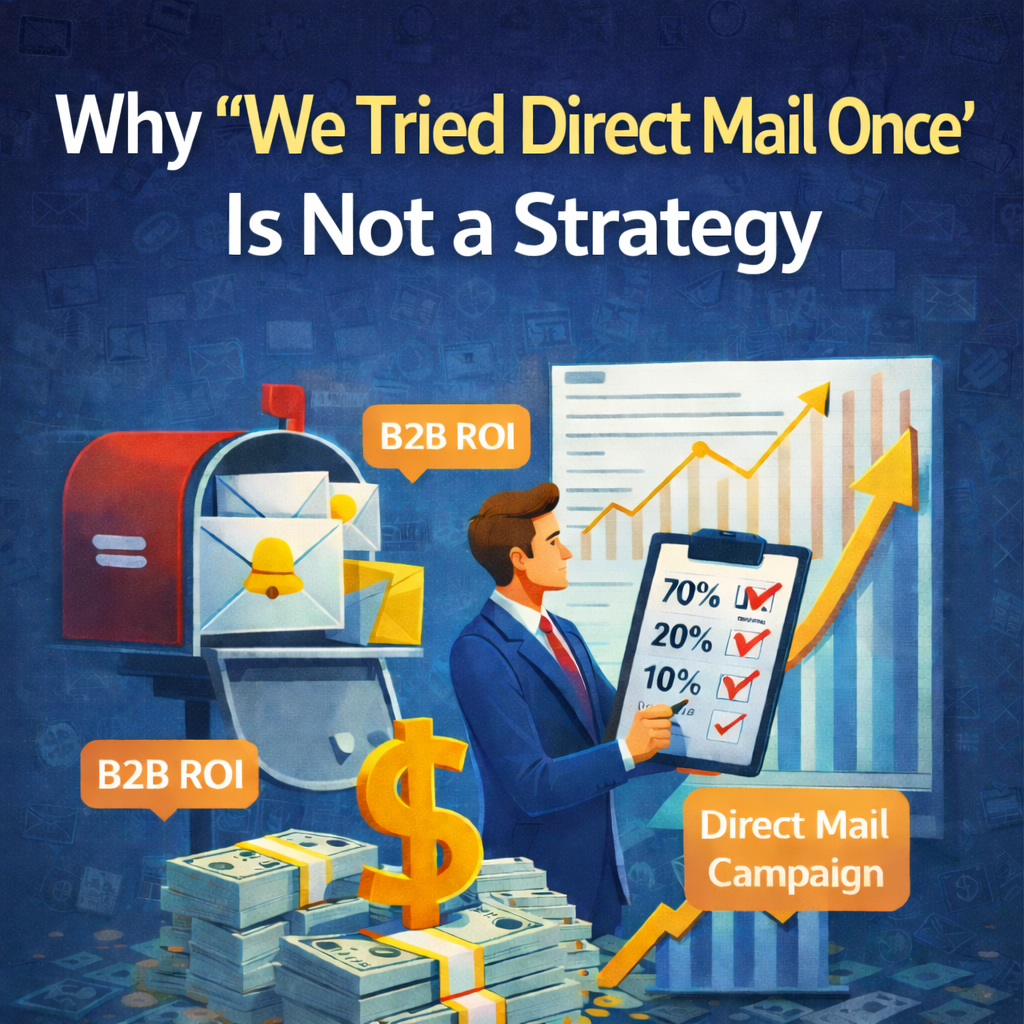
[00:19:42] Wilson: So, okay, no, that’s a great question, it’s an important question, I believe, yeah. Um, so I, I think that, you know, sometimes the, the discussion comes down to: why digital, why physical, you know, is, isn’t that stuff old, why would I use that? And, and yes, I, I mean it’s been around for a long time like some other mediums have. But I would tend to look at it more like a toolbox, right? As a marketer, you need a toolbox with lots of tools in it and you need to be able to use the right tool to solve the right problem. Yeah. And, you know, and so, and so that’s really where we go with this. I mean, if we, if we think about um, direct mail, um, the Direct Marketing Association says on average it returns $13 for every dollar invested. Um, so that’s assuming a well-targeted piece with a, with a well-performing offer, yes. So in general, if you’re using direct mail, the formula is, um, 70% list, 20% offer, 10% creative—whatever’s left is creative. Um, so we want to find the right audience, and if we can, if we can make the right offer to the right audience, then good things happen, right? And so that, that’s really the formula. So it turns out that the list is the most important part, not the creative. But most people focus on it the other way—they focus on the creative part, yeah.

[00:21:16] Jeff: Um, so that’s kind of an interesting dichotomy, yeah. You need, we need, you need to have people that are actually the right audience, otherwise it’s trying to sell you know basic… yeah, you don’t want to be selling something to someone that doesn’t like… okay, what are we want to sell? I want to sell fax machines to teenagers—of course, that’s not going to work, so…

[00:21:31] Wilson: Exactly, that’s why when you’re trying to boil the ocean, you know, you’re just trying to send to everybody, that’s not very effective. People can do that with tools like email marketing because the cost per send is, is very low, you know? If you’re doing a million emails, you may only pay a quarter penny a piece or something like that, you know, something very small, um… actually probably less than that. Um, but if you’re sending direct mail, every piece you send out needs postage, and postage costs money. So you’re going to have to, in order to produce a return, you’re going to need to make sure it’s very targeted and you have the right offer. The way to do that depends on the audience, and it requires testing. Um, so the, the, the question is, why, how do you measure? So the usually what we’re looking at is return, return on investment. So return on investment means dollars out versus dollars in. We have to make sure when we do that calculation, we have to factor in lifetime customer value—that’s a common, uh, omission, right? If I’m selling out, spending 10 bucks to get somebody to spend five, you say, “Why would I do that?” Well, except if he’s going to spend five bucks a month for the next 12 months, then that changes the equation, yeah, right? So direct mail, because it’s always been ROI, numbers-driven, that’s why it survives, because as soon as it stops making sense, people stop using it. But people are showing positive ROI, so they keep using it. And these days, we have lots of people who are new marketers who’ve only, you know, been exposed to digital that are rediscovering it, so that’s kind of an interesting phenomenon, too.

[00:23:15] Jeff: It’s almost becoming unique—in other words, um, if I sent you know a digital colleague I’ve never met before, but I sent him a gift and arrives in the mail, that’s memorable because everyone does email, but no one sends things via snail mail, so yes, it’s very memorable. The other question I have is, and talked about target, target audience, um, is there something you want to say about that, or…?

[00:23:43] Wilson: Well, no, I was, I’m going back to your other point, you asked me before, too… um, why I mean, you know, we’re talking about where this tool, what’s unique about this tool. If we think about a toolbox, and I can tell you a story about some ways we use it, but there’s a couple, couple things that are about mail that make it very unique. Um, first of all, it’s proactive, right? If I’m using Google AdWords or something like that, which is a great tool, fine tool too, we use it, um… but I have to wait for people to come find me. But there are sometimes when I just want people to find, I want to find them—I want them to respond to my offer. So mail allows us to be proactive—it’s proactive communication. Secondly, mail can reach everybody in the United States six days a week mostly, um… um, I’d say mostly mainly because some businesses are not open six days a week—some businesses are open, you know, five days a week—but to the extent that, that they’re open, um, I know how to reach them and, and I, and I can deliver a message to them. Um, if you’re talking about something like email, um, even though it has a cost, the cost advantage we talked about, being able to connect with everybody is not even possible—something like 35% of even legitimate emails never deliver, spam filters and what have you, um… and the third, the third thing is that, um, is that the targeting—the lists are very well-developed. So if I want to find Jewish dentists in New Jersey who purchased a car in the last, last six months, I can probably do that—I can probably get a mailing address. But trying to do that for a digital delivery point is really, really difficult, yeah.

[00:25:25] Jeff: Um, yeah, so on the, the other question I have too about this is um, is this more for targeting local, helping local businesses, um, or, or national organizations that are trying to reach local businesses, um… is that, I’m just trying to think about, you talked about things like dentists, you talked about, um, you know, florists, that sort of thing. So, um, is that the sort of like, you got the ideal customer profile, the one that wants to send it, but the audience they’re trying to reach is more local rather than national?

[00:26:01] Wilson: I, you know, it just depends on the, the, the customer and the application. Certainly, you know, if you’re a, you know, if you’re a florist, or a pool cleaner, or a realtor, then you’re probably focused in a local area, and we see a lot of that. But we do have very large national organizations, too—organizations that send to mail to people all over the United States, because with some of those businesses we’re talking about, you know, the thing that makes those potential customers a target is their location, right? They’re close to the place where we deliver a product or service. But there are some products or services that we might offer that are not location-specific. So for example, imagine I’m trying to do—this is not direct mail specifically—but imagine I try to do debt collection, imagine if I’m a mortgage broker trying to do cash-out refi. I mean, there’s no reason why I just need to do that in Oregon—I can offer that product nationwide, um, true. So there, so there can be a local component, but it’s certainly not a requirement, right? Um, the better requirement is, is that you know that I have a good list and a good offer, and, um, you know, I can generate a positive ROI, right?

[00:27:23] Jeff: So in terms of measuring a positive ROI, because, um, on the internet it’s basically you can measure it, but you sometimes trying to work out: how do people discover me? What was the first click? And the click could have been, it could have been an ad, it could have been an SEO, it could be… so how, whereas how do you actually measure that it’s actually the direct mail that’s produced it? Because that’s actually not digitally recorded. So how do you do that? Is that because that’s the only marketing they’re doing at the time and it’s coded or something? No…

[00:27:51] Wilson: Attribution, attribution is, I think what we’re talking about. Attribution is a big deal, you know, being able to figure out, you know, who’s responding to my offer, which ones are producing results and which ones are not. Typically with mail, we use a response device to do that—some kind of a response device. So, phone number—a certain phone number—fax number… well, not that people use fax anymore, but historically… specific landing page, um, okay, right? And, and we have the ability of our system, too, to generate a PIN, so we can generate a PIN number that’s specific to a client, to a, to a client and to a campaign, and that PIN number will identify where the piece came from. Historically, the biggest way that people identify that is by using a 800-number. So they use a toll-free number—you can buy toll-free numbers, there are lots of places to get toll-free numbers, and then you just program them to redirect to your office. But then at the end of the month, you can scan down your, your toll-free numbers and you can see which campaigns are producing calls, right? Okay, right. That makes total sense.

[00:29:07] Jeff: Because I used to do direct mail. I actually used fax for marketing and, um, it was a lot of fun. So Jay Abraham was one guy that I used to, uh, use as my inspiration for direct marketing back in the 1990s—he’s been around a long time. So all right, so you are generating data at the other end. You are using your tool to actually create, save you time and be very efficient to actually create the direct mail that’s sent out by your partners. So are you, to make sense of the noise and data—because you’re trying to find signal in the noise—are you using AI? And there’s going to be a segue from this um… are you using AI to help you make sense of the noise? In other words, what’s working, what’s not? Um, are you doing that at all, or that’s next, or we never…?

[00:29:49] Wilson: I, yeah, I would say we’re approaching it a little bit differently. I mean, it’s, um, so when we’re doing, when we’re doing network routing and we’re looking out at the environment, we have to take a lot of factors into consideration. Um, in today’s environment, everybody needs an AI story, and that would be ours, except I’m very realistic about it. When I talk to people, I say this is no, this is real intelligence—this is not artificial, you know? We’re looking at the factors in the network and we’re making decisions in an automated way, right?

[00:30:30] Jeff: So, so the other thing I want to ask, too, is okay, so what are the real numbers in terms of, uh, making it very efficient to send a mail—in other words, how do you reduce costs in terms of getting that all done? So what’s, what’s your numbers compared to other people doing direct mail versus you doing your technology to do direct mail? Is there any statistics or numbers in terms of “we save 20% of costs, uh, we deliver better, faster”? Um, what’s your data tell you about you versus your competitors, for example?

[00:30:59] Wilson: Yeah, that’s a good point. I, I mean, I, I’m not sure that I have, you know, specific numbers that we quote in that way. I will say that if you need to be in the mail, you, you have a piece of, uh, you know, mail job is 50,000 pieces and you need to be in the mail tomorrow or the next day, we’re the only people who are going to be able to do that for you.

[00:31:24] Jeff: Okay, well that’s the right answer. That’s what I was trying to find out—in terms of you make it easy and fast, would that be a good summation?

[00:31:28] Wilson: Yeah, easy, easy and fast. And we have the automation, so if we need to do other interesting things—you want to hook it to a CRM, or you want to hook it to an application, or, you know, any other way that you want to, um, play around with mail algorithmically—we, we have the ability to do that, because once we’ve captured it digitally, there’s lots of things we can do to it before we turn it into paper, right?

[00:31:57] Jeff: The other question I have, um, is that it sounds to me like you’re only operating from the USA, is that correct?

[00:31:57] Wilson: Um, we’re only producing mail in the USA today—the USA and Canada. And we, um, we had a facility, a dedicated facility in Canada, but we, we weren’t getting enough volume. But if we have the volume, that will return—I mean, that relationship still exists, okay? Um, I think this is one of the areas where I think Speedy has a really cool, really great role to play. Speedy, the application, they’ll even take a single letter. Speedy was designed to take the place of a postal meter—I’m not sure if you have those where you, you are…

[00:32:34] Jeff: Never heard of it, okay.

[00:32:34] Wilson: But here in the United States, a lot of large corporations have something called a postal meter. The leading provider in that industry forever has been a company called Pitney Bowes. Um, and the reason why um, they exist is because a lot of companies look at postage like money, and so they need an effective system to ma-, to manage this money. Like, somebody’s, somebody might, you know, take off with the postage or send their own personal letters, or what have you. So, so they tend to treat that postage as money. But, and the way that works is, some people print the mail internally in the internal mailroom, and then they run it through the Pitney Bowes machine. The Pitney Bowes machine puts postage on it, and then they still have to get it in the mail. But from our perspective, that’s really not the biggest part of the problem, right? I mean, so I mean, I know how to get stamps and I know how to get postage. Uh, the really hard part is to, you know, is, is that I have to create a letter, I have to print it, I have to fold it, I have to insert it, I have to address it—I have to address it properly—I have to get postage, and then I still have to get it in the mail, yep. Which, if you’re a mailroom, means you still got to put it in a truck and drive it somewhere, or somebody’s got to, can pick it up. So there’s a lot of pieces missing. With a tool like Speedy, you can just create the letter, push the button, and boom, it’s gone—you just, just bypass that entire process.

[00:34:04] Jeff: Wow, and that’s here…

[00:34:04] Wilson: That’s probably a $6 billion market—postal meters, wow. But because the way the tool is designed, consumers can use it in the same way. A consumer can put a letter, because we don’t care whether it’s a business or a consumer. And if, if you have your consumer who’s in another part of the world—you know, wherever that might be—um, you know, if you’re in New Zealand, you could drop your letter on, on this icon, it will, you know, it will fly across the ocean electronically, end up in a queue here, be, be, you know, be batched, processed, printed, folded, inserted, mailed next day, and at a fraction of the postage. You don’t have to pay international postage. Oh, and by the way, nobody had to pay for any jet fuel to get it there.

[00:34:55] Jeff: Okay, so you’re distributing the distribution, yeah.

[00:35:00] Wilson: So, so if, if you’re doing international mail, if you’re in an international location and you’re doing mail to the United States, there is no more efficient way to do that.

[00:35:08] Jeff: Very cool. All right, I’m going to segue to something very, very non-direct mail, because you’re in the middle of doing a degree, I believe, at Harvard University, or have done it, on… which has a lot of AI in it, I’ve interested in, um… and you’ve been in business for a long time, you’ve done six startups, you’ve done raise venture capital, and it sounds like your brain’s running at a million miles an hour, um, all the time. So you, you’re studying AI—what are some of the things that you, fascinated you about AI, and a generative AI, for example? And what are you, what are you learning? What are your insights from your Harvard experience, education experience about AI?

[00:35:48] Wilson: You know, AI is interesting, but you know, the AI that we see today, it’s a lot different than… well, let me, let me back up and say, even before the PhD program, right? I started as a software engineer. And even back in the ’80s when I started as a software engineer, people were talking about AI, except AI looked more like, you know, like HAL from 2001: A Space Odyssey, you know, the movie. Just stop in…

[00:36:15] Jeff: Yep, exactly.

[00:36:15] Wilson: So, uh, along the way people have tried inventing languages like Lisp and others, they’ve tried um, creating knowledge bases, they’ve tried, um, expert systems, you know? There’s, there’s been a lot of different incarnations of AI along the way. In, in this particular case, we’re looking at large language models, and they’re really looking at pattern matching. And based on patterns that occur, um, in data—different pools of data—then being able to generate new ideas based on prompt. It’s a completely different… I mean, artificial intelligence for me is more like—have you ever seen the movie I, Robot? Yes. Will Smith. Yeah, I mean, that looks like artificial intelligence to me, but, but this is a step along the way. So I mean, all of that stuff has to evolve. Um, because we’re doing pattern matching, there are some natural limitations built into it, like there are lots of examples of, you know, people doing 1 + 1 = 6. When he said, well, how’s that work? Well, because AI is not really doing the math, it’s just looking at an image of a one and an image of a one, and it sees enough images of one that match it, you know, that are matched with an image of six, it just figures that’s the way it should work, you know? Um, the other thing I will say is, I, you know, the, the place I’ve spent most of my research time most recently is on innovation—you know, diffusion of innovations and stages in the life cycle. I actually did a PhD dissertation on it, so that information is public—you can find it in, um, Google Scholar. Um, but basically, depending on the point of the life cycle, different kinds of innovation are different, more important—whether that’s product innovation, process innovation, marketing innovation, organizational innovation. Um, and when we’re talking about creativity and innovation, that brings always brings me back to generative AI. And I think that there’s some natural limitations—and I’m not saying these won’t be overcome, I mean people definitely will work on them—but if you think about the way people, the way AI would approach that with a large language model, is they look at all the successful outcomes, and based on these successful outcomes, um, or popular outcomes, they’re going to forecast a new one. But that’s not really what, the way the innovation happens. Innovation is a process of trial and error—we learn as much from every mistake as we do from every successful venture, sometimes more from every mistake, you know? They asked, uh, Edison one time, he said, you know, “You failed 100 times making a light bulb, why do you keep doing that?” And he said, “Because every time I try, I learn, yeah, there’s one more way I, I’m not supposed to do it. And process of limitation, it gets me closer to a solution.” Yeah, um, but AI, the way it’s conceived of today, doesn’t really go through that step. So there’s a whole bunch of… I think without having access to the mathematics behind it, um, there are a whole bunch of false steps or mistakes that we don’t get to see. And because we don’t see them, we can’t take off from them or evolve from them, right? Yep, okay. And then the second thing is, be-, because of the way AI is designed, it can never know when it’s finished, right? I mean, it, it doesn’t… the only way it can, it can be finished is if a human says, “Oh, that works, that makes sense,” right? So, so it, not only can I not make the mistakes, but it doesn’t… that process of going through the iterations to arrive at a fin-, final product is problematic, too. Because I don’t have some, you know, some being there to say, “Oh no, that’s right, oh no, that’s wrong, take a right, take left, take, you know…” Have you ever done, um, brainstorming, you know, with a, with a group of people, and you know, you’re in a room and the one thing you say, you don’t say, “That’s a bad idea,” you just try to capture all the ideas you can say, and then one person will say something and somebody else will say, “Oh yeah,” they’ll play off that and play off that and play off, you know… and, and that process is what leads to new innovations and new creations. But I think with the technology we have today, it’s difficult to get to that um, impossible, it’s just trickier, yeah. Um, so when we, we can use um… and most ideas, I mean, I mean, thinking out loud, most ideas are not really all seminal genius, right? All some new idea. A lot of times it’s a, a combination of old stuff, maybe even unrelated old stuff that we put together, you know? Mail and the internet. So, and sometimes the alchemy works, and other times it doesn’t. Exactly, yeah. I mean, I mean, if, if every pattern in the future, if every solution in the future is going to look like all the patterns in the past, then, then that’s not very interesting, is it? Well, there, well, there’s no future then, there’s no innovation, yeah, yeah.

[00:41:39] Jeff: Okay, interesting. All right. Yeah, so I, I think, I think it’s really cool and it’s exciting. People are doing some great things, certainly generative AI has a lot to bring. Um, it’s not the Holy Grail of AI, we’ve got a lot more to do.

[00:41:51] Wilson: Oh, yeah, we just started. We’re essentially two years in the democratization of AI, which is ChatGPT and Chat.

[00:41:57] Jeff: So, uh, what’s happened… I am blown away by the velocity of change and development, um… and we’re seeing basically about a trillion dollars in data centers, you know, and investment in the large language models and so on. So the amount of money pouring in is going to cause a bubble, but again, we are laying the foundation for continuing to evolve AI to be our assistant, to be our guide, to be our coach. Because I think for me, with AI, I, I’m watching a game. All of us come from a fixed past, brought up a certain way—went to the same church, went to the same, um, you know, went to the same, um, you group, football, college, whatever it is, right? So we’re… and we got, we go to college, so we got, we’re all raised in bubbles, aren’t they? Different bubbles. So we end up having quite fixed thinking. And what I love about brainstorming with AI is that it can come up with all combinations you haven’t even thought of, thought of. And that’s for me is that, I think the AI can break our own vertical bubbles that trap us in the past, but we need to be open to the future to find the innovation and recombination of the world’s intelligence, which is what’s sitting in knowledge—which is sitting in the cloud, um, in ones and zeros. Um, so we actually, for me, I find it exciting because I ask a question of AI, and it’s tapping the world’s intelligence, the world’s wisdom, the world’s, you know, knowledge, and it comes up in ways that I wouldn’t have thought of. And then I can recombine it myself as well on top of that. But it breaks a bubble of our templated thinking that traps us almost in a prison of our own mind. Right? I mean, you think about some of the work with, um, companies like IDEO and others have done, right? The, the idea is that you’ve, you know, you have, if you have groups with, that have diverse backgrounds and life experiences…

[00:44:01] Wilson: Much more creative, yeah.

[00:44:01] Jeff: …then you can get better solutions. I mean, if you think about a Venn diagram and, you know, there’s one person, they have certain amount of knowledge and life experiences. If we have a lot of different people with non-overlapping, you know, spaces, then our, our solution set, potential solution set becomes much larger, exponentially larger.

[00:44:25] Wilson: Yep, that’s what I’m saying.

[00:44:25] Jeff: And that’s what makes it exciting, um… and I think for me, I see AI as both an amplifier and accelerator of human intelligence, um, as our, you know, as a coach assistant that has almost perfect knowledge, um, that can recall it in seconds. So for me… but it doesn’t mean that we hand over the keys of the kingdom to the AI—we actually use it as our coach and assistant to help us, um, break boundaries down that we quite often as humans are locked in, and that includes bias, um, includes, you know, racial, gender, whatever it is. But what it does, I think it, it opens our mind to a whole world rather than be trapped in our own world, right?

[00:45:16] Wilson: No, that’s true. I mean, the thing about AI is that from an algorithmic standpoint, it’s data-driven, so we’re looking at the data and saying, “What does the data tell us?” But data can have bias.

[00:45:26] Jeff: Oh, sure.

[00:45:26] Wilson: You know, so if, if, you know, if, if you’re, you’re tapping into the articles from Fox News, you’re going to get a different result than if you’re tapping into the articles from MSNBC, right? I mean, there’s, there’s bias in that data. Yep. And, and the language model can’t tell, it just, it’s just looking at data and aggregating it in the best way it can, yeah. And the other thing I’ve come across recently is the idea of Sovereign AI, um… because the trouble with capturing all the world’s data and putting it into one bowl of soup is that it all becomes homogeneous. And the problem with that is that then the world all starts to look the same, which is boring as bat shit—I don’t want the world to look the same, I go to Europe to see Europe, not to see Australia. Um, so for me, I think human imperfection brings its own joy as well and, um, you know, perfection’s overrated, because job done, might as well fall asleep, right? But…

[00:46:24] Wilson: Right. I mean, I mean, with some things, it’s the imperfection that makes it interesting. I mean, like, I mean, think about art, you know? Monet, Degas, things like that. I mean, you could take a photograph of those images, but what makes it interesting when the artist does is to get, you know, their own take on it—they, you see it the way they see it with all its imperfection, yeah.

[00:46:53] Jeff: Yeah, yeah, yeah, it’s that for me, too. He’s done some blind testing with even poetry, and actually, um, AI—in other words, poetry created with AI—they’ve done blind tests, people viewing it and say, “Tell me which one you like best.” And the scary thing is that most people choose the AI-generated art and poetry.

[00:47:15] Wilson: Oh, yeah.

[00:47:15] Jeff: Which is a bit scary, but on the other hand it’s rather interesting. I read Yuval Harari, um, you know, the guy that wrote Sapiens, um… he’s just written a book recently which he’s worried about AI, because generative AI is starting to tell stories. And what makes us human is our stories. So, and when I, you go to write an introduction, you know, humans are, humans are pain and happiness machines—we actually learn from pain and… well, we don’t, um… we’re all trying to find our own story amongst all that noise. So for me, his worry is about the fact that, um, AI is going to start creating stories that we’ll believe and that will change humanity. So it’s quite a fascinating take by him because he’s very much into humans’ uniqueness is our stories.

[00:48:14] Wilson: Yeah, the only thing that it makes me think about is the fact that a lot of the great literature and great art, and, and music too, I mean, is driven by emotion, right? It’s, which is, which is your story that you’re telling, whether it’s in whatever media it is. And, and emotion is not data, I mean, emotion is something different than that. So I, I mean, I don’t think… I mean, you might be able to, to create a table that says, “See this, generate this emotion; see this, generate this,” but it’s still not going to be authentic emotion that you’re trying to generate for a reader or a viewer or somebody who’s engaged with your art. Um, I think that’s really tricky. I, I, I think you can do replication. But, you know, one of the things about music, I mean, I, I think about, too, in every generation you’ll have great bands, you know? We listen to rock music, and some of that music, it’s not all just good music—some of it is angry, right? You get, get this anger, or, you know, or, or, or lovesickness, or whatever, whatever that emotion is, and they manage to turn it into this powerful music that communicates that to somebody else. But that’s not just about data, I mean, I mean, there’s something more there.

[00:49:40] Jeff: Yeah, a lived experience. Exactly. So for me, I’m fascinated by the intersection of human and machine, and I think machines actually asking us big questions like: what does it truly mean to be human?

[00:49:52] Wilson: That’s a good point, yeah.

[00:49:52] Jeff: So, I don’t have the answer.

[00:50:01] Wilson: No, well, that’s, that’s what, that’s the fun—is the journey, not, not arriving, um, right?

[00:50:09] Jeff: Yeah, and, uh, so for me, too, the hom-, you know, the homogeneous nature of AI is that it, it’s basically not allowed to do bad things. So what sort of try to, try and program it so it only gives positive things, so AI can’t sound angry, otherwise it’s turned off.

[00:50:24] Wilson: Well, if you… but if you want to capture emotion, you have to do all emotion—you have to do anger, you know, anger, joy, sadness, all…

[00:50:33] Jeff: Exactly, so yeah. All right, anyway, I’m fascinated, um, and, um, I’m having fun exploring and writing about it. I, I write to learn, I read to get ideas and information, but then I got to make sense of it. So, and part of trying to make sense of it is actually having interesting conversations and hearing stories from smart, intelligent people around the world such as yourself. So, um, thank you, I appreciate that.

[00:51:02] Wilson: Yeah, it’s, um, this brings me joy.

[00:51:02] Jeff: So that leads me, and a segue to: so for you, Wilson, if you had all the money in the world, uh, what would you do every day that would bring you deep joy and satisfaction?

[00:51:18] Wilson: That’s a great question. I mean, it’s, it’s an important question, too. I mean, certainly one of the ways we measure success, we keep scores with money, but at least in entrepreneurship, um, that shouldn’t be the goal and that shouldn’t be the primary goal. And the reason why—and don’t let investors ever hear you say that!—but, but the reason why is because, you know, honestly, most startups fail. I mean, they’re, they don’t, you know… I think it’s nine out, I think it’s nine out of 10, or even exactly… a lot of entrepreneurs in order to do a number of startups before they get one that gets traction is successful. So, so and I’m not saying that to say you shouldn’t do it, I’m saying there has to be more in it—there has to be some other passion you’re pursuing or some other need you’re fulfilling. And if you can make a lot of money along the way, that’s a great thing, too. Um, so for me, I, I really like to build things. I mean, I like to start, start with an idea—start with an idea that I think could change the world and then try to make it real, okay? And if I can do that, that feels really good for me. And so there’s the, the initial idea, there’s additional things that work on it—we’re solving problems. And in my case, because I can’t paint or sing or… I’m using technology to do that, you know? Um, so I enjoy that a lot. I, and I like, I like the idea of making a difference in people’s liv-, lives, making a tangible difference and making the world a better place. And if I can do that using my art, which is technology—my art form which is technology…

[00:53:01] Jeff: That’s your tools, yep.

[00:53:01] Wilson: …that’s a really good thing for me, yeah.

[00:53:01] Jeff: So you are doing what we designed as humans to be, and, uh, we are creators and we are also… watching over the millennia we’ve seen that we are actually creative tools to help us do things better and faster and make a difference. And, um, you just said that what brings you joy is creating and I love that. And creating, and, and sometimes understanding, too—looking at a complex problem and just saying, “I wonder why it works that way, let’s find out.” And that’s the other part of being human is, um, some have more of it than others, and that is curiosity, yeah.

[00:53:47] Wilson: Yeah, yeah.

[00:53:47] Jeff: Yeah, for me, Joseph Campbell, um… for me, uh, which brings me joy and part of my creation is writing, um, nice, and communicating, and listening, um, and trying to be better at it every day. Um, as Joseph Campbell says, we, we, there is no essential purpose to our lives as humans except to follow your bliss. And, um, for me that is, and follow your bliss means you’re following your curiosity—what gives you joy, what, what sits inside you that says, “When I do this, this fans great,” like you were saying you’re creating from technology tools. And for me, I am curious about something. And what I do now is, and I’ve done it for the last 15 years now since I started my blog on, because I was curious about social media, was to actually… I follow my bliss now by curiosity, but then create out of that curiosity, that’s… so I think as following your bliss and then actually creating something out of that is, I think that makes me as human as I possibly can be. And, um, and then paths will open and doors will open, um, that you never expected. Because we all think we got control—at the end of the day, most of the time we don’t.

[00:55:13] Wilson: No, no. I, I actually… I mean, I, I think those were good, great points. And I talked with an entrepreneur one time—it was a gentleman who owned, he started a window company, very successful, ended up selling it to Viking Industries or something, it was um… made millions of dollars, hundreds of millions of dollars. And I asked him, I said, “What is your secret? I mean, if you had to tell an entrepreneur what’s the secret to being successful, what would you say?” And he said, he said there are really two elements that you need to think about, think about, spend some time thinking about. One is: think about your passions—everybody has stuff um, that they feel passionate about, feel strongly about. And he said, and then think about your gifts—the things you’re really good at doing. Everybody has some gifts as well. And the right opportunity is probably the one that lies right at the intersection of those two things: something that you’re really good at but that also brings you joy.

[00:56:14] Jeff: Yeah, that is a great point. And there is a fantastic model, uh, for success, for happiness, and it’s called the Ikigai model, which is out of, um, Japanese philosophy, which is the intersection of those. And you just mentioned the word intersection of those two, but check out Ikigai. It’s really fascinating about what are you good at, what do you love doing, also what’s your experience, okay? And then what will the world pay you for, okay? So have a look at the Ikigai model—it’s fascinating, I think. And for me, it’s the best summation of, of, uh, what you should be doing in life sits in the intersection of all those questions.

[00:57:02] Wilson: No, I’ll do it. It sounds great, yeah. I’d love to, yeah, I’d love to explore more.

Physical Mail in a Digital First World

Episode Details

Podcast: Think Bigger Real Estate Podcast
Episode: Physical Mail in a Digital First World
Published: October 15, 2025
Guest: Wilson Zehr, PhD
Guest’s businesses: Zairmail, Cendix, and Speedy Desktop Comp
Host: Justin Stoddart
Duration: Approximately 26 minutes (26:05)

Apple Podcasts: https://podcasts.apple.com/us/podcast/physical-mail-in-a-digital-first-world/id1224994638?i=1000732057803

“As marketers, we can be most effective not by thinking just in terms of digital or analog, but in terms of the customer and what they need from us to move forward.”

In a world where inboxes overflow and screens dominate attention, it’s tempting to assume that physical mail is a relic of the past. But what if that assumption is costing you real opportunities?

And if you’re a real estate professional looking to build trust, stay memorable, and break through digital clutter, you’ll want to pay attention.

The Underrated Power of the Mail Moment

As Dr. Zehr explains, mail has unique advantages that no digital tool can replicate:

“Mail reaches every household and business in America six days a week. It’s proactive communication—you don’t have to wait for someone to find you.”

Unlike emails that often land in spam folders or social posts that get lost in the algorithm, physical mail commands attention. The “mail moment”, as the U.S. Postal Service calls it, is still part of America’s daily rhythm. People check their mail expecting something of value—and when your message arrives there, you’re not competing with a thousand other digital distractions.

That alone is a huge advantage in today’s marketing environment.

Precision Targeting Meets Tangible Trust

One of the most surprising takeaways from the conversation was how data-rich and precise direct mail targeting has become.

“If you want to reach Jewish dentists in New Jersey who bought a car in the last six months—we can find that list,” Zehr explains with a smile.

For real estate professionals, that means you can craft mail campaigns that go beyond the generic “Just Listed” postcard. You can reach homeowners in a specific price range, with kids in school, or who have lived in their homes for more than five years.

Mail lists can mirror the same demographic filters that digital marketers use—but with the added benefit of landing in the one place every client still visits daily: their mailbox.

Case Study: How Analog Helped a Community Win Big

To illustrate how digital and analog can work together, Zehr shared a story from a local political campaign in Oregon. The community needed to pass a bond measure to rebuild an aging athletic facility.

Using a hybrid approach—building a digital hub for information and engagement, combined with precisely timed direct mail to different audience segments (homeowners, renters, parents)—the campaign passed “by a wide margin.”

It wasn’t luck. It was a strategy.

Each message was tailored, delivered at the right moment, and reinforced across multiple channels. The same principles apply in real estate: combine digital visibility with tangible, personal communication, and you’ll drive results that outpace either medium alone.

Key Takeaways for Real Estate Professionals

1. Don’t Compete—Own the Moment

Your clients’ inboxes are crowded. Their mailboxes aren’t. When your brand shows up in a physical space, you own that attention—if only for a few seconds. Use that opportunity to be memorable.

2. Think “Digital + Analog,” Not “Either/Or”

Digital tools are vital—but the most effective marketers use them alongside print. Imagine running an online campaign to capture leads, followed by a beautifully designed postcard that lands days later, reinforcing your value and call to action. That’s brand synergy.

3. Target with Surgical Precision

Gone are the days of “spray and pray.” Today’s mailing lists can target homeowners who fit your exact client profile. The result? Better response rates, higher ROI, and a marketing strategy that feels more human.

4. Lead with Strategy, Not Just Tools

Zehr’s 70–20–10 formula says it best: 70% of success comes from the right list, 20% from the offer, and 10% from the creative. In other words—get clear on who you’re talking to and why, before worrying about how it looks

Watch the full Youtube video here:
https://www.youtube.com/watch?v=Vu-7WtKNuu8&t=11s

Apple Podcasts: https://podcasts.apple.com/us/podcast/physical-mail-in-a-digital-first-world/id1224994638?i=1000732057803

Timestamps

00:01 – Intro: Is there still a place for physical mail?
01:25 – Guest: Dr. Wilson Zehr, CEO & Founder of Zermail
02:45 – Why direct mail still works in a digital-first world
04:20 – The power of proactive communication
06:15 – Cutting through digital clutter and spam filters
08:10 – Email overload vs. the “mail moment”
10:18 – Blending digital and analog: a real-world campaign
13:00 – How targeted mail won a community bond measure
16:45 – Hyper-targeting in direct mail: real estate & lending examples
19:40 – The 70–20–10 marketing formula explained
21:55 – Cost, targeting, and using mail strategically
22:40 – Where to start: Zermail and easy mail automation
24:35 – New tool “Speedy” for fast, single-letter mailing
25:18 – Final thoughts: blending timeless trust with modern tech

👉 Book on Calendly

Wilson Zehr
is a Direct Mail Industry Expert, Direct Marketing Specialist, and CEO of Cendix (www.cendix.com), the leading provider of web-to-print solutions. He is also the founder of Zairmail (www.zairmail.com), responsible for many industry firsts in direct mail.

Free Direct Mail Sample Kit

See direct mail before you send it

Get samples of direct mail postcards and letters, plus service details to help you launch your first campaign. Your kit ships free by USPS.

Request Your Free Sample Kit →
Click to View Full Episode Transcript

Podcast: Think Bigger Podcast
Episode: Physical Mail in a Digital First World
Host: Justin Stoddart
Guest: Wilson Zehr (Seasoned Entrepreneur, Academic & Founder of Zairmail)


[00:00:01] Justin: Is there really a place for physical mail? Today’s episode, we’re going to make you a believer. We’re going to share with you specific examples of those professionals who have not overlooked the analog version [00:00:01], who realize that it’s a necessary component to drive the customer forward faster [00:00:07]. When everyone else is competing for eyeballs online, you can be one of a kind showing up by supplementing your digital with analog [00:00:15]. Today’s episode, I’ve got a special guest who’s been in this industry for a long, long time [00:00:23]. He’s going to be sharing information that’s going to help you know how to stand out again in a crowded market [00:00:30].

[00:00:34] Justin: So the big question is this: how do those of us in the real estate industry who have crazy amounts of ambition, how do we think bigger than the building of our own empires? How do we create success and significance, income and impact? My name is Justin Stoddard, this is my co-host Stephanie Peek [00:00:34], and together we bring you the Think Bigger Real Estate Podcast [00:01:00]. All right, welcome back everybody. Hey, I am without my lovely co-host Stephanie Peek, so today, um, I will go at it alone [00:01:08], but with my good friend Wilson Zehr [00:01:21]. Now, for those of you that don’t know Wilson, he is the CEO and founder of Zairmail [00:01:26]. Um, Wilson’s been in the—not just the mailing business for a long time, but he’s actually been in the world of business for a long time. He’s been teaching at the university level with a PhD for over 20 years [00:01:31], he’s raised over $60 million in venture capital for startups, he’s founded six companies himself [00:01:41]. He’s truly someone who understands business at the highest level [00:01:48], and today we’ve got the good fortune of bringing him here on the Think Bigger Real Estate Podcast to help you understand what you might be missing out on and getting more client conversion by supplementing in direct mail [00:01:48]. Wilson, it’s a pleasure to have you here today. Thanks for taking some time to pour into our audience [00:01:59].

[00:02:04] Wilson: Good morning, Justin. Thanks for having me, appreciate the opportunity [00:02:04].

[00:02:09] Justin: Yeah, no, uh, Wilson and I have known each other for a long time and we just recently got reconnected [00:02:09]. And, uh, when I um was reminded at how deep his expertise is in the mailing space, I realized this audience needed to hear it because, again, there’s some agents who I know who do very, very well with direct mail campaigns [00:02:13]. Again, they don’t ignore the digital, but they see it—uh, they see it differently, right? [00:02:20] They don’t see it’s one or the other [00:02:25]. So Wilson, help us to see, kind of to understand from a real estate agent’s perspective, what they might be missing if they’re only doing digital [00:02:25].

[00:02:35] Wilson: Yeah, that’s a great question, Justin [00:02:35]. um, I was just thinking about the best place to start. Um, you know, as—as marketers, um, I think it—it often we can be most effective not by thinking it just, um, you know, terms of digital or analog or some specific tool [00:02:44], but in terms of the customer and what they need from us to move forward [00:03:00]. You know, there’s a—an old saying: “If all you have is a hammer, everything looks like a nail,” you know? And that doesn’t always produce the best result [00:03:00]. Um, there are some things that, um, mail does [00:03:13]. Um, you know, there are some things that mail does that, um, other tools do not [00:03:13]. That, um, so we can just touch on those briefly first [00:03:23]. You know, mail allows us to reach every household and business in America six days a week [00:03:30]—five days if you’re, you know, if you’re talking about a business enterprise, but uh, to the home still six days a week [00:03:37]. It’s proactive communication. Unlike a lot of, you know, digital tools like AdWords, things like that, you don’t have to wait for somebody to find you; you can reach out and find them [00:03:42]. Thirdly, we can do precise audience targeting. So, you know, the demographics are very well-developed over a lot of years [00:03:49]. So if you want to reach Jewish dentists in New Jersey that have purchased a car in the last 6 months, we can find that list [00:03:55] and hundreds of variations on that list. So we, you know, we can get to exactly the person we need [00:04:08].

[00:04:14] Wilson: Um, oh, and by the way, there’s no spam filters on it either [00:04:14]. So you know, even in the best of worlds with email campaigns, for example, um, something like 30% of even legitimate emails are not delivered because of the spam filters and, uh, you know, protections built into the internet [00:04:20]. Um, and then finally, it’s just built into the American psyche [00:04:29]. You know, people are used to, you know, getting communication in the mail [00:04:37]. It’s part of their daily routine. The Postal Service would call it the “mail moment,” you know? When you get home, you check your mailbox and, you know, there’s voices from the heaven and there’s lights [00:04:42] and—and, uh, you know, and people check their mail. So I—I think they romanticize it a little bit, but it still remains that people are used to getting stuff in the mail, looking at the mail [00:04:48]. They don’t have a negative reaction to it, which is a good first step [00:05:00]. And that’s why, in general, the Direct Marketing Association tells us that, on average, mail produces $12 for every dollar spent [00:05:04], which is in excess in—in—in of many digital tools [00:05:10].

[00:05:19] Wilson: So the question is not, I think, whether digital or direct analog or direct mail or door hangers or yard signs. The question is what makes sense, you know, at this stage in a customer journey given what we need [00:05:19]. We need to, you know, what—where we need the customer to go in order to help them [00:05:27]. Um, lots and lots of campaigns use variations. For real—realtors forever, realtors have been using things like just-sold, just-listed postcards [00:05:35]. Um, we have clients that are doing, um—in tight housing markets where they’re sending out letters on a weekly or bi-weekly basis saying, “We’ve got a client and you’re, you know, that’s interested in buying in your neighborhood, here’s what they’re looking for.” [00:05:49] And they’ll send that out through letters, and hopefully a neighbor can help, you know, tip them off on something new [00:06:04]. Um, there’s a lot of different things you can do. The other thing that’s—that’s interesting, I think, in the—in, uh, in this era is that digital is so crowded [00:06:09]. And when I have a piece of mail in front of somebody at their mailbox, I own that space. I’m not competing with anybody [00:06:16].

[00:06:24] Justin: It’s fascinating to think that way because, again, we’ve—yeah, being in our digital world today, all the things that you talk about, right, of—of trying to gain mindshare, of, right, um, not being filtered out [00:06:24], right? There’s—there’s—you’ve helped me to realize that there’s a—there are a number of ways where the analog mail system is superior [00:06:39]. And I think, you know, I’ve noticed an increase in kind of spam filter and even organization within my email inbox because it’s so overdone, right? There’s so many emails that go out [00:06:46]. Um, and there’s so many—even if you open up Facebook, right? How many of your—of the posts that come up in front of you are ads? [00:07:00] Right? To where it starts to really become quite the littered environment [00:07:13]. And to where it just becomes almost kind of like white—not, I guess white noise, um—and—and—and people don’t give the attention to those spaces that they used to [00:07:13]. Whereas, you know, I think people would—would similarly, you know, they—they look at their mail over a garbage can because there’s, uh, you know, they’re also trying to filter out [00:07:18]. But if you can get good at standing out in that environment, it’s going to get in front of their eyeballs [00:07:25]. Right? It’s—it’s like they’re going to see it. And that’s the one thing you can’t say in digital: when you’re putting ads in front of people, you can’t guarantee that anybody’s going to see it [00:07:43]. You can’t guarantee that anybody’s going to—going to actually look at it and—and read it and get a chance to decide if they want it or not, right? [00:07:48] Whereas what I hear you saying is that in the physical space, um, people are going to decide they’re going to see it, and you’re going to have a chance to—to—to encourage them to read it [00:07:57]. Is that—is that a fair assessment, or what did I get wrong there? [00:08:07]

[00:08:11] Wilson: No, I—I do think that’s a fair assessment. But—but you, it, uh—you reminded me of one thing [00:08:11]. You know, and not to pick on email, email is a great tool for some things, like like direct mail. It’s got things it’s good at and things that it’s not as good at [00:08:14]. And you know, for me personally, I probably get four or 500 emails a day [00:08:21]. So, and I start out my day by going through my email box usually, um [00:08:26]. And when I’m doing that, I’m not looking for stuff to read; I’m looking for stuff to delete, because there’s no way I’m going to read four or 500 emails [00:08:31]. Um, and I—thankfully, my—in my mailbox is a lot less crowded than that [00:08:37].

[00:08:46] Justin: Yeah, you can imagine having—boy, that’s a lot of emails, Wilson [00:08:46]. Um, I—I probably get a hundred, um, and you get four or five—that’s—that’s incredible [00:08:52]. And, uh, yeah, you’re right. I do the same thing. I go in—in fact, what I’ll do with my email is I’ll go over to the side and I’ll check everything [00:08:59]. Like, in—in other words, everything’s about ready to get deleted, and then I go through and with each subject line, I’m asking myself, “How much do I need this right now?” [00:09:02] Right? And if I don’t need it, if it’s not a very personal email from somebody, or if it’s not something that’s—that’s exactly what I need at that moment, it’s probably good, but I—I archive it, right? I delete it [00:09:09]. Um, so I know, again, as you mentioned, they shouldn’t be seen as mutually exclusive, right, between the digital and the physical [00:09:19]. I know you, um, have done, um, you know, robust mailing campaigns for real estate as well as for even political campaigns [00:09:27]. I know an experience that—that you were going to share here today involved kind of the marrying of the two: the digital and—and the—and the analog [00:09:36]. Which, again, I think we have to look at our brand not as, uh, not as a—one of the delivery methods, right? It’s not an online brand, it’s a brand [00:09:48]. And yes, we deliver that brand online, and we also may deliver it in the mailbox [00:10:02]. But what is it, um—kind of talk to us about the marrying of those two, uh, modalities [00:10:02].

[00:10:12] Wilson: Sure. Well, the example we talked about, or we, you know, alluded to briefly, was the idea of a, you know, a local political campaign we worked on—something in Eastern Oregon [00:10:12]. I know we’re both sitting in Oregon right now, um, small rural community [00:10:21]. Um, they were looking at play replacing an aging athletic facility [00:10:27]. In order to do that, they needed a bond. The state of Oregon had a, you know, program going where if the local school district could, you know, could get a bond approved, the state would match them dollar for dollar, so it seemed like a great opportunity [00:10:34]. Years prior, they—they had passed a bond measure, and they told me they stayed up all night waiting because it was too close to call [00:10:45]. I mean, they were up at 2:00 a.m. waiting for the last returns to come in. They finally won by, you know, half a dozen votes or something [00:10:58]. Wow. So—so they got us in involved in that program, and, um, you know, we had to figure out how to—how to not only get it over the finish line, but get it over the finish line in a more robust fashion than that [00:11:02].

[00:11:14] Wilson: Um, so it turns out that, you know, as you know, Oregon is a vote-by-mail state, has been for 30-plus years [00:11:14], and that’s all about, you know, reducing costs, so it’s been very effective for us [00:11:22]. But it also means that we have, um—we know when—when ballots are going to be delivered, we know when an election is going to be held, um, we know things like, you know, who the registered voters are [00:11:28]. So we start out by building a little—a site, a web presence for the—for the initiative itself [00:11:41]. We put information about the school bond measure, what the funds would be used for, who would benefit from it [00:11:46]. We went out to the community and got, um, you know, testimonials or little videos from people who had used the facility over time and take advantage of the old one, who plan to take advantage of the new one, you know? [00:11:52] So to build this linkage with the community, we got the Parent-Teachers Association involved, you know? Um, so it—so we created this digital focal point where we could direct people for more information, if people wanted to volunteer, what have you [00:12:04]. Then we—we pulled the dates, um, for the election [00:12:20]. We also went to the, um, elections office and we purchased a list—actually, I’m not sure it cost me money, we just had to pay for the media that went on, it’s all publicly owned [00:12:29]. Um, we purchased a list of registered voters, and then we segmented that list into, um, homeowners versus non-homeowners [00:12:41], because it turns out that the way you pay for a bond like this is you pay for it in taxes, right? [00:12:49] A certain, uh, charge per thousand of assessed valuation. So homeowners pay for it.

[00:12:54] Wilson: So we—we broke the list into homeowners versus renters, and then those lists we broke into those with kids and school-age, um, school-age children, and the other one into, um—the same way, you know, school-age children versus, you know, not [00:12:54]. And then we segmented the message. And to the folks that—that were paying, that had kids in school, that’s a very powerful message, you know? “We’re getting this money to put new facilities in place, it’ll benefit your family and your kids.” [00:13:08] For those to who are renters, it’s all good, right? So we can talk to them about the good things we’re doing in the community [00:13:22]. For those who—who, you know, who have—who don’t have kids in school but are homeowners, we need to talk to them about community and investing in the future, the next generation, how it’ll make our community a better place to live [00:13:34]. So, you know, with that messaging in place, we know when the—the—the ballot, you know—we went out with a piece, an informational piece up front, to let people know that this was coming and—and why it was a good thing [00:13:46]. Um, we know when the ballots were mailed out, so the day before the ballots are delivered, we landed in—in mailboxes with a postcard that said, “Hey, you’re going to receive a ballot, here’s what it’s about, we’d appreciate a yes vote, and here’s why.” [00:13:57] Um, because we know from the research—we know that some people receive a ballot and they vote immediately, some people put it aside and wait till the due date [00:14:09]. So we’re going to hit them right before they get the ballot.

[00:14:21] Wilson: We know when the due date is, we’re going to hit them—we hit them with another piece right before the—the due date for the election to remind people who were, you know, who were running behind that they should get that ballot in [00:14:21]. Um, in between, we did, you know, coffee meetings with the, you know, with the—the parents and the teachers association [00:14:29]. We had a local TV news station, you know, EOU Live, which is, you know, this is a—a university piece we did [00:14:35]. Um, you know, coffee meetings with the Lions, we did, um—we did door hangers and yard signs and a bunch of other—we used a bunch of other tools that are, you know, that are easier to connect with people, different kinds of people with [00:14:51]. Um, that all combined, when it came election night, it was not even close [00:15:06]. I mean, the, you know, the—the initiative passed by a wide margin, um [00:15:14]. And I—we can’t take full credit for that, i mean the community needed the facility and—and—and that’s part of the reason why it was approved [00:15:21]. I mean, it was a good idea to begin with [00:15:28]. But the idea that we understood who the customer was, what message they needed to hear, what the journey looked like, and we could use the right tool for the right job all along that journey, I think played a major part in our success [00:15:32].

[00:15:46] Justin: I mean, that’s what everybody wants, right? Is speaking the right message to the right audience, right? When you do that, you win [00:15:46]. And I don’t know that everybody was aware of how specifically you could target a specific demographic of people, right? People who have school-age kids [00:15:51]—like, that’s interesting. And—I, and maybe—maybe most of my audience did. If you don’t, you do now [00:15:58]—that there’s some really powerful tools to be able to—to have your marketing pieces delivered only in the mailboxes of those people who meet a certain criteria by which you can identify, right? [00:16:08] I mean, I—I guess I’m assuming that, um, you know, in today’s world of digital, well, online we hear like, you know, group after group screaming that, “Hey, we can do that for you digitally, digitally, digitally.” [00:16:23] I think few people recognize you can actually put do the same thing in their mailbox, right? Is that—is that true, Wilson? When you talk to people, are they surprised knowing how specifically you can target, uh, your ideal client avatar? [00:16:37]

[00:16:50] Wilson: Yeah, I—I think people—I I think that’s something people generally aren’t aware of, but the demographics around mailing lists are extremely well-developed [00:16:50]. I mean, people have been sending mail for 100 years, and so, I mean, you can get into minutia [00:17:00]. And for specialized mailing, there’s all kinds of interesting stuff. For example, when we do work for banks sometimes and they’re trying to get people to do like a cash-out refi, they can give us their underwriting criteria [00:17:07]. We can pull, you know—we can look at a FICO score, you know, 640 or above, no bankruptcies in the last 24 months, no 30-day lates in the last 12 months [00:17:20]. We can, you know, loan-to-debt values, so we right put in the underwriting criteria and pull lists of people that match our underwriting criteria exactly [00:17:25], so that every person who calls us back, we’ll be able to do a loan with—you know, at least that’s what the numbers would tell us [00:17:39]. Um, we can, you know—I mentioned that before about letters, there are some, um—oh, real estate letters [00:17:44]. So there are—there are some areas in the country where—where homes are in high demand. I mean, people just can’t find anything, you know? [00:17:51] They want a specific school district or specific area, and they need a specific price range [00:18:04]. So we can pull the list of homeowners whose homes meet those criteria and reach out to to them and say, “Hey, we’ve got a buyer who’s interested, what do you think?” [00:18:04] You know? And—and it’s proactive, right? I—I don’t have to wait for that person to find me online [00:18:16].

[00:18:22] Wilson: I think that’s the biggest thing is is—well, let me back up a bit [00:18:22]. So when we’re thinking about direct response—not just mail, but direct response in general—you know, the formula we use is—is 70-20-10 [00:18:30]. So 70% is the list, 20% is the offer, right? So we need to make sure we’re talking to the right person [00:18:35]. And we also know that if we—if we, you know—if we, if we make the right offer to the right person, good things usually happen [00:18:42]. And then whatever’s left is creative [00:18:48]. So that list turns out to be pretty important, um, you know? So—so in that case, you know, if—if I’m online and I’ve got—and even if I have a very powerful message, which is, you know, which is important, um—I need to make sure that I get in front of the right person in order for anything to happen [00:18:53]. Which means if I’m using a tool like AdWords—which is a good tool, we use it, too, in our business, by the way, um, for certain things [00:19:15]—I have to wait for somebody to look for me to decide, “Hey, I want to sell my home,” or, you know, “Hey, I’m looking to—for another something in another community.” [00:19:21] Whereas with a tool like, uh, the mail, I can reach out and connect with somebody and say, “Hey, look, here’s what I got and I think you should be interested in this.” [00:19:32]

[00:19:43] Justin: Um, I would imagine this is opening some eyes of some people saying, “You know what? I’ve wanted to stay in front of that particular neighborhood, and more specifically people who meet this certain criteria, right?” [00:19:43] Who I can really relate with, their ideal clients that I can serve—whether they’re people who are maybe moving into their first home, people, you know, moving um out of their first home into their next home, people who are selling their final home, right? [00:19:59] I would imagine that—that, uh, when you start to really consider who is it that I’m trying to serve, right? [00:20:11] And I think that’s what you said—the 70% is about having the right list, the right people [00:20:11]. And I do think that, for many people, they believe that with—with an analog version like mail, it was like, “Well, I just have to send it to the whole neighborhood,” so it seemed cost-prohibitive [00:20:18]. Whereas what you’re saying is you can actually get a list that zeroes in on exactly who you want to put your message in front of [00:20:24]. Then the offer gets easier because you’re talking to a very specific avatar, right? [00:20:35] The next 20% gets easier because you’re speaking to somebody instead of just some group of people trying to capture all of them [00:20:39].

[00:20:44] Wilson: True. I mean, it—it depends on the offer, though, too, Justin [00:02:04]. I mean—I mean, we see people doing just-sold postcards, for example [00:20:50]. And in that case, we start with an address, we do a radius search—just everybody within three blocks—because, yeah, you know, if I did a—a good job for, you know, for Steve homeowner, then maybe, you know, I’ll do a job good job—people will believe I’ll do a good job for Steve homeowner’s neighbors as well, right? [00:20:57] So that—that can be powerful, too [00:21:15]. So I—I can see that kind of a radius search. But oftentimes, we have something very specific we’re looking for or something very specific we want people to do, and in that case, I can get much more targeted [00:21:15]. I mean, we do have people that do stuff like newsletters, too, you know, for a neighborhood—”Here’s what’s new.” Um, I will say, um, that that’s one of the places where email can play a role, too [00:21:26]. Because once I have a relationship with somebody and I’m a trusted partner, then maybe I will use something more digital on an ongoing basis to save the postage [00:21:31]. So we’re, you know—we’re happy to help people figure that out, too. I mean, it’s—it at the end of the day, we need our customers to be successful because that’s—that’s how they—we build trust with them, and that’s the reason they keep coming back and doing more [00:21:51].

[00:22:04] Justin: Yeah, I love it [00:22:04]. Well, tell me, um, how do people get in contact with you if they’re like, “You know what? I’m probably missing out by only focusing on digital, or maybe not even marketing at all.” But if you were to say, um, like where would be the starting point? Would it just be going to zairmail.com? [00:22:09]

[00:22:18] Wilson: Yeah, I think that—that’s the right starting point: zairmail.com [00:22:18]. Zairmail is like airmail with a Z on the front. Um, you’ll see that we have a toll-free number plastered right across the front of it [00:22:24]. Unlike a lot of online brands, we actually, um—we want you to call. We’re happy to talk to you. We’ll talk about your application, you know, what you’ve done in the past, what you want to do in the future, what you need to be successful [00:22:32]. We’re happy to have that conversation [00:22:43]. Um, there’s plenty of information on the blog—we’ve got something called a Direct Mail Journal, so lots of informational articles there, lots of information on the site, um, about, you know, how to be successful with, um, some in marketing in general, but direct mail marketing because that’s our—our thing [00:22:43]. Um, and as you mentioned before, I do teach at the university environment, so I teach, um—um, usually teach, um, marketing, entrepreneurship, finance, and business strategy [00:23:02]. And so we have—we have a lot of resources to draw from if people are just looking for how to get started, and what they should be using, and what’s working and what’s not [00:23:13], um, we’re happy to share [00:23:22].

[00:23:22] Justin: I love it, Wilson [00:23:22]. Uh, yes, coming from deep experience both in, uh, your own successful businesses to helping to capitalize a number of other great businesses, to teaching at the university level for 20 years [00:23:28]. Yeah, like there’s—I noticed this when you and I had a conversation first off, I thought, “I’m learning a lot from Wilson really quickly.” [00:23:37] So he’s definitely somebody that, um, is not just a “turn the, you know, turn the lever” and—or “turn the wheel and pull the lever” kind of guy [00:23:44]. He’s going to strategize with you, and he’s got deep experience to be able to help you to actually build something that’s going to succeed [00:23:55]. And again, his goal is that you succeed so you keep coming back, right? [00:24:00] And that’s—that’s the beauty of having a great partner [00:24:04]. So Wilson, I want to thank you for taking time again to pour into, uh, this audience—the Think Bigger Real Estate audience today—and opening up our minds as to maybe an area of—of, uh, positioning and branding marketing that we might be missing out on and kind of looking past [00:24:04]. Which I would argue a lot of people are, which is a great place to then refocus on it, because it’s where you can stand out [00:24:13]. So we appreciate your time very much. And, uh, any final words here you have for—for—for our audience? [00:24:24]

[00:24:28] Wilson: I do. And thank you again for the opportunity, Justin [00:24:28]. I wanted to share a—a—a tool that we just released that’s called Speedy—it’s zairmail.com [00:24:33]. You can download it for free. It’s a desktop icon that allows you to mail even a single letter, so you just drop a document on it, or you click it and—and type your message, push the button, and it turns into mail [00:24:39]. Um, the first two letters are free, and I think it’s a, you know—for anybody who’s sent mail, which is 90% of America, it’s a faster, easier solution [00:24:53]. It just makes sense, and it’s going to be free, so give it a try [00:25:00]. And you remember the numbers on the website—give me a call, let me know what you think [00:25:06].

[00:25:12] Justin: I love it, Wilson [00:25:12]. Again, thank you so much. And for everybody listening in—uh, listening in today—uh, I want to remind you, um, that, uh, here is where we expand your possibilities, right? [00:25:12] We give you some tactical stuff like we did with Wilson today [00:25:22]. And our mission and our aim is to help you to have, uh, not just a successful business, but a significant life—one of great impact [00:25:22]. And, uh, you can do that when you implement the very best practices out there, and Wilson’s helped us do that today [00:25:27]. So thanks everybody for tuning in to, uh, this episode of the Think Bigger Real Estate Podcast [00:25:31]. If this has been valuable, please share it with a friend [00:25:36]. Thanks again, Wilson. Take care, everybody [00:25:40].

[00:25:44] Wilson: Thanks, Justin. Take care [00:25:44].

Marketing Secrets No One Shares with Wilson Zehr

Episode Details

Podcast: The New Moat
Episode: #176 – Marketing Secrets No One Shares with Wilson Zehr
Published: July 22, 2025
Guest: Wilson Zehr
Guest’s businesses: Zairmail and Cendix
Guest’s title: Founder & CEO of Zairmail; CEO of Cendix
Host: Eitan Koter
Duration: Approximately 33 minutes (32:58)

Apple Podcasts: https://podcasts.apple.com/us/podcast/176-marketing-secrets-no-one-shares-with-wilson-zehr/id1721814393?i=1000718443199

On this episode, host Eitan Koter welcomes Wilson Zehr, CEO of Zairmail.

Wilson has over 25 years in tech, innovation, and business strategy. He has helped launch eight tech startups and raised more than $60 million in venture capital.

He has also spent years teaching marketing and entrepreneurship at the university level.

Now, Wilson leads Zairmail. The company makes sending direct mail as simple as sending an email.

In today’s world, where inboxes are crowded and digital ads get ignored, Wilson believes direct mail is making a real comeback.

Brands, startups, and political campaigns are turning to mail to reach people in ways that digital channels cannot.

Wilson explains how direct mail cuts through the noise, reaches every home and business, and offers precise audience targeting.

He shares how automation and data make it easy for brands to get the right message to the right people at the right time.

Eitan and Wilson talk about how timing, good lists, and a strong offer are key to any campaign’s success.

Wilson brings real examples of what works and what to watch out for.

His advice is practical, not just theory. He believes marketing should be about what gets results, not just chasing the latest trend.

Whether you are a marketer, founder, or just curious, you will pick up clear ideas you can use right away.

Tune in to learn why direct mail is back in the spotlight and how it could help your business stand out.

Takeaways:

  • Direct mail is experiencing a resurgence due to digital fatigue.
  • It reaches every household and business six days a week.
  • Direct mail is proactive and can engage customers at the right time.
  • ROI is a key driver for direct mail campaigns.
  • Understanding the customer journey is essential for effective marketing.
  • Sales and marketing are critical for startup success.
  • Data-driven marketing enhances targeting and effectiveness.
  • AI should be viewed as a tool to enhance marketing efforts.
  • Entrepreneurs need support and resources to succeed.
  • Zairmail offers innovative solutions for direct mail automation.

Chapters: 

00:00 Introduction to Wilson Zare and Zairmail 

02:41 The Comeback of Direct Mail in a Digital World 

05:25 Advantages of Direct Mail Over Digital Marketing 

07:57 Integrating Direct Mail into Omnichannel Strategies 

10:40 Case Study: School Bond Initiative in Oregon 

15:38 The Importance of Targeted Messaging 

18:19 Sales and Marketing in Startups 

21:00 The Role of Data in Direct Mail Campaigns 

23:34 AI in Marketing and Direct Mail 

28:43 Conclusion and Resources

Watch the full Youtube video here:

Apple Podcasts: https://podcasts.apple.com/us/podcast/176-marketing-secrets-no-one-shares-with-wilson-zehr/id1721814393?i=1000718443199

👉 Book on Calendly

Wilson Zehr is a Direct Mail Industry Expert, Direct Marketing Specialist, and CEO of Cendix (www.cendix.com), the leading provider of web-to-print solutions. He is also the founder of Zairmail (www.zairmail.com), responsible for many industry firsts in direct mail.

Free Direct Mail Sample Kit

See direct mail before you send it

Get samples of direct mail postcards and letters, plus service details to help you launch your first campaign. Your kit ships free by USPS.

Request Your Free Sample Kit →
Click to View Full Episode Transcript

Podcast: The New Moat
Episode: Marketing Secrets No One Shares
Host: Eitan Koter
Guest: Wilson Zehr (Seasoned Entrepreneur, Academic & Founder of Zairmail)


[00:00:00] Wilson: …if I can find a problem, a compelling problem that people need to solve and they understand they need to solve it, then the sales piece goes a lot easier [00:00:00].

[00:00:06] Eitan: Welcome to the Mastering E-commerce Marketing Podcast. I’m your host, Eitan Koter from Vimmi [00:00:06]. In an era of rising acquisition costs and increased competition, this podcast is dedicated to helping you drive sales, engage customers, and build meaningful communities so you can turn passive visitors into active buyers [00:00:13]. Now let’s get started with the episode [00:00:21].

[00:00:29] Eitan: In this episode, I’m meeting a seasoned entrepreneur, marketing strategist, and educator who’s redefining what it means to connect with customers in a digital-first world [00:00:29]. Wilson Zehr is the CEO of Zairmail, a platform that’s made sending direct mail as fast and as easy as email [00:00:39]. With over 25 years of experience launching tech startups, raising more than $60 million in venture capital, and teaching marketing and business strategy at the university level [00:00:45], Wilson brings a rare blend of real-world execution and academic insight [00:00:52].

[00:00:58] Eitan: In this conversation, we dive into why direct mail is making a powerful comeback, how startups and political campaigns alike are using it to cut through the digital noise [00:00:58], and what today’s brands can do to drive deeper engagement in an age of digital fatigue [00:01:06]. If you’re looking for fresh, actionable strategies to stand out and grow smarter, this episode is just for you [00:01:12]. Wilson, welcome to the show. How are you today? [00:01:19]

[00:01:26] Wilson: Fine, Eitan. How about yourself? [00:01:26]

[00:01:26] Eitan: Doing great. Looking forward to this episode. Pretty excited about, you know, your story and about Zairmail [00:01:26]. I mean, yeah, I mean digital world, digital fatigue, all these words—I mean, we all feel them probably [00:01:32]. There are good insights that you will educate us all today [00:01:40]. But before we dive in, Wilson, if you can choose like three words that probably better describe you or are most important to you and share it with us, and also please explain why you chose these words [00:01:40].

[00:01:50] Wilson: Great question and a challenging one to start with, by the way [00:14:46]. Thank you for having me on, I really appreciate the opportunity, and I’m always happy to talk [00:14:53]. In terms of three words, I know you asked me that before, but I came up with four [00:02:00], and I would say: innovation, education, family, and community [00:02:04]. So that spans my interest and the focal point of most of my activities [00:02:07].

[00:02:17] Eitan: It’s kind of a common thread here. I feel like a life which is well-balanced, right? And now it’s as well-balanced as it could be, which is not easy as a founder and tech CEO, right? [00:02:17]

[00:02:29] Wilson: No, yeah. You know, it’s um—time is always a—time is always a difficult thing to manage, and it’s always at a premium, right? [00:02:29] Yes. Just setting up this interview, I mean, we wrestled with that a little bit—time zone differences and schedules and all kinds of things [00:02:41]. I mean, it’s—it’s tricky, especially if you’ve got a, you know, family and other activity that you’re involved in [00:02:49].

[00:02:56] Eitan: As we grow, I think we must be smarter in the way we prioritize things, with the way we delegate things and make decisions, right? That’s, I think, a very important process of growth [00:02:56].

[00:03:10] Wilson: No, I agree, too. I mean, we have those catchwords we talk about a lot of times about having a balanced life [00:03:10], you know, being able to balance fitness, and education, and family, and community, and things like that, which I try to do, too [00:03:16]. But you know, it’s funny that sometimes it seems hard to balance in that way [00:03:21]. It seems like you spend a little bit of time where you’re more focused on your business, and then you have a little period of time where you’re more focused on your family, and you kind of move back and forth [00:03:27]. Because we can’t always control when we have an opportunity to do those things, and the demands come externally [00:03:37]. I mean, we don’t—we can’t control them. Well, we could try, but oftentimes we have limited control [00:03:41].

[00:03:52] Eitan: Exactly, exactly. But as long as we are feeling passionate, or let’s say our vitality is at a very good level, then we can process things, handle things, and try to cope with everything that surprises us like almost every day [00:03:52].

[00:04:05] Eitan: Yeah, no, exactly. So Wilson, why do you believe direct mail is making a comeback right in an age of digital overload or digital fatigue? [00:04:05]

[00:04:11] Wilson: You know, direct mail um—it’s true. I mean, some—some people are rediscovering it, some people are discovering it for the first time [00:04:11]. I mean, if we look at the volumes from the US Postal Service—I mean, we’d seen, well, we could break that down a little bit [00:04:16]. Here in the US Postal Service, I mean, there’s—there’s more than one class of postage [00:04:28]. I mean, there’s a number of classes of postage. In the direct mail industry, we tend to talk about first-class mail and standard mail [00:04:33]. Standard mail being, you know, bulk mail—it’s the most advertising mail that’s sent in large quantities [00:04:38]. You know, if you use GE Healthcare, Mastercard, Visa, people like that, they’re sending mail—you’re sending more standard mail mainly because the postage is a lot less expensive [00:04:44], you know, sometimes 20 cents a piece or more [00:04:51]. And when you’re sending millions of pieces of mail, excuse me, that makes a big difference [00:04:57].

[00:05:02] Wilson: But if we look at the volumes overall, you know, the first-class mail volumes have been way down because a lot of transactional mail has gone electronic, which makes sense [00:05:02]—sending your Visa card statements, bank statements, things like that [00:05:07]. But direct mail, a lot of advertising mail, has held relatively constant [00:05:14]. It’s down, but it’s not down as much, and the reason for that is that most direct mail is ROI-driven, you know? [00:05:14] And as long as people are generating the kind of returns they need, they keep spending on it [00:05:20]. It’s true that some forms of digital advertising seem cheaper on the face—I mean, if you look at search engine optimization, email marketing, things like that [00:05:27]—but direct mail does some things that no other medium can do [00:05:38].

[00:05:44] Wilson: And as a marketing professor, you know, I always think in terms of… I think we need to step back and think in terms of the job we’re trying to solve rather than the medium, right? [00:05:44] There’s this old saying that if all you have is a hammer, every problem looks like a nail [00:05:54]. But if we think about a customer, the customer journey—which is really what we’re focused on, you know—moving the customer from not understanding who we are or what we offer, or even sometimes even what problem we’re solving, to being a customer [00:06:00]. You know, building that awareness and preference and helping them become a customer [00:06:11] may require a lot of different tools depending on what we’re trying to accomplish and the stage in the buying process [00:06:18]. And so, really, what I think we need to do is stand back and look at, you know, what are we trying to sell? What kind of budget do we have to work with? What does that journey look like, and what are the best tools to help us accomplish that? [00:06:26]

[00:06:42] Wilson: If you think about direct mail—and you didn’t ask this question, but I’ll throw it out there since we’re talking about it—direct mail, you know, when you think about direct mail as a tool, it does some things that no other medium can do [00:06:42]. First of all, direct mail reaches every household and business in America six days a week, and um, you know, that’s by mandate [00:06:53]. The US Postal Service is required to deliver [00:06:58]. So, you know, I’m not worried about, you know, spam filters or lost things [00:06:58]. I think the last stat I saw said something like 35 or 40% of even legitimate email is never delivered, you know? [00:07:11] It’s just swallowed up by the network somewhere [00:07:11]. Assuming that you could reach people, I mean, the average person has 2.7 email boxes or something like that, which they may or may not check on a frequent basis [00:07:17].

[00:07:30] Wilson: The second thing is it’s proactive communication [00:07:30]. With mail, I can reach out and touch people when I’m ready to talk [00:07:30]. Now, it still may wait to engage until they’re ready to move forward, but you know, I can have that conversation when we’re ready to do it [00:07:37]. Whereas if I’m using something like um, Google AdWords or something of that nature, I have to wait for people to find me [00:07:44], or a search engine, you know—I have to wait for people to get interested and look for a term [00:07:58].

[00:08:02] Wilson: Thirdly is just precise audience targeting [00:08:02]. You know, the demographics for direct mail, given that it’s been around for so long, the demographics are very well-developed [00:08:02]. So if I wanted to reach middle-aged dentists in New Jersey that have bought a car in the last six months, I could probably find that list [00:08:10]. If I wanted to do that for email or some online medium, it’d be really tricky [00:08:17]. I don’t think that information probably exists. We could probably try to approximate it, but we wouldn’t have the same kind of precision targeting [00:08:23].

[00:08:31] Wilson: And then finally here, it’s built into the American psyche [00:08:31]. I mean, people are used to getting mail once a day, you know, or at least once a day [00:08:38]. You know, they go to the mailbox and pick out the letters, decide what they want to act on, what they don’t [00:08:43]. The US Postal Service would call it the “mail moment,” you know? You go to the mailbox and you hear music from the heavens and things light up, and you know, you get these gifts in the mail [00:08:48]. Um, I think they over-romanticize it a little bit, but the fact remains that most Americans are programmed or are accustomed to receiving messages from the mail, and they react oftentimes positively to it rather than negatively [00:08:59]. Here in the US, I mean, if you’re doing telemarketing these days and you’re trying to get a consumer on the phone, man, that is a thankless job—one of the worst out there, right? [00:09:14] Yeah. No, it’s—with the do-not-call list, especially for consumers here, I mean, the size of the list is tiny these days [00:09:22]. I mean, there’s no way you can get to the same—get the same kind of reach [00:09:37]. But if you do get somebody, I mean, it’s like running into a buzzsaw. [00:09:44]

[00:09:49] Eitan: Yes, yes. So obviously a lot of advantages, great in terms of targeting and trying to find the intent [00:09:49]. How can brands effectively integrate a direct mail campaign into their, let’s say, omnichannel strategies, overall strategies? [00:09:56]

[00:10:03] Wilson: Oh, I mean, using tools like Zairmail, I don’t think it’s difficult to do at all [00:10:03]. The Zairmail tool was designed to let automation work for you [00:10:12]. So you upload a piece, upload a list, see a preview of what’s going to be produced [00:10:12]. You like what you see, you push the button, you’re in the mail tomorrow or the next day at a fraction of the cost [00:10:18]. I mean, that’s what we do, that’s what we’ve been doing for 20-plus years, amazing [00:10:23]. And we do have a new tool that we just introduced called Speedy, which is really a desktop application where you can just drop even a single letter on it [00:10:26]—like a Word doc or PDF—and it says, “Would you like to send this? Give us an address.” You give it an address, you push the button, it turns into a letter, goes out the door. [00:10:40]

[00:10:50] Eitan: Yeah. And what are some of the use cases? When do you recommend brands to send those direct mails? [00:10:50]

[00:10:57] Wilson: It’s going to depend on the brand, and the customer, and what we’re trying to accomplish [00:10:57]. But it’s usually an effective piece of the marketing mix [00:11:05]. We do have some customers that are just using mail. I mean, they have a call center and they’re trying to drive traffic to the call center, and they have a very specific demographic and a very specific message, and that’s what they do [00:11:05]. They’ll do, you know, 30,000 pieces of mail a couple of times a week and just keep the phone ringing [00:11:16]. So we have people that do that [00:11:22].

[00:11:22] Wilson: More often, it’s part of an integrated marketing strategy [00:11:22]. I can give you one example that I shared in the past: we worked on a school bond initiative in Eastern Oregon—and Oregon’s where I’m located, where I’m sitting right now [00:11:27]. We decided to take on this initiative for the school districts in La Grande, Oregon, Union County, Oregon [00:11:41]. And basically what was happening is they had a school bond, well, they had some athletic facilities that needed to be replaced [00:11:49]. The state of Oregon was offering some matching funds [00:11:56]. Um, in order to get those funds, the district had to do a bond measure to get their piece of the matching fund and replace an existing bond [00:11:56]. And so they put an initiative on the ballot to do that [00:12:11]. So we had to help people understand why that was a good idea and why they should vote for that [00:12:18]. Years earlier, they had done an initiative for the original bond and they had just barely passed it—I mean, they were up all night waiting, and I think they finally passed it by a couple of votes [00:12:23].

[00:12:41] Wilson: What we did is we looked at, from a marketing standpoint, you know, who do we need to support this, and what’s the messaging it will take to do that? [00:12:41] So we were able to go down and we bought a voter file from the county of all the people that vote [00:12:48]. We were able to overlay that—basically divide it into smaller lists [00:12:54]. Here, the way that that kind of funding works in the state of Oregon is it’s driven by property taxes [00:12:58]. So if you own property, you’ll pay a certain amount per thousand of assessed value [00:13:07]. So we took the list, we divided it into homeowners versus renters, and those two lists into those people with children in school and those people who did not have children in school [00:13:13]. And so we knew that those people who were homeowners would have to pay for it and had children in school, they had a very direct benefit but some very direct costs, too, so we needed to address that [00:13:29]. Those who were paying the tax but didn’t have kids in school, we had to sell them more about community, you know, and how to help their neighbors [00:13:41]. Yeah, but for those on the renter side, I mean, it’s almost all upside, so they’re not paying the bill for that, and their kids in school are going to benefit from it [00:13:47].

[00:13:59] Wilson: And so we took that messaging and different audiences. We built a little website, you know, just like a lot of folks would do, because we need a place to host content and a focal point to drive people to if they wanted more information [00:13:59]. We described the initiative and put all of the supporting materials there [00:14:17]. We made videos of children—or not just children, children, adults, families—that had used that facility in the past over the years, shared those stories with people [00:14:17]. We shared stories of support from the community [00:14:31]. Then we used social media—so we found social media networks that tied in the parents, tied in those audiences, and allowed us to share those stories [00:14:31]. We went to the Parent-Teacher Association and got them to share that information with their networks [00:14:46]. Then we went to parent-teacher meetings, we went to coffee meetings, we met with the Lions Club—you know, the local organizations—so that’s another type of outreach [00:14:53].

[00:15:08] Wilson: And we also did stuff like… well, let me back up first, because I’m giving you a smattering of stuff across the board, but that’s okay [00:15:08]. I mean, so we know from the… in Oregon, it’s all vote-by-mail—it’s been vote-by-mail for decades, right? I mean, that’s just the way we do things here [00:15:16]. It reduces costs, it maximizes voter response [00:15:28]. So we know from the state, we know when ballots are going to mail, we know when ballots are due, all right? So that gives us a timeline to work with [00:15:34]. So from a direct mail standpoint—so we talked about the other tools we used, outreach tools, and by the way, we did like everybody else: we did yard signs, we did door hangers, we did those [00:15:42]—but if we talk about the direct mail, given that we have these lists segmented, we can go out and touch, you know, connect with voters through the mail just before the ballots are delivered [00:15:48].

[00:15:59] Wilson: So the day before the ballot arrives in the mailbox, they get a jumbo postcard describing this initiative and what the benefits are [00:15:59]. And the reason why that’s important is because we know that some people just get a ballot in the mail and they vote right away, right? They don’t wait—they just check the boxes, put it in the mail so they won’t forget [00:16:12]. Secondly, about midway through the election, we did another reminder [00:16:24]. And then a couple days before the actual election itself, before the results were due, we hit them with another follow-up campaign to get any stragglers [00:16:29]. And given that activity, I mean, it wasn’t even close—it passed overwhelmingly [00:16:36], unlike the previous time where they just eked out a win [00:16:44]. And it wasn’t because we did anything tricky; it was just basic blocking and tackling: understanding who the customer is, what message they needed to hear, how to reach them, and how to move them along that journey to get to the place we needed to go [00:16:51].

[00:17:10] Eitan: And it was very, very targeted, right? To the specific people and audience that you need to actually target, right? [00:17:10]

[00:17:16] Wilson: Yes. And just keep sending them not just once, maybe more than that, like twice or three times, just to follow those follow-ups [00:17:16]. And it’s obviously a very, very effective process—super, super interesting, yeah [00:17:24]. Right. And we had a website out there, too, and it was optimized for the school bond initiative [00:17:24]. So if you went online and you queried for the school bond initiative, you’d go right to our website and you’d see that information, request additional information [00:17:37]. I mean, so it was a completely integrated campaign, and they used all of these tools in the most effective way possible. [00:17:43]

[00:17:49] Eitan: Yeah. So it’s just—it’s much more than just a technology platform where you can just upload a list and send whatever with some kind of a script [00:17:49]. The whole process of trying to identify customers and targeting, and those lists—this is something that also you provide as part of your services? [00:18:02]

[00:18:09] Wilson: Sure, sure. I mean, we’re happy to help our customers [00:18:09]. Most of the customers that come to us already have some idea of creative, what they want to send out, they in many cases already have a list, but we’re happy to help [00:18:17]. I mean, if you come with a problem, we’ll look at it for you, we’ll try and identify the right people to talk with, we’ll help you find the right list [00:18:28]. I mean, we have access to data from Acxiom and LexisNexis and 100 other providers, because we do this every day [00:18:34]. And ultimately, our goal here is to help people be successful, because we know that if you’re not successful using this tool, you won’t be coming back again, right? [00:18:44]

[00:18:59] Eitan: Sure. That’s life, obviously, in today’s era [00:18:59].

[00:19:09] Wilson: Direct mail historically, as I mentioned early on, direct mail is ROI-driven, right? [00:19:09] So people know what they spend, they know what they get in sales, and they need to be able to show a positive return [00:19:16]. And so to the extent our customers can show a positive return, they continue to come back [00:19:20], and if we can’t help them do that, maybe they look for other solutions, so we’re very focused on that [00:19:20].

[00:19:27] Eitan: Sure, sure. Do you see any specific industries or niches that this is more effective, or is it just working across the board? [00:19:27]

[00:19:34] Wilson: I don’t know. I mean, you know, people have these kinds of marketing problems in many different industries [00:19:34]. I mean, traditionally direct mail, we see a lot of—especially this kind of mail—we see a lot of people using it in real estate, mortgage marketing, independent insurance agents, people like that [00:19:42]. These days, we’re also seeing a lot of people using it for different forms of collection, or outreach for unclaimed rewards or unclaimed taxes, or just a whole bunch of different activities [00:19:53]. I mean, it really boils down to, I think, what you’re trying to accomplish more than what industry you’re in, yeah. [00:20:08]

[00:20:15] Eitan: Well, you’ve been involved in multiple tech startups. What’s your perspective on marketing? I mean, how do you launch a product, how do you manage growth? What’s your typical process or processes you believe in? [00:20:15]

[00:20:23] Wilson: So, it’s a great question, I mean—it’s a tricky one, too [00:20:23]. I’ve talked with a number of venture capitalists in the past who say, “You know, with the portfolio companies we have, if there’s an issue, it’s usually in sales and marketing, right? [00:20:38] People know how to build stuff—they have great ideas, they know how to build stuff—but not everybody knows how to sell stuff.” [00:20:43] And you know what? At the end of the day, universities are to blame, too [00:20:49]. I teach at the university when I’m not working on startups, and in the university environment, quite often we teach nothing about sales, or very little about sales, because we don’t think of it as being professional, you know? [00:20:54] It doesn’t have the same depth of research and academic literature behind it [00:21:07]. But the fact is that if we can’t sell stuff, then everybody else can just go home [00:21:14]. I mean, it doesn’t matter what we’re building if we can’t sell it, because we can’t pay for people to work on it [00:21:22].

[00:21:22] Wilson: So sales turns out to be very important, and it turns out that good sales is very professional, and it is, you know—we’re helping customers solve problems, we’re working together to solve problems [00:21:29]. You know, the problem is so often people think about sales as, you know, a guy in a plaid coat trying to sell a used car [00:21:41]. But in B2B, I mean, that’s not what we’re doing—we’re really working with customers to help solve real-world problems, and they have to get value from those solutions if we want to keep doing business with them, yes [00:21:48]. So, and direct mail is a tool that can help with that, but it’s really going to depend on the venture [00:22:01]. But I do think, I mean, sales and marketing are very important for just about any startup venture [00:22:07]. I mean, unless you can get that initial traction, then everything becomes a little trickier [00:22:15]. You see startups these days—you know, people get a big pile of money and they just hire, you know, 50 or 100 sales reps and use brute force to iterate [00:22:21], but for most of us, that’s not really an option. [00:22:35]

[00:22:43] Eitan: Sure. I mean, obviously, in the tech world it’s a more product-led growth strategy, right? Kind of a strategy right? Just probably delay the hiring of a sales team just to perfect the product, because sales have their way to close business even if the product is not totally perfect for that specific use case [00:22:43]. And a lot of tech startups are pushing product-led growth and just trying to fine-tune the products to the maximum before they feel that they hit product-market fit, and then hiring a sales team just to grow this [00:23:05]. So yeah, that’s—that’s interesting [00:23:13]. Wilson, what about the data part? I mean, data is so important today, right, for any company, just to feed AI engines [00:23:20]. How do you collect data? What type of data is available with a direct campaign? [00:23:27]

[00:23:34] Wilson: The data—I mean, for us, data is usually in the form of mailing lists and demographics, and they are, as I mentioned before, pretty well-developed [00:23:34]. I mean, you can go on the platform today and put in demographic criteria and pull lists for consumers and businesses [00:23:47]. We offer consumer data through Acxiom, which is the largest consumer database in the United States [00:23:54]. Our business lists are coming through Dun & Bradstreet [00:24:01]. We’re looking at things like different kinds of liens and other kinds of financial information from LexisNexis, and we have scabs of other special providers [00:24:01]—you know, if you want a subscription list from a particular magazine, or different kinds of custom lists built, we can do that as well [00:24:14].

[00:24:23] Wilson: It’s really important, when direct mail—we talk about this model for success being 70-20-10 [00:24:23]. So if we think about our success, 70% of it is the list, right? We need to make sure we’re talking to the right person [00:24:36]. 20% is the offer, and whatever is left is creative [00:24:44]—being able to break through the clutter and get our message across [00:24:44]. But what one thing we know is if we have a compelling offer and put it in front of the right person, good things usually happen in terms of sales [00:24:51].

[00:25:03] Wilson: You touched on something that I think is interesting, too, and it really depends—from a startup standpoint, it really gets a lot easier if we’re solving a compelling problem rather than pushing a technology [00:25:03], and you see people coming in both directions [00:25:09]. But if we’re just pushing a technology, especially a technology that’s solving a problem that people don’t realize they have, then that becomes a missionary sell, and that’s just a lot more effort [00:25:15]. People do it, but it’s harder [00:25:32]. But if I can find a problem, a compelling problem that people need to solve and they understand they need to solve it, then the sales piece goes a lot easier, yes, for sure, for sure [00:25:32].

[00:25:46] Eitan: I mean, you’ve been involved in innovation, and obviously in all those years and launching multiple startups, is there something right now that you see in the near future that’s exciting, that you find exciting in the industry? [00:25:46] Probably on the marketing side, some kind of a trend that you feel is important to mention—trends like, are you talking about AI? [00:26:07]

[00:26:12] Eitan: AI—how do you see this integrated into your business? [00:26:12]

[00:26:12] Wilson: Yeah, AI is an interesting term for me because I started my career in computer science, and at the most basic level, we’re a software company [00:26:12]. So we’ve created software that automates the production, routing, and production of direct mail [00:26:29]. And as software people, I mean, I’ve been hearing about AI for 40-plus years, right? Different forms [00:26:35]. Space Odyssey—remember that movie talking about how… [00:26:41] and more recently, I, Robot, Will Smith [00:26:49]. And I don’t think we’re anywhere near that yet [00:26:49]. Everybody today, it seems like—especially if you’re out raising money—everybody needs an AI story, but whether they really need to use AI and what that means in their context can be very different [00:26:58].

[00:27:04] Wilson: A lot of what we’re talking about are large language models, so we’re grinding through data and using that data to try and identify patterns or trends—that’s a useful type of data analysis, and we can try and use those patterns to forecast into the future [00:27:10]. That has its own limitations because obviously, the future doesn’t always repeat the past, right? [00:27:24] And then there’s something called linear extrapolation, which means we’re going to take a pattern from the past and try to extend it into the future using the same basic slope, or curve, or behavior, which of course often does not work [00:27:32]. So that gets a little tricky, too [00:27:46].

[00:27:46] Wilson: I will say, I mean, we use things that you might consider AI in our business [00:27:46]—like, for example, we have intelligent network routing [00:27:55]. So we do handle fulfillment through a network of production partners across the United States, and we look at things like pricing, and network traffic, and what’s being produced, and time zones [00:28:00]—a lot of different stuff to try and find the most efficient way to produce it, and we’ve been doing that for a long time [00:28:12]. In a way, it’s a form of AI, and it’s real-time—we use real-time data to do that [00:28:21]. For customer acquisition, we use some tools to try and identify likely users of our product or service, people we could add most value to [00:28:26].

[00:28:37] Wilson: But I would encourage people to use AI, at least in its current incarnation, think of it more like a tool rather than a destination [00:28:37]. We see this in academia, too—mean that people are using what we call AI to do research, right? To grind through a bunch of data and gather information really quickly [00:28:50]—it’s really good for that [00:29:04]. I read an article the other day saying some very large percentage of lawyers are using AI today because so much of their job is doing research, you know—looking at precedent and contracts and other results—and a tool like that can help them go through a lot of data very quickly [00:29:04]. So that all makes perfect sense to me [00:29:22]—most of the tools we have are great for that [00:29:28].

[00:29:29] Wilson: The internet was life-changing, right? I mean, it impacted everything: schoolwork, international relations, communications—I mean, the way we do any number of things [00:29:29]. I’m not sure AI, at least in the current incarnation, has the same kind of implications [00:29:47]. I am sure it can be a useful tool in the right hands if people know how to use it, and we’re seeing signs of that [00:29:54]. Especially when educators don’t see it as a threat, they tend to embrace it as a tool, then it becomes even more valuable, yes, yes [00:30:00].

[00:30:12] Eitan: Yeah, there are so many AI use cases that you see there. Okay, nice. I mean, all those, you know, picture creation, video—I mean, it probably influences huge industries, but for others, it just still doesn’t make any effect on their business or on their life [00:30:12]. But we are at the beginning, right? We don’t know how things are going to scale, you know, in terms of AI [00:30:32]. So Wilson, what is the best way for people to find you, right? And to find Zairmail? [00:30:32]

[00:30:37] Wilson: Zairmail’s online at zairmail.com—it’s like airmail with a Z on the front [00:30:37]—so you can find the site there [00:30:53]. It’s fast to sign up, no credit card required [00:30:53]. If you have questions—I mean, a lot of people hide from phone calls—our toll-free number is right there in big numbers [00:31:01]. If you have a problem, call us, we’re always there [00:31:07]. We also have this new application, Speedy, which you can find at zairmail.com [00:31:07]. You can download it today for free, you can use it for free [00:31:14]—the first two letters are free. If you refer friends, we’ll give you more free letters, so you could essentially send free letters using Speedy forever, as long as you’re referring potential users to us [00:31:23]. So I think that’s a pretty good deal [00:31:28].

[00:31:37] Eitan: Great. So we will add all those links obviously in the show notes. Wilson, anything else you want to add? That’s an open ending, that’s okay. I think we covered a lot, but yeah, you’re open to say anything [00:31:37].

[00:31:48] Wilson: Yeah, no, I just wanted to say that we’re always here to help [00:31:48]. In the university environment, we’ve helped hundreds of companies in terms of solving problems, and at Zairmail we do that every single day [00:31:54]. So we’re always open—we love entrepreneurs, we want to see people be successful, we’re always happy to help in any way that we can [00:32:07]. If you need help, send me an email, connect on LinkedIn, call the number—we’re here, we want to help you be successful, we’d love to have a chat [00:32:15].

[00:32:28] Eitan: Amazing. That’s a great summary, Wilson. Thank you so much. It was really, really interesting. Wish you all the best and good luck [00:32:28].

[00:32:34] Wilson: Thank you, Eitan, really appreciate the opportunity. Thank you [00:32:34].

[00:32:35] Eitan: Thank you for listening to the end of this episode. If you found this episode valuable, please subscribe so you won’t miss any of our future content [00:32:35]. Explore Vimmi, the video commerce platform that includes live shopping, shoppable video, and social commerce capabilities [00:32:42]. Visit Vimmi at www.vimmi.net. We appreciate your support and look forward to bringing you more valuable insights in our next episode [00:32:48].

Why “We Tried Mail Once” Is Not a Strategy

You’ve probably heard this before—or said it yourself:

“We tried direct mail once. It didn’t work.”

That sounds reasonable at first glance. But here’s the problem:

Trying direct mail once is not a strategy.
It’s a one-off test without a plan—and no serious B2B growth channel operates that way.

Direct mail isn’t outdated. In fact, it’s seeing renewed interest because it cuts through digital saturation and delivers measurable results when executed with discipline.

The Core Rule: 70/20/10 Drives Results

At Zairmail, we use a simple framework to guide every campaign:

70% list
20% offer
10% creative

The list determines who sees your message.
The offer determines whether it resonates.
The creative supports attention—but only when the first two are right.

When a mail campaign underperforms, it’s rarely because of format or design. It usually comes down to one of two issues: targeting the wrong audience, or presenting an offer that doesn’t align with buyer needs. No amount of creative can compensate for either.

Be Clear on the Goal of the Campaign

Marketing exists on a continuum—from brand advertising to direct response. Problems arise when these goals are mixed or misjudged.

Brand Mail: Build Recognition Over Time

Some direct mail campaigns are designed to build familiarity and credibility rather than prompt immediate action. Success looks like increased brand recognition, greater trust with key accounts, and stronger recall when a buying decision happens later.

In these cases, repetition is essential. Every touch builds brand memory and reduces friction over time.

Direct Response Mail: Measure ROI, Not Just Response

For B2B marketers, direct response mail isn’t about impulse behavior. It’s about creating measurable movement in the buying journey.

These campaigns often see the highest response on the first send, with response rates declining over time. That’s expected. What matters is return on investment, not raw response volume.

A campaign can remain profitable at lower response rates if margins are strong or lifetime customer value is high. Over time, lists may fatigue—but that doesn’t stop smart teams from testing, refining, and improving performance.

Why Direct Mail Still Breaks Through

In a digital-first world, physical mail has structural advantages. It’s tangible, harder to ignore, and free from inbox fatigue. When integrated with digital channels, direct mail reinforces messaging and improves overall campaign effectiveness.

Final Thought

Direct mail doesn’t fail because it “doesn’t work.”
It fails when it’s treated as a one-time experiment instead of a disciplined marketing channel.

When campaigns are built with the right audience, a compelling offer, and a clear objective—then measured, refined, and repeated—direct mail becomes a reliable driver of awareness, engagement, and revenue.

Saying “we tried mail once” isn’t a conclusion.
It’s an incomplete evaluation.

👉 Book on Calendly

Wilson Zehr is a Direct Mail Industry Expert, Direct Marketing Specialist, and CEO of Cendix (www.cendix.com), the leading provider of web-to-print solutions. He is also the founder of Zairmail (www.zairmail.com), responsible for many industry firsts in direct mail.

What Happens After the Win-Back Letter Is Sent: Determines Your ROI

If you ask any revenue leader what keeps them awake at night, you’ll hear the same concern—sometimes spoken aloud, often whispered quietly:

“Our warm leads are going cold… and our lapsed customers aren’t coming back.”

Every funnel leaks.
Every database decays.
Every fast-growing company eventually runs into the same reality.

Email open rates flatline.
Retargeting costs climb.
SMS starts to feel intrusive.
Customers unsubscribe or worse, disappear without a trace.

Yet some teams continue to grow quarter after quarter.

Not because they send more messages, but because they reactivated the customers everyone else lost.

And increasingly, they’re doing it through a channel many digital-first teams once abandoned.

Direct Mail Is Back, and It’s Becoming a Re-Activation Engine

This isn’t nostalgia.

It’s performance.

Modern direct mail is no longer manual, slow, or disconnected from data. High-growth organizations are using automated, trigger-based, highly personalized direct mail to solve the hardest problem in revenue: bringing dormant customers back to life.

Why?

Because it solves three challenges digital channels struggle with.

1. It Reaches Customers Digital Channels Can’t

People change email addresses.
Ignore SMS.
Block ads.
Disable cookies.
Unsubscribe from everything.

But physical addresses?
Those rarely change.

Direct mail reaches customers digital channels simply can’t.

2. It Cuts Through Digital Saturation

Digital channels compete for pixels.

Direct mail arrives alone.

No spam folders.
No notification fatigue.
No crowded feeds.

Just a physical message that gets held, opened, and actually noticed.

3. It Creates Emotional Weight

There’s something different about receiving a real, tangible message—especially when it’s personalized.

It feels intentional.
It feels valuable.
It feels human.

And that emotional signal matters when you’re asking someone to re-engage.

How High-Growth Teams Use Direct Mail for Re-Activation

These aren’t random mailers. They’re strategic, lifecycle-driven campaigns designed to trigger action.

1. The “Return to Value” Letter

A brand- or founder-led message reminding customers:

  • Why they chose you
  • What’s changed or improved
  • Why now is the right moment to return

This works especially well for B2B services, financial and legal firms, healthcare networks, SaaS, and high-value eCommerce.

Why it works: It feels personal, authoritative, and important.

2. The Incentive-Based Postcard

Fast. Visual. Action-driven.

Examples:

  • “Your $50 credit expires in 7 days.”
  • “Scan to restore your account.”
  • “We upgraded your plan—here’s what’s new.”

Why it works: Urgency plus clarity, with a frictionless path back online.

3. The Official-Style Snap Pack

Snap packs demand attention.

High-growth teams use them for:

  • Compliance-safe reminders
  • Reinstatement offers
  • Final-notice win-back campaigns

Why it works: It mimics official communication—dramatically increasing open rates.

4. The Automated Multi-Touch Journey

The most effective teams don’t rely on one piece.

They build sequences:

  • Letter → emotional appeal
  • Postcard → offer-driven nudge
  • Snap pack → attention reset
  • Final reminder → urgency

Why it works: Repetition, variation, and escalating intent.

Direct Mail as an Omnichannel Force Multiplier

High-growth teams don’t choose between digital and mail.

They layer them.

When direct mail works alongside email, SMS, retargeting, and on-site personalization, it becomes the touchpoint that reactivates every other channel.

Final Thought

Direct mail doesn’t just bring customers back.

What happens after it does—how fast you respond, how consistently you follow up, and how well your systems handle renewed interest—is what ultimately determines ROI.

That’s where the real opportunity lives.

👉 Book on Calendly

Wilson Zehr is a Direct Mail Industry Expert, Direct Marketing Specialist, and CEO of Cendix (www.cendix.com), the leading provider of Web-to-print solutions that increase sales both online and offline. He is also the founder of Zairmail (www.zairmail.com), the company responsible for many “industry firsts” in direct mail.

How High-Growth Teams Use Direct Mail for Re-Activation: The Scalable Strategy Driving Modern Customer Win-Backs

If you ask any revenue leader what keeps them awake at night, you’ll hear the same whisper over and over:

“Our warm leads are going cold… and our lapsed customers aren’t coming back.”

Every funnel leaks. Every database decays. Every high-growth company eventually hits the same wall:

  • Email open rates flatline
  • Retargeting gets expensive
  • SMS feels intrusive
  • Customers unsubscribe or simply vanish

But the teams that break through?
The ones fueling revenue growth quarter after quarter?

They’re using a channel that digital marketers left behind—
and rediscovering its power in the age of automation.

Direct Mail Is Back — And It’s Becoming a Re-Activation Engine

This isn’t nostalgia. It’s performance.

High-growth organizations are embracing automated, data-driven direct mail because it solves the three biggest challenges in re-activation:

1. It Reaches Customers Digital Channels Can’t

People:

  • Change emails
  • Ignore SMS
  • Install ad blockers
  • Disable cookies
  • Unsubscribe from everything

But their physical address?
That rarely changes.

Direct mail reaches the unreachable.

2. It Cuts Through the Digital Saturation

While digital channels fight for pixels, direct mail arrives with zero competition in the physical inbox.

No spam folder.
No ad fatigue.
No buried tabs.

Just a message that gets held, opened, and felt.

3. It Creates Emotional Weight

There’s a psychological impact to receiving a real, physical piece of communication—especially when it’s personalized.

It feels intentional.
It feels valuable.
It feels like your business cares.

How High-Growth Teams Actually Use Direct Mail for Reactivation

These aren’t random mailers. They’re strategic, automated, lifecycle-aligned touches.

1. The “Return to Value” Re-Engagement Letter

A founder-led or brand-led letter reminding the customer:

  • Why they chose you
  • What’s improved
  • How they benefit now

This works especially well for:

  • B2B service providers
  • Legal & financial firms
  • Healthcare networks
  • SaaS platforms
  • eCommerce brands targeting high-value buyers

Why it converts:
It feels personal, authoritative, and high-stakes.

2. The Incentive-Based Postcard

Fast, visual, and action-led.

Examples:

  • “Your $50 credit expires in 7 days.”
  • “Scan this QR code to return to your account.”
  • “We upgraded your plan — here’s your new benefit.”

Why it converts:
It pushes urgency, shows value instantly, and brings people back into the digital funnel with QR codes/PURLs.

3. The Official-Style Snap Pack

Snap packs scream “open this.”

High-growth organizations use them to:

  • Deliver compliance-safe reminders
  • Announce reinstatement offers
  • Trigger final notice win-back campaigns
  • Re-engage dormant but high-value customer segments

Why it converts:
It mimics an official notice, dramatically lifting open rates.

4. The Multi-Touch Automated Journey

The most effective reactivation strategy mirrors email automation—just… offline.

Example sequence:

  1. Letter – Emotional + relational appeal
  2. Postcard – Fast, offer-driven
  3. Snap Pack – Attention-grabbing
  4. Final Reminder – “Last chance before your account resets”

Why it converts:
Repeated exposure, multiple formats, escalating urgency.

Direct Mail as an Omnichannel Force Multiplier

High-growth teams don’t choose between direct mail and digital.

They layer them.

When someone receives mail alongside:

  • Email reminders
  • SMS nudges
  • Retargeting ads
  • Social proof content

…your win-back rate can skyrocket.

Direct mail becomes the touchpoint that reactivates every other touchpoint.

👉 Book on Calendly

Wilson Zehr is a Direct Mail Industry Expert, Direct Marketing Specialist, and CEO of Cendix (www.cendix.com), the leading provider of Web-to-print solutions that increase sales both online and offline. He is also the founder of Zairmail (www.zairmail.com), the company responsible for many “industry firsts” in direct mail.

Using Direct Mail to Support Long Sales Cycles

How smart brands stay unforgettable while everyone else fades into the inbox void.

Let’s get something straight:
Not every sale is a fast yes.
Some of the most profitable deals in your pipeline are marathons disguised as conversations.

These are the deals where:

  • Legal reviews the fine print
  • Finance squeezes the budget
  • IT checks integrations
  • Ops asks for a meeting next Thursday… for the fourth time
  • And the VP who signs everything off is conveniently always “traveling”

In other words—real buying cycles take time.

And during all that time, there’s one existential threat to your entire sales process:

They forget about you.

So here’s the good news:
Direct mail is your antidote to disappearing.

Why Direct Mail Dominates in Long Sales Cycles

Email is noisy.
Phone calls are mistimed.
Retargeting ads are ignored.

But direct mail?
It slices through the modern attention storm like a samurai sword through warm butter.

A letter or postcard isn’t just another touchpoint—it’s a presence.

It sits on a desk.
It gets shared in a meeting.
It becomes a physical reminder that your company is real, reliable, and worth another look.

Direct mail does something digital rarely can:

It keeps your brand alive inside the organization.

While they compare solutions…
While they collect quotes…
While they argue in conference rooms with mediocre coffee…

Your message remains visible, credible, tactile, and impossible to scroll past.

Respectful Persistence: The Art of Staying Present Without Pushing

Nobody likes the desperate salesperson hovering in their inbox.

Long sales cycles require something more elegant—
consistent, low-pressure, strategically timed touchpoints.

Direct mail gives you that perfect balance.

A high-performing cadence looks like this:

Month 1 – Authority Letter (2 pages)

You introduce your value, credibility, and difference.
This is your anchor point — the “We’re the one to watch” moment.

Month 2 – Value-Driven Postcard

Short, punchy, memorable.
“Here’s what we helped a client save last quarter.”
Get on their boardroom whiteboard without being in the room.

Month 3 – Case Study Snapshot

Look what success with us actually looks like.
People love stories, especially ones that make them look smart for choosing you.

Month 4 – Personal Letter

Warm. Confident. Not pushy.
“Let me know if you need updated numbers or want to loop us into internal discussions.”

Month 5 – Strategic Reminder Postcard

Just enough presence to keep you in the race while competitors fall silent.

The psychology is simple:

  • You’re not selling too hard.
  • You’re not disappearing.
  • You’re not annoying.
  • You’re simply… present.

It feels professional.
It feels patient.
It feels like you’re the grown-up in the vendor lineup.

When Stakeholders Compare Vendors, Paper Always Wins

Inside every company considering your service, there are usually 5–12 people weighing in.
Some read your emails.
Most don’t.
Some open attachments.
Most don’t.
Some attend the demo.
Most don’t.

But a postcard?
A letter in a project folder?
A summary taped to the wall near the project manager’s desk?

Everyone sees that.

Direct mail becomes
The handout in the meeting

The reference sheet in the debate
The reminder in the decision-maker’s hands

Your words become part of the internal conversation even when you’re not.

Blending Direct Mail With Your Digital Strategy

This is where marketers become artists.

A masterful long-cycle strategy stacks your communications like this:

  • Email: Info-rich
  • Phone: Personalized
  • Direct Mail: Memorable
  • Retargeting: Familiar
  • Follow-up Letter: Trusted

Together, these create what we call multi-channel dominance — the moment your prospect thinks, “We just keep seeing these guys everywhere… maybe that’s a sign.”

(It is. And it’s intentional.)

What to Send and Why

Letters

Perfect for storytelling, offers, proposals, and high-trust messaging.

Postcards

Great for insights, stats, quick reminders, and visual reinforcement.

Snap Packs

Fantastic for urgency, updates, confirmations, and getting attention.

Every piece builds on the last.
Every message reinforces the brand.
Every touch increases momentum.

And when the decision finally lands on someone’s desk…
your brand is the one they remember.

The Bottom Line: Long Sales Cycles Reward Consistency

You can’t rush internal committees.
You can’t speed up budget cycles.
You can’t control when someone finally has time to review.

But you can control whether they think of you first when they do.

Direct mail gives you a competitive advantage in the simplest, smartest way possible:

It makes forgetting you impossible.

In a world drowning in digital noise…
the companies who win long sales cycles are the ones who stay visible, human, and consistently present.

And that’s exactly what direct mail delivers.

👉 Book on Calendly

Wilson Zehr is a Direct Mail Industry Expert, Direct Marketing Specialist, and CEO of Cendix (www.cendix.com), the leading provider of Web-to-print solutions that increase sales both online and offline. He is also the founder of Zairmail (www.zairmail.com), the company responsible for many “industry firsts” in direct mail.

The 2025 Marketing Battlefield: Why Smart Brands Are Going Offline Again

Let’s be honest — in 2025, digital channels are a battlefield.

Your audience is dodging banner ads, skipping pre-roll videos, and deleting emails faster than you can say “unsubscribe.” Everyone’s fighting for a few fleeting seconds of attention, and the competition has never been fiercer.

But while most marketers are still pouring money into crowded digital spaces, the smartest brands are winning offline with something so simple, it almost feels like cheating: letters and snap packs.

The Numbers Don’t Lie

Direct mail isn’t just surviving. It’s thriving.

  • 📈 Up to 30× higher response rates than email or social media.
  • 📨 82% of consumers say direct mail influences their purchase decisions (DMA).
  • 👀 Snap packs get opened 90%+ of the time because they look urgent and official.
  • 👩‍💻 Even digital natives love it: 75% of Millennials say mail makes them feel special.

In an era of endless digital noise, physical mail breaks through. It’s tangible, trusted, and impossible to scroll past.

Why Letters and Snap Packs Win

Letters

Perfect for storytelling, fundraising, financial offers, or any message that benefits from a personal touch.
Letters feel private, thoughtful, and authoritative the perfect format for one-to-one communication that builds trust and drives response.

Snap Packs

These sealed, perforated mailers are the marketing world’s best-kept secret.
They look official, feel urgent, and create engagement before the recipient even reads your message. The physical act of tearing them open triggers curiosity and action every marketer’s dream.

Unlike postcards or emails, letters and snap packs carry weight and credibility. When someone opens one, they instinctively take it seriously.

The Real Advantage

Letters and snap packs deliver where digital can’t:

✉️ They cut through the noise with real physical presence.
🙌 They feel personal, not disposable.
📌 They linger on desks and countertops, quietly reminding recipients to respond.
💰 They deliver measurable ROI averaging 29%, higher than paid search.

This isn’t nostalgia for “old-school” marketing.
It’s about human psychology curiosity, trust, and connection the drivers behind every purchase decision.

Direct Mail Made Simple

Here’s the kicker: launching a letter or snap pack campaign today is almost as easy as sending an email.

With modern platforms like Zairmail, you can:

✅ Upload your creative
✅ Target your audience (or use your own list)
✅ Print, mail, and track results often by the next day

No envelopes to stuff. No post office lines. Just a streamlined, high-impact campaign that lands directly in the hands of your audience.

Your 2025 Marketing Edge

If you want your message to actually get seen, it’s time to step away from the screen and into the mailbox.

Because while everyone else is battling for pixels, you can be the one winning with presence.

💌 Get your FREE sample kit and enjoy 10% off your first order.
See for yourself how powerful direct mail can be for your brand.

📅 Ready to talk strategy?
Schedule a quick 15-minute call today:
👉 Book on Calendly

Wilson Zehr is a Direct Mail Industry Expert, Direct Marketing Specialist, and CEO of Cendix (www.cendix.com), the leading provider of Web-to-print solutions that increase sales both online and offline. He is also the founder of Zairmail (www.zairmail.com), the company responsible for many “industry firsts” in direct mail.

Click here to get a free Zairmail Sample Kit with all the information you need to get your direct mail campaigns off the ground!

How to Calculate ROI for Every Campaign

Budgets are tight. Marketing leaders need proof that every dollar spent is working not just impressions, but measurable outcomes. That’s where ROI (Return on Investment) comes in. Whether you’re sending letters, snap packs, postcards, or multi-piece campaigns, ROI gives you the numbers you need to justify spend, optimize performance, and scale with confidence.

Measuring ROI for direct mail is not only possible, and it’s simpler than you might think.

Step 1: Know Your Costs

Start by calculating the total cost of your campaign. For mail campaigns, that includes:

  • Printing and postage
  • Creative or design costs
  • Mailing list acquisition or data processing

💡 Use our free Direct Mail Cost Calculator to get a precise estimate for any campaign.

Step 2: Track Every Response

Every mail piece should have a clear, trackable call-to-action (CTA) so you can measure results. Examples include:

  • A unique landing page or URL
  • A QR code
  • A dedicated phone number
  • A promo or discount code

Tracking responses allows you to tie leads directly to each piece of mail.

Step 3: A Simple ROI Formula

Here’s a reader-friendly way to calculate ROI:

Profit ÷ Cost = ROI

Where:

  • Profit = Revenue from sales – Campaign cost
  • Cost = Campaign cost

Step 4: Example Calculation

Let’s say you mailed 10,000 pieces of mail:

  • Response rate = 10% → 1,000 responses
  • Close rate = 10% → 100 customers
  • Average purchase = $500 → $50,000 revenue
  • Campaign cost = $5,000

Profit = $50,000 – $5,000 = $45,000
ROI = $45,000 ÷ $5,000 = 9 → 900% ROI

That means for every $1 spent, you earned $10 back.

Step 5: ROI Comparison Table

Response RateClose RateCustomersRevenueROI
2%10%20$10,000100%
5%10%50$25,000400%
10%10%100$50,000900%

Even small improvements in response rate or close rate can dramatically increase ROI.

Final Thoughts

ROI doesn’t have to be complicated. By tracking responses, measuring revenue, and using a simple formula, you can prove the value of any direct mail campaign letters, snap packs, postcards, or multi-piece mailings — and scale what works.

Take the next step:

Direct mail campaigns don’t just get delivered — they deliver results. ROI shows you how!

Why Direct Mail Is the Smartest Move in Marketing!

Let’s get real: in 2025, inboxes are war zones. Everyone’s hit with thousands of emails, endless retargeting ads, and notifications that never stop buzzing. But while brands battle for attention online, the savviest marketers are winning offline — with something so simple it almost feels unfair: direct mail.

That’s right. Letters, snap packs, and postcards aren’t just “nice to have.” They’re the difference between getting ignored and getting results.

Numbers don’t lie

Direct mail isn’t just working — it’s outperforming nearly every digital channel out there:

  • 82% of consumers say direct mail directly influences purchase decisions (DMA).
  • Average response rates are to 30× higher than email, social media, or paid search combine.
  • 70% of consumers say mail is more personal than digital communication.

And it’s not just older demographics: Millennials and Gen Z love physical mail. 75% of Millennials say mail makes them feel special.

Here’s why letters, snap packs, and postcards win

📜 Letters: Perfect when you want to tell a real story, explain an offer, or make the recipient feel like they’re getting something exclusive.

🗂️ Snap packs: Those sealed, perforated mailers get opened over 90% of the time because they look official and urgent — and people can’t resist opening them.

📮 Postcards: Bold, oversized, and impossible to ignore. No envelope, no friction — just your message front and center.

Direct mail doesn’t get scrolled past, deleted in a second, or buried under notifications. It gets seen — and it sticks around on desks and kitchen counters, quietly doing its job.

Why today’s best marketers choose direct mail

Because it cuts through the digital clutter, feels personal, and actually drives action.
It has higher recall: people remember direct mail 49% more often than digital ads.

It’s shareable: households often pass mail around, meaning more than one person sees your offer.

It delivers ROI brands can see: average ROI for direct mail is 29% — on par with social media and higher than paid search.

This isn’t about going “old-school.” It’s about doing what works.

And it’s ridiculously easy now

Modern tools (like Zairmail) make launching a direct mail campaign as fast and simple as sending an email:

  • Upload your creative.
  • Choose a highly targeted list (or use your own).
  • Print, mail, and track it — sometimes next day.

No licking envelopes. No trips to the post office. Just results.

Want to stand out in 2025?

Direct mail isn’t optional — it’s the unfair advantage that smart brands are using right now to drive response, boost conversions, and build real relationships.

Because while everyone else fights over the same digital ad space, you’ll be in your customer’s real mailbox — where you’re not just seen, but remembered.

And if you want to do it fast, easy, and at scale?

Zairmail has your back!

Wilson Zehr is a Direct Mail Industry Expert, Direct Marketing Specialist, and CEO of Cendix (www.cendix.com), the leading provider of Web-to-print solutions that increase sales both online and offline. He is also the founder of Zairmail (www.zairmail.com), the company responsible for many “industry firsts” in direct mail.

Click here to get a free Zairmail Sample Kit with all the information you need to get your direct mail campaigns off the ground!


About the Author

Wilson Zehr, PhD is a Direct Mail Industry Expert, Direct Marketing Specialist, and CEO of Cendix (www.cendix.com), the leading provider of Web-to-print solutions that increase sales both online and offline. He is also the founder of Zairmail (www.zairmail.com), the company responsible for many "industry firsts" in direct mail.


Click here to get a free Zairmail Sample Kit with all the information you need to get your direct mail campaigns off the ground!


Sign-up for the Zairmail Newsletter

Receive direct mail tips and insights that can help grow your business, sent right to your inbox.

Sign-up for our email newsletter, and you'll also get a free Zairmail Sample Kit.


Zairmail Direct Mail   1.888.898.0066   503.624.6099

Home     Send Direct Mail     Free Sample Kit     Login

Frequently Asked Questions     Contact Us


© 2003-2026 Cendix Solution. All rights reserved.    Terms and Conditions    Privacy Policy


Zairmail site is secured through GoDaddy SSL Zairmail site is an Authorized Partner with First Data Zairmail is an Authorized Affiliate Merchant with the U.S. Postal Service Zairmail is a Known Shipper with the U.S. Deparment of Transportation Zairmail is PayPal Verified Zairmail is a member of the Direct Marketing Association Zairmail is a member of the Printing Industries of America Association Zairmail is Microsoft Certified Partner Zairmail is a member of the Intel Channel Partner program