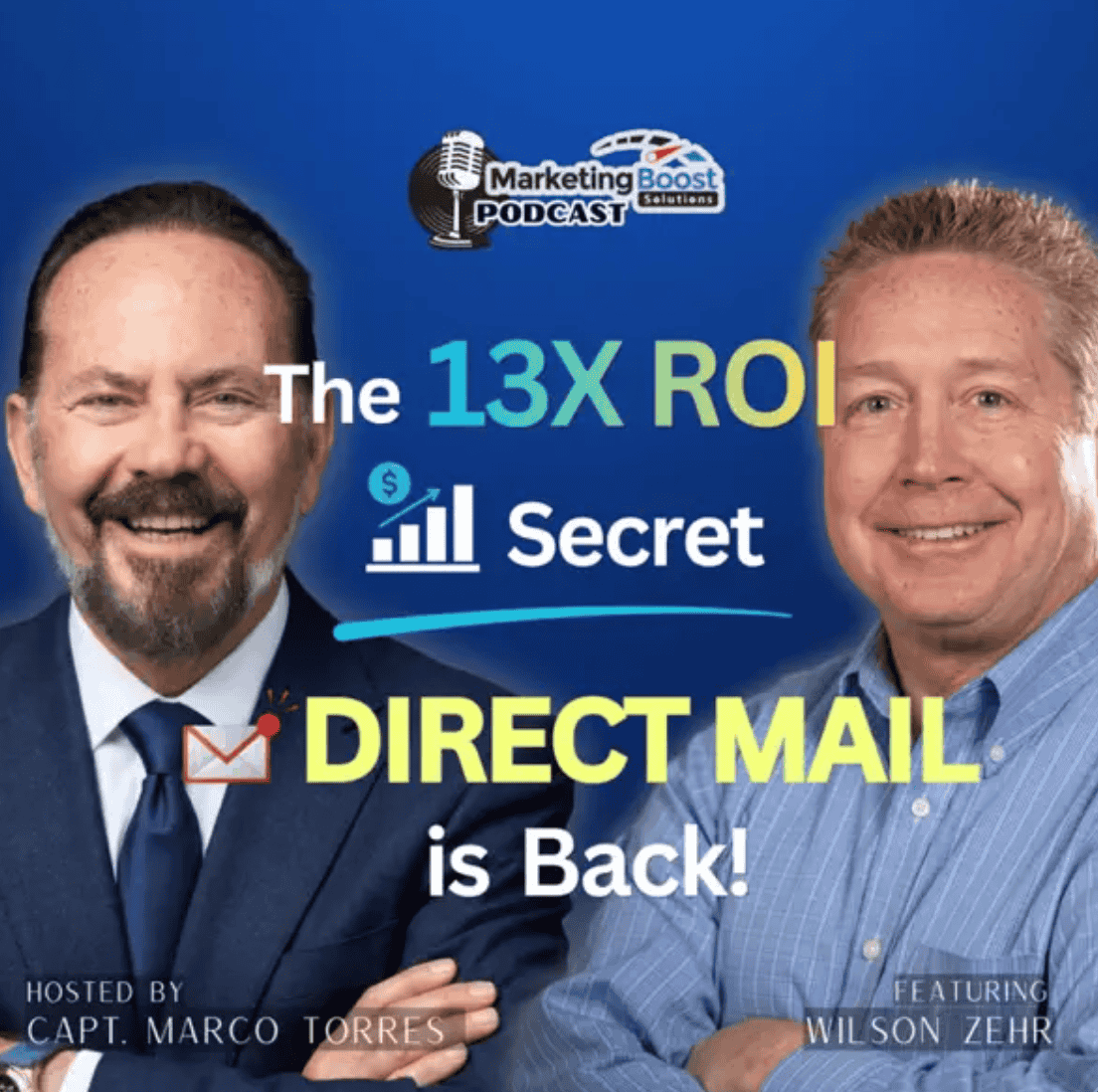
Episode Details
Podcast: Marketing Boost Solutions
Episode: Why Direct Mail Is Crushing Digital Ads: The Marketing Comeback Nobody Saw Coming
Published: June 23, 2026
Guest: Wilson Zehr, PhD
Guest’s businesses: Zairmail and Cendix
Host: Capt. Marco Torres
Duration: Approximately 50 minutes (50:19)
Apple Podcast: https://podcasts.apple.com/us/podcast/why-direct-mail-is-crushing-digital-ads-the-marketing/id1639926186?i=1000773898352
What if the most overlooked marketing channel today is the one sitting in your mailbox? In a world flooded with emails, social media ads, and AI-generated content, could an old-school direct mail marketing strategy actually outperform modern digital tactics?
Discover Direct Mail Marketing
In this episode of the Marketing Boost Solutions Podcast, Capt. Marco Torres sits down with Dr. Wilson Zehr, entrepreneur, startup veteran, professor, and marketing strategist, to uncover why direct mail is making a powerful comeback. With over 25 years of experience launching technology startups and helping raise more than $60 million in venture capital, Dr. Zehr shares how physical marketing creates trust, cuts through digital noise, and delivers measurable results. Discover how businesses can combine direct mail with digital marketing to increase engagement, generate more leads, and build stronger customer relationships.
Tune in and walk away with actionable ideas you can test right away, whether you’re a small local business or a growing startup. The future of marketing isn’t digital or physical… it’s knowing how to strategically combine both.
Free Direct Mail Sample Kit
See direct mail before you send it
Get samples of direct mail postcards and letters, plus service details to help you launch your first campaign. Your kit ships free by USPS.
Request Your Free Sample Kit →Episode Highlights
03:10 Why Direct Mail Is Making a Major Comeback
07:25 The Trust Factor: Why Physical Mail Creates Credibility
11:45 Cutting Through Digital Noise and Inbox Fatigue
16:20 The ROI Behind Direct Mail Marketing
20:05 Combining Digital and Physical Marketing for Better Results
25:30 Using Direct Mail to Re-Engage Lost Leads
30:10 Common Marketing Mistakes Businesses Make Today
35:40 How Small Businesses Can Start Testing Direct Mail
40:15 Entrepreneurship, Innovation, and Solving Real Problems
45:20 The Mindset Behind Long-Term Business Success
Apple Podcast: https://podcasts.apple.com/us/podcast/why-direct-mail-is-crushing-digital-ads-the-marketing/id1639926186?i=1000773898352
👉 Book on Calendly
Zairmail is a cloud-based platform that enables organizations to automate business-critical physical mail at scale. Combining powerful integrations, workflow automation, and a nationwide production network, Zairmail helps organizations execute high-volume mail operations with greater speed, reliability, visibility, and operational efficiency. Visit www.zairmail.com to learn more.
Click to View Full Episode Transcript
Podcast: Marketing Boost Solutions
Episode: Why Direct Mail Is Crushing Digital Ads: The Marketing Comeback Nobody Saw Coming | Wilson Zehr
Host: Capt. Marco Torres
Guest: Wilson Zehr (Seasoned Entrepreneur, Academic & Founder of Zairmail)
[00:00:00] Marco: Welcome to the Marketing Boost Solutions Podcast, the number one source for proven solutions to all your marketing challenges. Welcome back to the Marketing Boost Solutions Podcast. Today, we’re diving into a really interesting topic: the role of direct mail in today’s digital-heavy marketing world and why physical touchpoints may actually be coming back more powerful, not less.
[00:00:28] Marco: Joining us today is Dr. Wilson Zehr, entrepreneur, marketing strategist, professor, and startup veteran with more than 25 years of experience in technology, innovation, and business growth. Over his career, he’s helped launch multiple tech startups and participated in raising over $60 million in venture capital. Today, we’re going to talk about why direct mail still works, how businesses can combine physical and digital marketing more effectively, and what marketers are getting wrong in today’s crowded landscape. Wilson, welcome to the show.
[00:01:06] Wilson: Hi, good morning, Marco. Thank you for having me. Really appreciate it.
[00:01:06] Marco: You bet. Thank you for being here. I like this topic. I have… I’m not using direct mail anymore, so I’m all ears on why I and everybody else should be. And I almost get it, because more and more, you know, we get just so many emails and so many TV video and so much AI going on out there that going back to basics… It seems like… I remember like my football coach would tell me, you know, when you’re screwing up, he’d grab me by the face of my helmet and say, “Go back to basics—block and tackle.” And direct mail is like the original direct response marketing strategy. So, how did you get into direct mail? How did you… tell us about your background. What got you to where you are today?
[00:02:00] Wilson: Oh, those are two different questions! Yeah, but I’m happy to capture both. I mean, in terms of my background, I have an undergraduate degree in finance with a minor in computer science. I spent five or six years working as a software engineer, you know, working on compilers—I’m not sure if anybody remembers what that is anymore. And I went back to school, got an MBA, and just short of a PhD… and then started working in marketing. I was a product line manager for a couple of products, and then worked into strategic alliances, business development, executive leadership. Done six or eight startups and, you know, continue to advise and teach at the university level. I have a PhD in innovation and management, and I also have a graduate degree from Harvard University in data analytics. So, way, way more education than anybody should have, I promise, but I can’t help myself, I guess.
[00:03:14] Wilson: And yeah, go ahead, go ahead. That’s fine. Then in terms of… yeah, I should leave time for somebody else to talk, too, right? In terms of how we found Zairmail… you know, at the time when the internet… it didn’t start in 2000, but the internet’s been around for 50 years or more, but the worldwide web—the emergence of the worldwide web—created a lot of opportunities. One of the areas where I spent a lot of time, especially with software, is in convergence—looking at legacy applications, things that don’t connect to the digital world, and finding ways to bridge that gap.
[00:03:57] Wilson: And so one of the first startups we did was called Eusion. It was jointly funded by Intel, Microsoft, France Telecom, and Telecom Italia, where it focused on Voice over IP gateways and applications—basically bridging the public telephone network, the analog public telephone network, with the digital network. So, a lot of the tools you see today like Skype, and what we’re talking on today, this conference technology, are based on some of those fundamental things we worked on.
[00:04:26] Wilson: We also looked at mail. Mail is a legacy application that’s still, in the United States anyway, a huge industry—six-plus billion dollars. Well, that’s just the postal meter side of it; the mailing industry is many times larger than that. But it had no connection to the digital environment. So we first worked on hybrid mail in partnership with the US Postal Service, delivered that product in the early 2000s, and have continued to develop solutions and streamline the application. And you know, it seems like we’ve been able to add a lot of additional value to people who still use the mail. I mean, there are many, many companies that use the mail on a daily basis because it’s strategic to their business, because it does some things that no other medium can do.
[00:05:26] Marco: So with all of that, you’ve taught at several universities. Young entrepreneurs—what are young entrepreneurs getting right today, and what are they getting wrong, in your opinion?
[00:05:35] Wilson: Oh, that’s a… that’s a great question, but it is a broad question. I mean, I’m sure not everybody is making the same mistakes or making the same right decisions, either—it depends on the individual, what they have to work with, and the opportunity they’re pursuing. I think if I was to single out one area where I would provide additional advice, it would be motivation. And not that people aren’t motivated—they are—but I worry about what people are motivated by. It seems like a lot of times, people are more motivated by the money or the potential for riches. You know, they look at Elon Musk or Jeff Bezos or somebody like that and think, “Well, I could be a billionaire,” which is fine—I mean, that’s not a bad goal—but being a billionaire really shouldn’t be the goal. That’s just an outcome, right? That’s the way you keep score.
[00:06:46] Wilson: Jeff Bezos didn’t start out to be a billionaire; he started out to change the world with online shopping, right? You know, be the catalog shopping answer for this era. And it just turned out that people embraced that—I mean, it was very successful. I think we need to start out with that idea: that entrepreneurs can change the world, literally. And if you think about the tech Big Five or even Big Seven today, 50 years ago, none of those companies existed. But they probably, in terms of market capitalization, make up more than one-third of the entire market capitalization. And that’s because those people changed the world. Nike made a difference, right? I mean, and it all started with somebody’s vision, somebody’s dream. In some cases, they didn’t know that they couldn’t do that, and they did it anyway. And that should be what motivates all of us—to change the world in a way that makes a difference. And if we can do that, the other rewards, the other stuff, just comes.
[00:07:49] Marco: Very, very true. Right, you’ve got to have a vision. You’ve got to have something you’re providing. I mean, if you help enough other people get what they want in life, as old Zig Ziglar used to say, you get what you want. So you’ve got to have a product or service that you’re going to help solve some kind of problem, or some kind of a solution that helps people get what they want, and therefore they’re going to be willing to pay you for yours, and you’ll get to whatever level of success you’re looking for.
[00:08:16] Wilson: No, I agree. But I think it goes farther than that because if you think about most entrepreneurial ventures, most entrepreneurial ventures fail—90%. I mean, it’s so risky. And so if you’re going to go down that path, then you should do something that you feel passionate about—something you feel passionate about and you want to commit yourself to, that’s going to make a difference. If you just want to make money, there are lots of ways to do that—you could be a doctor, a lawyer, or any number of other things.
[00:08:46] Marco: Growth through… how true. So we live in a world dominated by digital ads, AI, email, social media. Why is direct mail still working? And do you have any examples of who’s using a combination of direct mail and digital that’s working really well?
[00:09:11] Wilson: I think, mean, there are lots of examples of people using direct mail. Oftentimes I hear people ask, “Well, are people still using mail? I thought that was dead.” And the fact is that mail volumes overall are down. I mean, when we think about mail as a tool, there are lots of ways people use it. Historically, people used it for transactional mail—you know, credit card statements, bank statements, things like that. And people are doing most of that work electronically these days, and that makes a lot of sense. I receive my credit card bills electronically and I pay them electronically—I mean, that makes complete sense.
[00:09:55] Wilson: But there are other ways to use the tool that bring benefits that no other tool can provide—we can talk about those in a minute. But the industry—the direct response industry, especially around mail—has always been ROI-driven. And the reason for that is because, unlike email or other kinds of tools, it’s not free. You have to pay postage, and so it has a cost to it. And so if we’re going to spend money doing promotion, then we need to get a return that covers those costs and produces a profit. So return on investment has always been a key driver, and it still is. And as long as people are getting a return on their investment, they will continue to use the tool. The Direct Marketing Association, which has now been absorbed by larger organizations, shares with us that direct mail on average returns $13 for every dollar invested. That, of course, assumes a good list and a well-thought-out mail campaign with a good response rate. But there are people producing those returns, or returns superior to that, and as long as they continue to do that, the medium will continue to exist.
[00:11:16] Marco: 13-to-1! I mean, that gets my… gets my ears to perk up. So, but what is the… okay, what’s a more realistic strategy if you’re going to start doing direct mail, in the process of finding out what works and designing a good direct mail campaign that works? Do you need to have several mail pieces in sequence like you do with email and texting, or how would somebody start testing direct mail as part of their overall strategy?
[00:11:53] Wilson: That’s a great question, and that’s part of the way that the Zairmail company that we run fits into the picture. I share this story from time to time: my friend from the US Postal Service shared with me that his father owned this little hardware store in Virginia—I think it was Virginia—and he was always worried about generating more business, you know, keeping his store open, making it thrive. And Marty—my friend’s name was Marty—Marty said, “Hey Dad, you should use the mail. You should use the mail to promote your business. Like, you know, I work at the Postal Service, it’ll be good for me, it’ll be good for your business—everybody wins. You should do that.” And he spent years telling his dad about that. One morning, his dad woke up and said, “Hey, I want to do direct mail.” So he got his stuff together, went down to the post office, walked up to the counter, and said, “I want to do some direct mail. What do you got for me?” And the guy just looked at him with a blank stare. And he said that was his wake-up call—that for the average business, it wasn’t as easy as it could be. So with a product like Zairmail, the product we offer, you can basically upload a list, upload your document, you see a proof in real-time. You like what you see, you push the button, and you’re in the mail tomorrow or the next day at about half the cost.
[00:13:37] Marco: It’s time to, wow, surprise and impress your clients with the most powerful customer draw card available anywhere. The Marketing Boost Solutions Show is brought to you by Marketing Boost, where you can get valuable travel and restaurant incentives to drive your leads from prospects to paying customers. Now you can offer complimentary hotel stays in over 130 destinations worldwide. Go to marketingboostsolutions.com and try it for free right now. Zairmail: smarter, faster, at scale. Like you said, you upload a list… tell us about that again, kind of what are the…
[00:14:13] Wilson: Yeah, you just upload a list, you upload a document, you see a proof of what’s going to be produced in real-time. You like what you see, you push the button, and out it goes.
[00:14:24] Marco: Sweet. Yeah, so that… you guys help design the creatives and what have you as well?
[00:14:32] Wilson: We can. A lot of the customers we have already have creative, or maybe they already have a list or they have other pieces of the campaign, and they just need us to make it faster and easier. But, you know, we’re in the business of direct mail, so any barrier that you have to using the mail, we can help remove it. So if you don’t have a list, we’ll help you find one; if you have a piece of creative or you don’t have creative, we’ll help you put it together—whatever it takes to help you be successful marketing through the mail. With that said, there are other applications—it’s not all just marketing, either. I mean, we do some work with, you know, tax liens, and collections, and notifications, and things like that. We do some certified mail—do a lot of different things. I mean, the whole point of the platform is to automate the production and delivery of mail, and we do that fulfillment… from those slides in the middle, you’ll see the diagrams—the Zairmail advantage—you can see that we do this production and fulfillment through a nationwide network of production facilities. So we’ll route the job electronically to a place near where it needs to go, where we turn it into physical mail and mail it. That is faster, it gives us no single point of failure, has almost unlimited capacity, and it’s better for the environment, too. So, yeah, I mean, this is the way that mail should have been done, but we reinvented it because it didn’t work that way.
[00:16:14] Marco: Uh, are businesses… what do you think about businesses becoming too dependent upon digital—you know, email—and dropping direct mail completely? I mean, it’s as you said, it’s a lot… it’s a lot more expensive, obviously, to… I mean, email is not free, either, but compared to direct mail, it almost is. So, to prepare for this, let’s say in my business, I’ve got business owners that join Marketing Boost and subscribe to our services, or they don’t subscribe—they come in and they check us out and they start to, you know, they drop off before putting in a credit card. I don’t have their address just yet. Is there a service that would grab their email and phone and go out and grab their address from some other databases that I could then do a direct mail piece to? Do you have integration of digital… is that something that exists out there between digital and direct mail for acquiring the rest of their correct address?
[00:17:37] Wilson: There are—I mean, there are a lot of questions kind of packed in there, but let’s see if we can address that. I do think if we want to reach people, usually we would start the other direction. I mean, it depends on what data we have, but the database—that’s one of the advantages of mail—is that the demographic data, or the data in the demographics, are very well-developed. So if I want to find, you know, a list of dentists in New Jersey that bought a car in the last six months, I probably could do that. I can get homeowner data; if I’m the right kind of institution, I could get credit score data. So that information is very well-developed. Not so in the digital environment.
[00:18:27] Wilson: I mean, if I start with a name and a physical address, I can oftentimes append an email address—find an email address—or append a phone number to it. But there are a couple of other wrinkles involved with that. One is here in the United States, of course, we have the do-not-call registries, which means that, you know, if we’re doing consumer data and try to append a phone number, a lot of phone numbers these days are on the do-not-call list, and we can’t really append them. And if we can append them, we can’t call them without the risk of fines. In the case of email, you know, the average person today has 2.7 email boxes or something like that, so we would have to find the right email box—which we can try—but something like 30% of even legitimate emails never deliver because of the spam filters and ISPs and things like that, which doesn’t happen in the mail.
[00:19:33] Wilson: So that’s a challenge with email. What you’re really hoping is that, given the volume, people try to boil the ocean—given the volume, you’re going to break through somewhere. Because I can just share my own experience: I get probably 500 email messages a day across… and I do have three email boxes that I monitor—I probably have more, but those are the three I monitor. So when I’m going through my email box in the morning, I’m not looking for stuff to read; I’m looking for stuff to delete. So I go through and delete, delete, delete, delete. “Oh, if I can respond to that, I will.” If I can’t, I just save it. But it’s really easy to get lost in that clutter.
[00:20:28] Wilson: And by the way, if I’m doing other kinds of digital advertising, a lot of times I don’t have that conversation alone. Maybe if I’m doing AdWords or something and people are clicking, maybe they’re clicking on competitors, too. So maybe I have that conversation with multiple people. With mail, usually if I send people a letter, they call me back—I’m having a one-to-one conversation with them about the product or service I’m offering and how I can solve their problems. So there are some very unique differences.
[00:20:54] Wilson: Now with that said, I don’t think it’s an either/or kind of thing. As marketers, we have to know—just like a mechanic, right?—you need to understand the tools in your toolbox and when it’s appropriate to use each. I can share a story about a political campaign we worked on for a local school district that was looking at a school bond measure, and they asked for our help to get that passed. It was a great bond measure, a great thing for the community. In order to promote that, we didn’t just pick one medium. We started out with this problem we were trying to solve: build awareness and establish preference for this bond that was in the best interest of the community. So we created a little website where we would put information about this bond, and it would be a focal point for our outreach. We gathered videos from students and other community members who’d participated over the years and kids who had used the new facility—that was all on there. We went out and we talked to the Parent-Teacher Association, and we had coffee meetings, and we had yard signs, and we did all the traditional kinds of things, but we also used mail.
[00:22:21] Wilson: One of the things that’s interesting, at least here, is I can get a voter file. So I went to the county elections office, we pulled a voter file—it didn’t really cost anything, I just had to pay for the media that they gave it to me on. We took that list and we divided it—we did an overlay and we divided it into four sections. First, we divided it into homeowners and non-owners, because bonds are paid for in Oregon by property taxes. The people who own homes will pay for it, and people who don’t will get the benefit of it, although if they’re renters, technically they pay in rent. And then we divided those two lists again into those with children and those who didn’t.
[00:23:03] Wilson: Based on that audience, the messaging was different, right? So for a homeowner who is going to pay the tax and doesn’t have kids in school, the message is all about community, right? If you have kids in school, we’re talking about the value proposition and how the kids are going to get more out of it, so we can change up that message. We know in Oregon it’s vote-by-mail—how it’s been for 30 or 40 years just because the economics make a lot more sense—so we know when the ballots are mailed. So we go out with the first piece when the ballots are mailed and explain why this is important, or slightly before the ballots are mailed. We do one piece in the middle—in between now and election day—because we know some people don’t wait until election day to vote when they vote by mail. Sometimes they vote right when they get the piece, sometimes somewhere along in the middle, sometimes the day when it’s due. And then we did a final piece right when the ballots were due.
[00:24:05] Wilson: So that combination of all of these tools we used in marketing allowed us to pass this ballot initiative or this bond measure by a wide margin. Years earlier, they did the same one, and they were up all night waiting because it was super close—I mean, they passed it by a couple of votes or something. But this wasn’t even close, because we were able to make people aware of this bond measure, how and why it was important to them, and establish a preference for it. But we didn’t do that just with one tool; we did it with a whole series of tools. And as a marketer who’s skilled in the art, you should know how to use all of those tools.
[00:24:49] Marco: What businesses… I mean, I can see how for political campaigns—I get them in the mail all the time—I can see that one of the things they have to invest in is direct mail. What are you seeing are some of the best success models for businesses using direct mail? One thing that comes to my mind—I think direct local businesses would make a lot of sense, things that are in the local community and they’re trying to promote a new restaurant that opened or services in the area that you may not know exist. But with all the clutter, with all the digital, with all the ads, with all the stuff on the internet, it’s harder to get in front of your local community as well as a direct mail campaign. You’ve got the addresses, you know exactly who’s in that area to drop a mail piece to. Who is it… what would you say is the best use case for direct mail? Is it local businesses, or does it still work for online digital companies like mine that are trying to solicit business owners? Who should be using this the most?
[00:26:00] Wilson: You know, if I look across our customer base, it’s a wide variety. I mean, traditionally we’ve done a lot of work with realtors, mortgage brokers, independent insurance agents, dentists, doctors—things that fit your mold. We have data that looks at new movers or new homeowners. New movers tend to need new providers in the new place that they move to. New homeowners spend a lot on their home—that has an impact for home improvement stores, for painters, for plumbers, etc.
[00:26:40] Wilson: We also do nationwide campaigns for people that are helping people with debt resolution, tax lien resolution, loans—auto loans, home loans, things like that—so those are national type products. So I think rather than a specific application or the industry vertical, we could talk about what mail does—the advantages as a tool. First of all, the mail can reach any household and business in America six days a week by congressional mandate. Secondly, we talked about before, it’s proactive. Well, the demographics are very well-developed, so I can target precisely who I want to talk with. Thirdly, it’s not passive—it’s more active. Even with something like AdWords, I have to wait for people to come and find me. But with direct mail, I can reach out and touch them, and that helps in a case where they may not even know that they have the problem that I’m trying to solve for them, so I have to do education. If you’re using a tool like AdWords, it presupposes that the person understands what they’re looking for.
[00:28:22] Wilson: And then there’s this idea that it’s very well accepted. I mean, people are used to… the Postal Service would talk about the ‘mail moment’—this idea that at the end of the day, people get home, they check their mailbox, there’s light from above and music, and they find the stuff they like in their mailbox. I think they would maybe oversell that a bit! But the fact is that it’s built into the American psyche. People are used to coming home, checking the mailbox, seeing what’s there. If there’s something that’s relevant to them, they’ll take action—they usually see it and do something with it. So you get some kind of an impact in a way that’s not offensive to people. I mean, check in with the political pollsters who are trying to call people at home these days and see what kind of experience they’re having! So there’s a lot of different things that this tool can do that other tools can’t.
[00:29:31] Marco: Do you have any experience… you say tools you can do that other tools can’t. Is there any way, or what ideas do you have, to combine digital and direct mail strategies for a specific mail list?
[00:29:42] Wilson: You know, we do that all the time. I mean, we talked about this political campaign where we had a web presence where we had information, and the direct mail that we sent out had information on the bond measure, but it also contained a link and directed people back to the website, right? Where they could find more information. So that kind of online presence tends to be pretty important for campaigns of that nature. Certainly, we can use other mediums that complement that. You’ve seen stuff like retargeting, where you go to a website, you’re looking at a product or service, and then as you go to other websites, the ads seem to follow you around. That same kind of information is available for mail—we can set it up today. We’ve got a product where if somebody goes to a website and they leave without purchasing something, we’ll send them a postcard in the mail. We can look up their IP address, map it to a physical address, and send them a postcard.
[00:30:46] Marco: Now we’re talking! That’s what I was asking you earlier. For example, they go to my website, they don’t complete the process—how do I combine that with direct mail? So you’re saying with the IP address, I can tag a street address and mail them a piece?
[00:31:03] Wilson: Yeah. Typically, in terms of how that would work functionally, is we’d put a pixel on the page. That pixel would identify the IP address. IP addresses are not 100% in terms of identifying a physical address, for a lot of reasons that I won’t bore you with, but there are ways using multiple sources to get a physical address in many cases. And in those cases, we can send them a physical postcard to follow up with. And then that list can also be used for something like a phone call follow-up.
[00:31:36] Marco: Is your business on autopilot yet? Do you have automation in place to capture, nurture, and convert prospects into clients via email, SMS, ringless voicemails, appointment setting? Get all the inbound and outbound marketing tools in one place. Go to marketingboostsolutions.com for more on automating your business so you can make money while you sleep. Tell me why or how does physical mail impact the trust factor and the credibility factor compared to the entourage of online ads?
[00:32:11] Wilson: Well, I would say, back to your question, too—I mean, it’s not that we have a preference for mail. When I think about how we market our business, we use everything. I mean, we have an online newsletter, an electronic newsletter that we send out to people, we use direct mail, we use AdWords—we use a variety of tools just like other businesses should be doing. But as you say, there is one other advantage to mail: this idea of credibility that comes with something that’s tactile and something that, you know, somebody’s identified a client, they’ve spent money to reach them. They reach out with a high-quality mail piece that has an offer that’s valuable to people—people tend to respond to that. It’s different than if you target somebody with a random piece of email. But email must work, too, because people keep spending money on it.
[00:33:18] Marco: Yeah. So how is AI now being used in direct mail? What integrations, what is… how is AI changing the direct mail industry?
[00:33:25] Wilson: Direct response AI, as we currently conceive of it—I mean, generative AI—can be used to generate content. With mail, we tend to think of the formula for success as being 70% list, 20% offer, 10% creative. Tools like AI can be used to help identify what that target audience is—you know, who the target audience is, what they look like, where that data might be sourced. It can help us identify an offer that’s compelling. All of those things could be done without AI, too, but using AI, you get to take advantage of the collective wisdom that comes from the large language model that underlies most of those tools.
[00:34:34] Wilson: We use it in our business—we use it to help understand the market, we use it to help understand our customer needs, we use it to help design software. It’s never 100%, but it can be used to save time in our solutions. We’re a software company, and if you look at our site, you saw that it’s not WordPress—that’s a very sophisticated piece of software that connects to servers and to a distributed production network. And all of that software is designed by engineers, software professionals, and AI can help them in their work, as well. So there’s lots of different ways it can help. And most recently, I’ve also seen customers who use AI to build assistants that can answer the phone. So you have the toll-free number, people call the toll-free number, and there’s an AI avatar that answers it and serves as a frontend to the customer interaction. I have mixed feelings about that, but I do see it.
[00:35:40] Marco: Speaking of that with direct mail, what is the best call to action to try to get people to…? Is it still, like you just described, have the phone number on there for them to call, or is it a QR code? Is it “check out this website”? What are you seeing is the call to action that turns into the best actual conversion?
[00:36:05] Wilson: I would say all of the above. I mean, we always want the customer to interact with us in a way that’s most comfortable for them. So I would always have a phone number. And by the way, I probably wouldn’t use an AI assistant—it would be better to have a live person answering the phone, and it would be better to have a live person answering the phone 24/7, which is possible these days. I mean, there are call centers that man the phone 24 hours a day, and it’s not that expensive—even a small to medium business can do that.
[00:36:42] Wilson: We should give the customer all of the response vehicles we can, so whatever’s in their comfort zone: QR code, we can redirect them to a website, toll-free number. The additional benefit of a toll-free number or a custom landing page is I can also identify people that came from a specific campaign. You mentioned earlier this idea of testing, which in marketing, testing is always a good idea. We can have two or three different pieces that we send out and see what the response rates look like, and maybe we put a different toll-free number on each one so that we can see which one people are responding to—that’s a pretty tried-and-true technique. And toll-free numbers are available to any business today at a very low cost.
[00:37:41] Marco: So, in setting up… I’m Business X and I want to get back to direct mail, or I want to start testing direct mail. What kind of an investment should I plan on in the budget to launch and get tested? You obviously have to test a few campaigns before jumping big bucks into throwing a lot of money at direct mail or any other campaign. First, look for it: “Do I have the right message? Do I have the right audience? Do I have the postcard or direct mail piece or long-form letter that is driving the call to action successfully?” Before you can get anywhere near that 13-to-1 ROI investment—for every dollar invested, get $13 back… I’m all in if I could do that easily. So, before you get to that point, what is the typical investment and the learning curve?
[00:38:48] Wilson: That’s a great question, and it’s really going to depend on the market, the offer, the experience of the marketer. I can talk about the economics of the tools we offer, though. If you’re using a tool like Zairmail, there’s no minimum quantity—you could send one piece of mail, but there is a minimum setup charge of $149, so you would expect to spend at least that much. In terms of pricing, there’s this thing that happens in the mail at 500 pieces. We don’t mail retail usually, unless it’s less than 500 pieces. But what we do is, when a direct mail piece comes through, we will do something called presort. And presorting allows us to sort the mail, package it up, put it in trays, and help do some of the work the Postal Service would usually do.
[00:40:00] Wilson: And if we do that, we get discounts, which means at 500 pieces or more, the postage gets less expensive. And 70% or more of the cost in direct mail is postage. So if people are going to do some tests, we would encourage them usually to do a test of 500 pieces or more because that’s where the postage is the most cost-effective. You can go below that 500 pieces, but once you do that, the postage gets more expensive, and below 250 pieces we have to use a live retail postage stamp, which is more expensive still. So that’s the economic side of it.
[00:40:43] Wilson: The other piece of it is, any kind of a marketing test, you need to make sure that you use enough pieces so that the response you get back is statistically significant, right? And if you’re looking at a market that maybe has a 2% response rate, then a thousand pieces will get you responses, but it may or may not get you a number of responses that can allow you to draw firm conclusions. If you have a product or service in a market that responds better—you know, 10 or 12%—then you can send out fewer pieces to get a statistically significant response.
[00:41:24] Marco: If someone wants to grow faster… well, you know what? Before I get into that, I want to tell you guys something about another offer, as we talked about. Hopefully, you’ve seen the goodwill that marketing this boost has brought you over the years, and now I’m launching trustbyreviews.com. We’re bringing you another amazing product, and right now it’s in beta mode. We’ve got a few of you already started on beta; we’re going to be opening it up again for another round of beta users exclusively for Marketing Boost members—you’re going to get a free account on Trust By Reviews. What we’ve done is built a platform, which is how Marketing Boost was born in the first place. When we launched Marketing Boost, we needed video testimonials for one of our big travel sites that we had, and we couldn’t get anybody to give us a video review—go that extra mile of filming a selfie video from the resort, the pool, the bar, the beach. And we knew if we only had video testimonials, we’d be able to sell so many more vacations, but we couldn’t get hardly anybody to do it.
[00:42:24] Marco: Well, we came up with an idea to offer an incentive—a reward—if they’d go the extra mile, and we started with a survey first. We’d hit them at their peak of happiness, the day after check-in, and we’d say, “Hey, how’s the hotel living up to your expectations?” And if they gave us a four or five-star rating, we’d then say, “If you’ll go the extra mile…” We’d email them right back and text them, “If you’ll go the extra mile and help others know about this resort and film a selfie video testimonial from the pool, the bar, the restaurant, whatever you like best—turn it into a hotel review, mention the hotel brand and ours—we’ll give you a bonus three-night hotel stay in Orlando or Las Vegas.” Well, that eventually became the birth of marketingboost.com. And now we offer… but I’ve seen for years people use Marketing Boost and they don’t know how to implement it. They haven’t figured out, for example, how Abby with testing finally figured out how to add it to his nine-value stack proposition. So many people don’t know how to use the Marketing Boost incentives well, but Trust By Reviews does it for you. We all need reviews, we all need feedback, we all need testimonials. We’ve built a platform that helps you implement that, solicit feedback, and offer a simple reward when they go the extra mile of posting their positive feedback on multiple third-party review sites or giving you a video testimonial—you can reward them again with another Marketing Boost reward for going that extra step. And this is going to help you do what it did for our main travel site—we had over 30,000 video testimonials, more than any other travel website in the world, thanks to using rewards for the video review. Now we built a platform to help you do the same, so go check out trustbyreviews.com. It’s currently in beta—not even available to purchase yet—but coming soon, so stay tuned.
[00:44:15] Marco: So before we wrap it up, Wilson, I’ve got your LinkedIn page on here, folks. All of the links to contact Wilson and his website are in the show notes below. Do you have any final words of wisdom, Wilson? Well, before I ask about final words, you said 10,000 pieces, for example. How much is a campaign of 10,000 pieces approximately going to run me—with the printing, the envelope, whatever I’m sending? Let’s say a postcard is probably the least expensive, so a postcard and everything else—what am I looking at? About a dollar each? 50 cents each? What is the typical investment there?
[00:45:00] Wilson: From a budgetary standpoint, I’d say for 10,000 pieces, probably budget about 90 or 95 cents a piece, something like that. So 10,000 pieces from a budgetary standpoint would be $9,500. But I would also say that, once again, we talked about 500 pieces, so an investment, especially for a small to medium business, can be much less than that. But I’m talking about a larger organization where mail is strategic to their business and they have a lot more money to invest—then yes, they could start with a bigger number. But it really depends on the client and what they’re trying to accomplish.
[00:45:45] Marco: And by the same token, it would make sense to me: you want to send 500, you want to send a thousand, you want to see, “Do I have that 2 or 3% conversion rate?” and then is that conversion… am I generating enough revenue from that 3% that’s going to cover, “Okay, this is working, so now I can scale it—I can send 3,000, I can send 5,000, I can send 10,000,” and continue to throw at it before you just go out and drop 10,000 and not know if that particular piece is worded properly, the creative, the imagery, the call to action—phone number, QR code, etc. Make sure everything is driving traffic before you start throwing the big bucks at it. So in your case, you could start with as little as $149. And what does that get somebody?
[00:46:36] Wilson: It depends. I mean, the most common pieces we see are either postcards, letters, or we do something called a snap pack, too. A snap pack is like a mailer that you would receive a PIN number or a rebate or something like that in, where you tear off the edges. For a small to medium business, a postcard would be a very common entry point—it would be the least expensive option, and you get the equivalent of a small billboard in the mail, so you’re going to get an immediate impression. With letter mail, you have to get opened, but letter mail also has the advantage of privacy, and you have more real estate to work with, so people choose that. We’ve got a whole… I mean, if somebody’s interested, we have a whole masterclass we do that talks about the tool and direct mail and techniques for success, things that you could use to increase your response rates. And by the way, I’ve worked on campaigns that have had response rates as high as 30 or 40%.
[00:47:55] Marco: Wow!
[00:48:01] Wilson: So I mean, there are times if you have the right audience and the right offer where you can just ring the phone right off the wall. But it’s finding the right audience and offering the right solution in the right timeframe that makes all the difference.
[00:48:22] Marco: Well, fantastic, Wilson. Where do we find that masterclass for direct mail? Is that something you have on your website?
[00:48:30] Wilson: It’s probably on the website—we actually have a blog on the website connected to the website, too. But if you go on YouTube and look for Zairmail—that’s like airmail, A-I-R-M-A-I-L with a Z on the front, so Z-A-I-R-M-A-I-L—and you put that into YouTube, we have a YouTube channel and you’ll see a masterclass in there. You’ll see a lot of content from Zairmail, but there is a masterclass in there that’s free to watch.
[00:49:01] Marco: Yeah, if you would send us the link to that—I didn’t capture that while we spoke—but if you send me the link to that, we’ll make sure it’s in the show notes so everybody can find it. I’m going to wrap this up here—we’ve taken an hour of your time, I appreciate that. Folks, if you like the content we brought you, I want to ask you… I’m going to need to ask you for a huge favor: make sure you like and subscribe to the show. It makes a huge difference to us to help get this word out about Marketing Boost Solutions business tips, ideas to help businesses succeed. So make sure you like, subscribe, grab the link, and share this with another entrepreneur that you might think is looking for ways to use direct mail to grab attention and get traffic into their business. So again, like, share, and subscribe, and we’ll see you on the next episode of the Marketing Boost Solutions Podcast. Thank you.
[00:49:44] Marco: Thanks for listening to another episode of Marketing Boost Solutions Podcast with your host, Captain Marco Torres. Now it’s on you—take the next step now. Go to marketingboostsolutions.com for more on how you can wow, delight, and surprise your clients with the most amazing draw card on the planet. So stay thirsty, my friends—stay thirsty for knowledge. See you next time.
[00:50:15] Wilson: All right. Thank you.