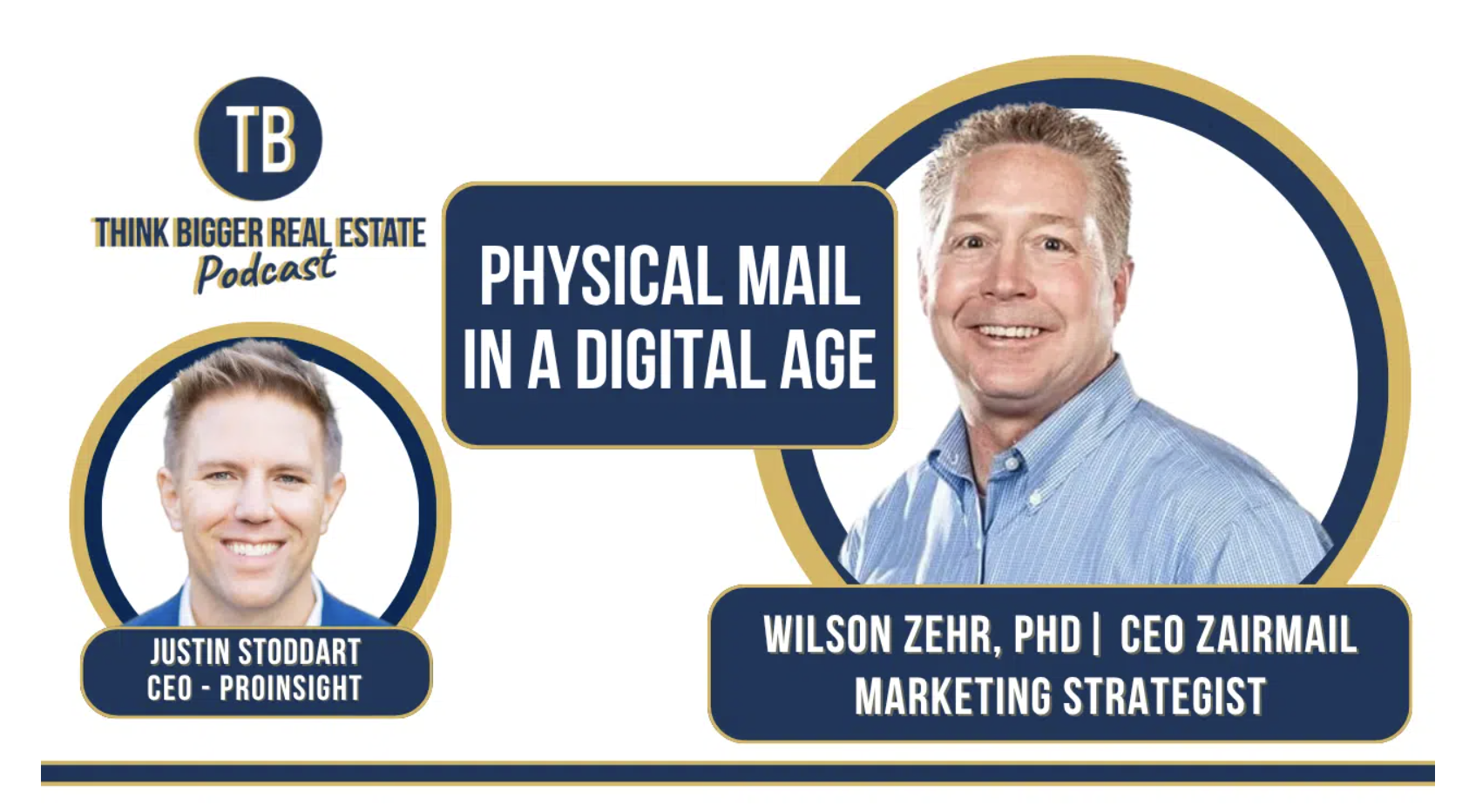
Episode Details
Podcast: Think Bigger Real Estate Podcast
Episode: Physical Mail in a Digital First World
Published: October 15, 2025
Guest: Wilson Zehr, PhD
Guest’s businesses: Zairmail, Cendix, and Speedy Desktop Comp
Host: Justin Stoddart
Duration: Approximately 26 minutes (26:05)
Apple Podcasts: https://podcasts.apple.com/us/podcast/physical-mail-in-a-digital-first-world/id1224994638?i=1000732057803
“As marketers, we can be most effective not by thinking just in terms of digital or analog, but in terms of the customer and what they need from us to move forward.”
In a world where inboxes overflow and screens dominate attention, it’s tempting to assume that physical mail is a relic of the past. But what if that assumption is costing you real opportunities?
And if you’re a real estate professional looking to build trust, stay memorable, and break through digital clutter, you’ll want to pay attention.
The Underrated Power of the Mail Moment
As Dr. Zehr explains, mail has unique advantages that no digital tool can replicate:
“Mail reaches every household and business in America six days a week. It’s proactive communication—you don’t have to wait for someone to find you.”
Unlike emails that often land in spam folders or social posts that get lost in the algorithm, physical mail commands attention. The “mail moment”, as the U.S. Postal Service calls it, is still part of America’s daily rhythm. People check their mail expecting something of value—and when your message arrives there, you’re not competing with a thousand other digital distractions.
That alone is a huge advantage in today’s marketing environment.
Precision Targeting Meets Tangible Trust
One of the most surprising takeaways from the conversation was how data-rich and precise direct mail targeting has become.
“If you want to reach Jewish dentists in New Jersey who bought a car in the last six months—we can find that list,” Zehr explains with a smile.
For real estate professionals, that means you can craft mail campaigns that go beyond the generic “Just Listed” postcard. You can reach homeowners in a specific price range, with kids in school, or who have lived in their homes for more than five years.
Mail lists can mirror the same demographic filters that digital marketers use—but with the added benefit of landing in the one place every client still visits daily: their mailbox.
Case Study: How Analog Helped a Community Win Big
To illustrate how digital and analog can work together, Zehr shared a story from a local political campaign in Oregon. The community needed to pass a bond measure to rebuild an aging athletic facility.
Using a hybrid approach—building a digital hub for information and engagement, combined with precisely timed direct mail to different audience segments (homeowners, renters, parents)—the campaign passed “by a wide margin.”
It wasn’t luck. It was a strategy.
Each message was tailored, delivered at the right moment, and reinforced across multiple channels. The same principles apply in real estate: combine digital visibility with tangible, personal communication, and you’ll drive results that outpace either medium alone.
Key Takeaways for Real Estate Professionals
1. Don’t Compete—Own the Moment
Your clients’ inboxes are crowded. Their mailboxes aren’t. When your brand shows up in a physical space, you own that attention—if only for a few seconds. Use that opportunity to be memorable.
2. Think “Digital + Analog,” Not “Either/Or”
Digital tools are vital—but the most effective marketers use them alongside print. Imagine running an online campaign to capture leads, followed by a beautifully designed postcard that lands days later, reinforcing your value and call to action. That’s brand synergy.
3. Target with Surgical Precision
Gone are the days of “spray and pray.” Today’s mailing lists can target homeowners who fit your exact client profile. The result? Better response rates, higher ROI, and a marketing strategy that feels more human.
4. Lead with Strategy, Not Just Tools
Zehr’s 70–20–10 formula says it best: 70% of success comes from the right list, 20% from the offer, and 10% from the creative. In other words—get clear on who you’re talking to and why, before worrying about how it looks
Watch the full Youtube video here:
https://www.youtube.com/watch?v=Vu-7WtKNuu8&t=11s
Apple Podcasts: https://podcasts.apple.com/us/podcast/physical-mail-in-a-digital-first-world/id1224994638?i=1000732057803
Timestamps
00:01 – Intro: Is there still a place for physical mail?
01:25 – Guest: Dr. Wilson Zehr, CEO & Founder of Zermail
02:45 – Why direct mail still works in a digital-first world
04:20 – The power of proactive communication
06:15 – Cutting through digital clutter and spam filters
08:10 – Email overload vs. the “mail moment”
10:18 – Blending digital and analog: a real-world campaign
13:00 – How targeted mail won a community bond measure
16:45 – Hyper-targeting in direct mail: real estate & lending examples
19:40 – The 70–20–10 marketing formula explained
21:55 – Cost, targeting, and using mail strategically
22:40 – Where to start: Zermail and easy mail automation
24:35 – New tool “Speedy” for fast, single-letter mailing
25:18 – Final thoughts: blending timeless trust with modern tech
👉 Book on Calendly
Wilson Zehr is a Direct Mail Industry Expert, Direct Marketing Specialist, and CEO of Cendix (www.cendix.com), the leading provider of web-to-print solutions. He is also the founder of Zairmail (www.zairmail.com), responsible for many industry firsts in direct mail.
Free Direct Mail Sample Kit
See direct mail before you send it
Get samples of direct mail postcards and letters, plus service details to help you launch your first campaign. Your kit ships free by USPS.
Request Your Free Sample Kit →Click to View Full Episode Transcript
Podcast: Think Bigger Podcast
Episode: Physical Mail in a Digital First World
Host: Justin Stoddart
Guest: Wilson Zehr (Seasoned Entrepreneur, Academic & Founder of Zairmail)
[00:00:01] Justin: Is there really a place for physical mail? Today’s episode, we’re going to make you a believer. We’re going to share with you specific examples of those professionals who have not overlooked the analog version [00:00:01], who realize that it’s a necessary component to drive the customer forward faster [00:00:07]. When everyone else is competing for eyeballs online, you can be one of a kind showing up by supplementing your digital with analog [00:00:15]. Today’s episode, I’ve got a special guest who’s been in this industry for a long, long time [00:00:23]. He’s going to be sharing information that’s going to help you know how to stand out again in a crowded market [00:00:30].
[00:00:34] Justin: So the big question is this: how do those of us in the real estate industry who have crazy amounts of ambition, how do we think bigger than the building of our own empires? How do we create success and significance, income and impact? My name is Justin Stoddard, this is my co-host Stephanie Peek [00:00:34], and together we bring you the Think Bigger Real Estate Podcast [00:01:00]. All right, welcome back everybody. Hey, I am without my lovely co-host Stephanie Peek, so today, um, I will go at it alone [00:01:08], but with my good friend Wilson Zehr [00:01:21]. Now, for those of you that don’t know Wilson, he is the CEO and founder of Zairmail [00:01:26]. Um, Wilson’s been in the—not just the mailing business for a long time, but he’s actually been in the world of business for a long time. He’s been teaching at the university level with a PhD for over 20 years [00:01:31], he’s raised over $60 million in venture capital for startups, he’s founded six companies himself [00:01:41]. He’s truly someone who understands business at the highest level [00:01:48], and today we’ve got the good fortune of bringing him here on the Think Bigger Real Estate Podcast to help you understand what you might be missing out on and getting more client conversion by supplementing in direct mail [00:01:48]. Wilson, it’s a pleasure to have you here today. Thanks for taking some time to pour into our audience [00:01:59].
[00:02:04] Wilson: Good morning, Justin. Thanks for having me, appreciate the opportunity [00:02:04].
[00:02:09] Justin: Yeah, no, uh, Wilson and I have known each other for a long time and we just recently got reconnected [00:02:09]. And, uh, when I um was reminded at how deep his expertise is in the mailing space, I realized this audience needed to hear it because, again, there’s some agents who I know who do very, very well with direct mail campaigns [00:02:13]. Again, they don’t ignore the digital, but they see it—uh, they see it differently, right? [00:02:20] They don’t see it’s one or the other [00:02:25]. So Wilson, help us to see, kind of to understand from a real estate agent’s perspective, what they might be missing if they’re only doing digital [00:02:25].
[00:02:35] Wilson: Yeah, that’s a great question, Justin [00:02:35]. um, I was just thinking about the best place to start. Um, you know, as—as marketers, um, I think it—it often we can be most effective not by thinking it just, um, you know, terms of digital or analog or some specific tool [00:02:44], but in terms of the customer and what they need from us to move forward [00:03:00]. You know, there’s a—an old saying: “If all you have is a hammer, everything looks like a nail,” you know? And that doesn’t always produce the best result [00:03:00]. Um, there are some things that, um, mail does [00:03:13]. Um, you know, there are some things that mail does that, um, other tools do not [00:03:13]. That, um, so we can just touch on those briefly first [00:03:23]. You know, mail allows us to reach every household and business in America six days a week [00:03:30]—five days if you’re, you know, if you’re talking about a business enterprise, but uh, to the home still six days a week [00:03:37]. It’s proactive communication. Unlike a lot of, you know, digital tools like AdWords, things like that, you don’t have to wait for somebody to find you; you can reach out and find them [00:03:42]. Thirdly, we can do precise audience targeting. So, you know, the demographics are very well-developed over a lot of years [00:03:49]. So if you want to reach Jewish dentists in New Jersey that have purchased a car in the last 6 months, we can find that list [00:03:55] and hundreds of variations on that list. So we, you know, we can get to exactly the person we need [00:04:08].
[00:04:14] Wilson: Um, oh, and by the way, there’s no spam filters on it either [00:04:14]. So you know, even in the best of worlds with email campaigns, for example, um, something like 30% of even legitimate emails are not delivered because of the spam filters and, uh, you know, protections built into the internet [00:04:20]. Um, and then finally, it’s just built into the American psyche [00:04:29]. You know, people are used to, you know, getting communication in the mail [00:04:37]. It’s part of their daily routine. The Postal Service would call it the “mail moment,” you know? When you get home, you check your mailbox and, you know, there’s voices from the heaven and there’s lights [00:04:42] and—and, uh, you know, and people check their mail. So I—I think they romanticize it a little bit, but it still remains that people are used to getting stuff in the mail, looking at the mail [00:04:48]. They don’t have a negative reaction to it, which is a good first step [00:05:00]. And that’s why, in general, the Direct Marketing Association tells us that, on average, mail produces $12 for every dollar spent [00:05:04], which is in excess in—in—in of many digital tools [00:05:10].
[00:05:19] Wilson: So the question is not, I think, whether digital or direct analog or direct mail or door hangers or yard signs. The question is what makes sense, you know, at this stage in a customer journey given what we need [00:05:19]. We need to, you know, what—where we need the customer to go in order to help them [00:05:27]. Um, lots and lots of campaigns use variations. For real—realtors forever, realtors have been using things like just-sold, just-listed postcards [00:05:35]. Um, we have clients that are doing, um—in tight housing markets where they’re sending out letters on a weekly or bi-weekly basis saying, “We’ve got a client and you’re, you know, that’s interested in buying in your neighborhood, here’s what they’re looking for.” [00:05:49] And they’ll send that out through letters, and hopefully a neighbor can help, you know, tip them off on something new [00:06:04]. Um, there’s a lot of different things you can do. The other thing that’s—that’s interesting, I think, in the—in, uh, in this era is that digital is so crowded [00:06:09]. And when I have a piece of mail in front of somebody at their mailbox, I own that space. I’m not competing with anybody [00:06:16].
[00:06:24] Justin: It’s fascinating to think that way because, again, we’ve—yeah, being in our digital world today, all the things that you talk about, right, of—of trying to gain mindshare, of, right, um, not being filtered out [00:06:24], right? There’s—there’s—you’ve helped me to realize that there’s a—there are a number of ways where the analog mail system is superior [00:06:39]. And I think, you know, I’ve noticed an increase in kind of spam filter and even organization within my email inbox because it’s so overdone, right? There’s so many emails that go out [00:06:46]. Um, and there’s so many—even if you open up Facebook, right? How many of your—of the posts that come up in front of you are ads? [00:07:00] Right? To where it starts to really become quite the littered environment [00:07:13]. And to where it just becomes almost kind of like white—not, I guess white noise, um—and—and—and people don’t give the attention to those spaces that they used to [00:07:13]. Whereas, you know, I think people would—would similarly, you know, they—they look at their mail over a garbage can because there’s, uh, you know, they’re also trying to filter out [00:07:18]. But if you can get good at standing out in that environment, it’s going to get in front of their eyeballs [00:07:25]. Right? It’s—it’s like they’re going to see it. And that’s the one thing you can’t say in digital: when you’re putting ads in front of people, you can’t guarantee that anybody’s going to see it [00:07:43]. You can’t guarantee that anybody’s going to—going to actually look at it and—and read it and get a chance to decide if they want it or not, right? [00:07:48] Whereas what I hear you saying is that in the physical space, um, people are going to decide they’re going to see it, and you’re going to have a chance to—to—to encourage them to read it [00:07:57]. Is that—is that a fair assessment, or what did I get wrong there? [00:08:07]
[00:08:11] Wilson: No, I—I do think that’s a fair assessment. But—but you, it, uh—you reminded me of one thing [00:08:11]. You know, and not to pick on email, email is a great tool for some things, like like direct mail. It’s got things it’s good at and things that it’s not as good at [00:08:14]. And you know, for me personally, I probably get four or 500 emails a day [00:08:21]. So, and I start out my day by going through my email box usually, um [00:08:26]. And when I’m doing that, I’m not looking for stuff to read; I’m looking for stuff to delete, because there’s no way I’m going to read four or 500 emails [00:08:31]. Um, and I—thankfully, my—in my mailbox is a lot less crowded than that [00:08:37].
[00:08:46] Justin: Yeah, you can imagine having—boy, that’s a lot of emails, Wilson [00:08:46]. Um, I—I probably get a hundred, um, and you get four or five—that’s—that’s incredible [00:08:52]. And, uh, yeah, you’re right. I do the same thing. I go in—in fact, what I’ll do with my email is I’ll go over to the side and I’ll check everything [00:08:59]. Like, in—in other words, everything’s about ready to get deleted, and then I go through and with each subject line, I’m asking myself, “How much do I need this right now?” [00:09:02] Right? And if I don’t need it, if it’s not a very personal email from somebody, or if it’s not something that’s—that’s exactly what I need at that moment, it’s probably good, but I—I archive it, right? I delete it [00:09:09]. Um, so I know, again, as you mentioned, they shouldn’t be seen as mutually exclusive, right, between the digital and the physical [00:09:19]. I know you, um, have done, um, you know, robust mailing campaigns for real estate as well as for even political campaigns [00:09:27]. I know an experience that—that you were going to share here today involved kind of the marrying of the two: the digital and—and the—and the analog [00:09:36]. Which, again, I think we have to look at our brand not as, uh, not as a—one of the delivery methods, right? It’s not an online brand, it’s a brand [00:09:48]. And yes, we deliver that brand online, and we also may deliver it in the mailbox [00:10:02]. But what is it, um—kind of talk to us about the marrying of those two, uh, modalities [00:10:02].
[00:10:12] Wilson: Sure. Well, the example we talked about, or we, you know, alluded to briefly, was the idea of a, you know, a local political campaign we worked on—something in Eastern Oregon [00:10:12]. I know we’re both sitting in Oregon right now, um, small rural community [00:10:21]. Um, they were looking at play replacing an aging athletic facility [00:10:27]. In order to do that, they needed a bond. The state of Oregon had a, you know, program going where if the local school district could, you know, could get a bond approved, the state would match them dollar for dollar, so it seemed like a great opportunity [00:10:34]. Years prior, they—they had passed a bond measure, and they told me they stayed up all night waiting because it was too close to call [00:10:45]. I mean, they were up at 2:00 a.m. waiting for the last returns to come in. They finally won by, you know, half a dozen votes or something [00:10:58]. Wow. So—so they got us in involved in that program, and, um, you know, we had to figure out how to—how to not only get it over the finish line, but get it over the finish line in a more robust fashion than that [00:11:02].
[00:11:14] Wilson: Um, so it turns out that, you know, as you know, Oregon is a vote-by-mail state, has been for 30-plus years [00:11:14], and that’s all about, you know, reducing costs, so it’s been very effective for us [00:11:22]. But it also means that we have, um—we know when—when ballots are going to be delivered, we know when an election is going to be held, um, we know things like, you know, who the registered voters are [00:11:28]. So we start out by building a little—a site, a web presence for the—for the initiative itself [00:11:41]. We put information about the school bond measure, what the funds would be used for, who would benefit from it [00:11:46]. We went out to the community and got, um, you know, testimonials or little videos from people who had used the facility over time and take advantage of the old one, who plan to take advantage of the new one, you know? [00:11:52] So to build this linkage with the community, we got the Parent-Teachers Association involved, you know? Um, so it—so we created this digital focal point where we could direct people for more information, if people wanted to volunteer, what have you [00:12:04]. Then we—we pulled the dates, um, for the election [00:12:20]. We also went to the, um, elections office and we purchased a list—actually, I’m not sure it cost me money, we just had to pay for the media that went on, it’s all publicly owned [00:12:29]. Um, we purchased a list of registered voters, and then we segmented that list into, um, homeowners versus non-homeowners [00:12:41], because it turns out that the way you pay for a bond like this is you pay for it in taxes, right? [00:12:49] A certain, uh, charge per thousand of assessed valuation. So homeowners pay for it.
[00:12:54] Wilson: So we—we broke the list into homeowners versus renters, and then those lists we broke into those with kids and school-age, um, school-age children, and the other one into, um—the same way, you know, school-age children versus, you know, not [00:12:54]. And then we segmented the message. And to the folks that—that were paying, that had kids in school, that’s a very powerful message, you know? “We’re getting this money to put new facilities in place, it’ll benefit your family and your kids.” [00:13:08] For those to who are renters, it’s all good, right? So we can talk to them about the good things we’re doing in the community [00:13:22]. For those who—who, you know, who have—who don’t have kids in school but are homeowners, we need to talk to them about community and investing in the future, the next generation, how it’ll make our community a better place to live [00:13:34]. So, you know, with that messaging in place, we know when the—the—the ballot, you know—we went out with a piece, an informational piece up front, to let people know that this was coming and—and why it was a good thing [00:13:46]. Um, we know when the ballots were mailed out, so the day before the ballots are delivered, we landed in—in mailboxes with a postcard that said, “Hey, you’re going to receive a ballot, here’s what it’s about, we’d appreciate a yes vote, and here’s why.” [00:13:57] Um, because we know from the research—we know that some people receive a ballot and they vote immediately, some people put it aside and wait till the due date [00:14:09]. So we’re going to hit them right before they get the ballot.
[00:14:21] Wilson: We know when the due date is, we’re going to hit them—we hit them with another piece right before the—the due date for the election to remind people who were, you know, who were running behind that they should get that ballot in [00:14:21]. Um, in between, we did, you know, coffee meetings with the, you know, with the—the parents and the teachers association [00:14:29]. We had a local TV news station, you know, EOU Live, which is, you know, this is a—a university piece we did [00:14:35]. Um, you know, coffee meetings with the Lions, we did, um—we did door hangers and yard signs and a bunch of other—we used a bunch of other tools that are, you know, that are easier to connect with people, different kinds of people with [00:14:51]. Um, that all combined, when it came election night, it was not even close [00:15:06]. I mean, the, you know, the—the initiative passed by a wide margin, um [00:15:14]. And I—we can’t take full credit for that, i mean the community needed the facility and—and—and that’s part of the reason why it was approved [00:15:21]. I mean, it was a good idea to begin with [00:15:28]. But the idea that we understood who the customer was, what message they needed to hear, what the journey looked like, and we could use the right tool for the right job all along that journey, I think played a major part in our success [00:15:32].
[00:15:46] Justin: I mean, that’s what everybody wants, right? Is speaking the right message to the right audience, right? When you do that, you win [00:15:46]. And I don’t know that everybody was aware of how specifically you could target a specific demographic of people, right? People who have school-age kids [00:15:51]—like, that’s interesting. And—I, and maybe—maybe most of my audience did. If you don’t, you do now [00:15:58]—that there’s some really powerful tools to be able to—to have your marketing pieces delivered only in the mailboxes of those people who meet a certain criteria by which you can identify, right? [00:16:08] I mean, I—I guess I’m assuming that, um, you know, in today’s world of digital, well, online we hear like, you know, group after group screaming that, “Hey, we can do that for you digitally, digitally, digitally.” [00:16:23] I think few people recognize you can actually put do the same thing in their mailbox, right? Is that—is that true, Wilson? When you talk to people, are they surprised knowing how specifically you can target, uh, your ideal client avatar? [00:16:37]
[00:16:50] Wilson: Yeah, I—I think people—I I think that’s something people generally aren’t aware of, but the demographics around mailing lists are extremely well-developed [00:16:50]. I mean, people have been sending mail for 100 years, and so, I mean, you can get into minutia [00:17:00]. And for specialized mailing, there’s all kinds of interesting stuff. For example, when we do work for banks sometimes and they’re trying to get people to do like a cash-out refi, they can give us their underwriting criteria [00:17:07]. We can pull, you know—we can look at a FICO score, you know, 640 or above, no bankruptcies in the last 24 months, no 30-day lates in the last 12 months [00:17:20]. We can, you know, loan-to-debt values, so we right put in the underwriting criteria and pull lists of people that match our underwriting criteria exactly [00:17:25], so that every person who calls us back, we’ll be able to do a loan with—you know, at least that’s what the numbers would tell us [00:17:39]. Um, we can, you know—I mentioned that before about letters, there are some, um—oh, real estate letters [00:17:44]. So there are—there are some areas in the country where—where homes are in high demand. I mean, people just can’t find anything, you know? [00:17:51] They want a specific school district or specific area, and they need a specific price range [00:18:04]. So we can pull the list of homeowners whose homes meet those criteria and reach out to to them and say, “Hey, we’ve got a buyer who’s interested, what do you think?” [00:18:04] You know? And—and it’s proactive, right? I—I don’t have to wait for that person to find me online [00:18:16].
[00:18:22] Wilson: I think that’s the biggest thing is is—well, let me back up a bit [00:18:22]. So when we’re thinking about direct response—not just mail, but direct response in general—you know, the formula we use is—is 70-20-10 [00:18:30]. So 70% is the list, 20% is the offer, right? So we need to make sure we’re talking to the right person [00:18:35]. And we also know that if we—if we, you know—if we, if we make the right offer to the right person, good things usually happen [00:18:42]. And then whatever’s left is creative [00:18:48]. So that list turns out to be pretty important, um, you know? So—so in that case, you know, if—if I’m online and I’ve got—and even if I have a very powerful message, which is, you know, which is important, um—I need to make sure that I get in front of the right person in order for anything to happen [00:18:53]. Which means if I’m using a tool like AdWords—which is a good tool, we use it, too, in our business, by the way, um, for certain things [00:19:15]—I have to wait for somebody to look for me to decide, “Hey, I want to sell my home,” or, you know, “Hey, I’m looking to—for another something in another community.” [00:19:21] Whereas with a tool like, uh, the mail, I can reach out and connect with somebody and say, “Hey, look, here’s what I got and I think you should be interested in this.” [00:19:32]
[00:19:43] Justin: Um, I would imagine this is opening some eyes of some people saying, “You know what? I’ve wanted to stay in front of that particular neighborhood, and more specifically people who meet this certain criteria, right?” [00:19:43] Who I can really relate with, their ideal clients that I can serve—whether they’re people who are maybe moving into their first home, people, you know, moving um out of their first home into their next home, people who are selling their final home, right? [00:19:59] I would imagine that—that, uh, when you start to really consider who is it that I’m trying to serve, right? [00:20:11] And I think that’s what you said—the 70% is about having the right list, the right people [00:20:11]. And I do think that, for many people, they believe that with—with an analog version like mail, it was like, “Well, I just have to send it to the whole neighborhood,” so it seemed cost-prohibitive [00:20:18]. Whereas what you’re saying is you can actually get a list that zeroes in on exactly who you want to put your message in front of [00:20:24]. Then the offer gets easier because you’re talking to a very specific avatar, right? [00:20:35] The next 20% gets easier because you’re speaking to somebody instead of just some group of people trying to capture all of them [00:20:39].
[00:20:44] Wilson: True. I mean, it—it depends on the offer, though, too, Justin [00:02:04]. I mean—I mean, we see people doing just-sold postcards, for example [00:20:50]. And in that case, we start with an address, we do a radius search—just everybody within three blocks—because, yeah, you know, if I did a—a good job for, you know, for Steve homeowner, then maybe, you know, I’ll do a job good job—people will believe I’ll do a good job for Steve homeowner’s neighbors as well, right? [00:20:57] So that—that can be powerful, too [00:21:15]. So I—I can see that kind of a radius search. But oftentimes, we have something very specific we’re looking for or something very specific we want people to do, and in that case, I can get much more targeted [00:21:15]. I mean, we do have people that do stuff like newsletters, too, you know, for a neighborhood—”Here’s what’s new.” Um, I will say, um, that that’s one of the places where email can play a role, too [00:21:26]. Because once I have a relationship with somebody and I’m a trusted partner, then maybe I will use something more digital on an ongoing basis to save the postage [00:21:31]. So we’re, you know—we’re happy to help people figure that out, too. I mean, it’s—it at the end of the day, we need our customers to be successful because that’s—that’s how they—we build trust with them, and that’s the reason they keep coming back and doing more [00:21:51].
[00:22:04] Justin: Yeah, I love it [00:22:04]. Well, tell me, um, how do people get in contact with you if they’re like, “You know what? I’m probably missing out by only focusing on digital, or maybe not even marketing at all.” But if you were to say, um, like where would be the starting point? Would it just be going to zairmail.com? [00:22:09]
[00:22:18] Wilson: Yeah, I think that—that’s the right starting point: zairmail.com [00:22:18]. Zairmail is like airmail with a Z on the front. Um, you’ll see that we have a toll-free number plastered right across the front of it [00:22:24]. Unlike a lot of online brands, we actually, um—we want you to call. We’re happy to talk to you. We’ll talk about your application, you know, what you’ve done in the past, what you want to do in the future, what you need to be successful [00:22:32]. We’re happy to have that conversation [00:22:43]. Um, there’s plenty of information on the blog—we’ve got something called a Direct Mail Journal, so lots of informational articles there, lots of information on the site, um, about, you know, how to be successful with, um, some in marketing in general, but direct mail marketing because that’s our—our thing [00:22:43]. Um, and as you mentioned before, I do teach at the university environment, so I teach, um—um, usually teach, um, marketing, entrepreneurship, finance, and business strategy [00:23:02]. And so we have—we have a lot of resources to draw from if people are just looking for how to get started, and what they should be using, and what’s working and what’s not [00:23:13], um, we’re happy to share [00:23:22].
[00:23:22] Justin: I love it, Wilson [00:23:22]. Uh, yes, coming from deep experience both in, uh, your own successful businesses to helping to capitalize a number of other great businesses, to teaching at the university level for 20 years [00:23:28]. Yeah, like there’s—I noticed this when you and I had a conversation first off, I thought, “I’m learning a lot from Wilson really quickly.” [00:23:37] So he’s definitely somebody that, um, is not just a “turn the, you know, turn the lever” and—or “turn the wheel and pull the lever” kind of guy [00:23:44]. He’s going to strategize with you, and he’s got deep experience to be able to help you to actually build something that’s going to succeed [00:23:55]. And again, his goal is that you succeed so you keep coming back, right? [00:24:00] And that’s—that’s the beauty of having a great partner [00:24:04]. So Wilson, I want to thank you for taking time again to pour into, uh, this audience—the Think Bigger Real Estate audience today—and opening up our minds as to maybe an area of—of, uh, positioning and branding marketing that we might be missing out on and kind of looking past [00:24:04]. Which I would argue a lot of people are, which is a great place to then refocus on it, because it’s where you can stand out [00:24:13]. So we appreciate your time very much. And, uh, any final words here you have for—for—for our audience? [00:24:24]
[00:24:28] Wilson: I do. And thank you again for the opportunity, Justin [00:24:28]. I wanted to share a—a—a tool that we just released that’s called Speedy—it’s zairmail.com [00:24:33]. You can download it for free. It’s a desktop icon that allows you to mail even a single letter, so you just drop a document on it, or you click it and—and type your message, push the button, and it turns into mail [00:24:39]. Um, the first two letters are free, and I think it’s a, you know—for anybody who’s sent mail, which is 90% of America, it’s a faster, easier solution [00:24:53]. It just makes sense, and it’s going to be free, so give it a try [00:25:00]. And you remember the numbers on the website—give me a call, let me know what you think [00:25:06].
[00:25:12] Justin: I love it, Wilson [00:25:12]. Again, thank you so much. And for everybody listening in—uh, listening in today—uh, I want to remind you, um, that, uh, here is where we expand your possibilities, right? [00:25:12] We give you some tactical stuff like we did with Wilson today [00:25:22]. And our mission and our aim is to help you to have, uh, not just a successful business, but a significant life—one of great impact [00:25:22]. And, uh, you can do that when you implement the very best practices out there, and Wilson’s helped us do that today [00:25:27]. So thanks everybody for tuning in to, uh, this episode of the Think Bigger Real Estate Podcast [00:25:31]. If this has been valuable, please share it with a friend [00:25:36]. Thanks again, Wilson. Take care, everybody [00:25:40].
[00:25:44] Wilson: Thanks, Justin. Take care [00:25:44].