Episode Details
Podcast: Uncomplicated Marketing
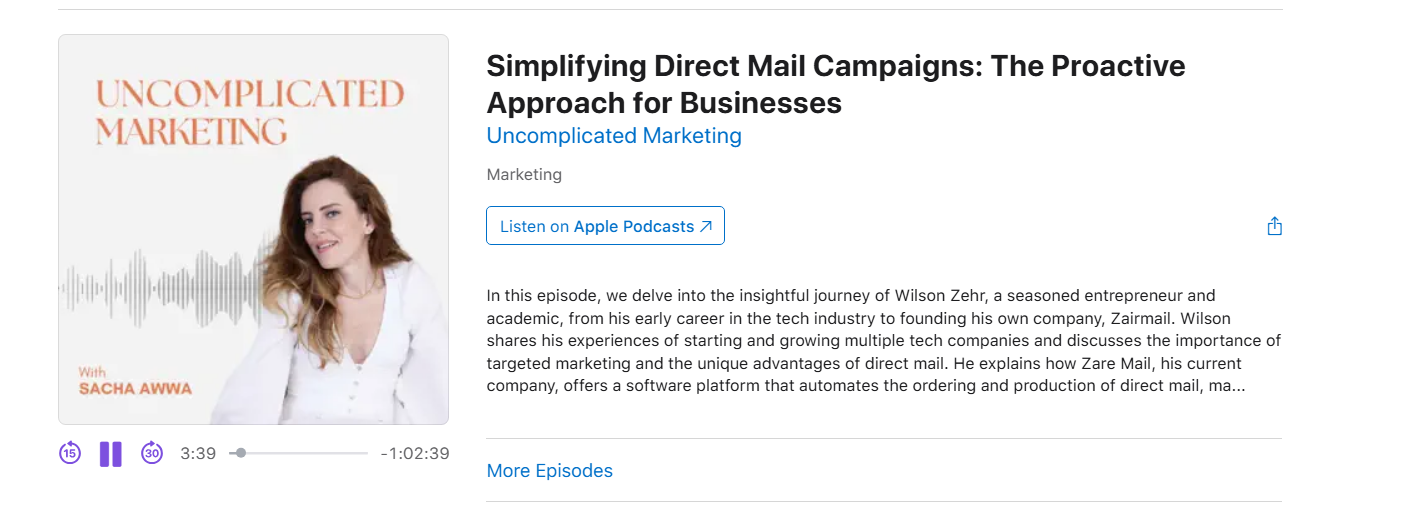
Episode: #14 – Simplifying Direct Mail Campaigns: The Proactive Approach for Businesses
Published: June 26, 2024
Guest: Wilson Zehr, PhD
Guest’s businesses: Zairmail and Cendix
Guest’s title: Entrepreneur, Technology Executive, and Direct Mail Industry Expert
Host: Sacha Awwa
Duration: 1 hour, 6 minutes
Apple Podcasts: Uncomplicated Marketing: Simplifying Direct Mail Campaigns: The Proactive Approach for Businesses on Apple Podcasts
In this episode, we delve into the insightful journey of Wilson Zehr, a seasoned entrepreneur and academic, from his early career in the tech industry to founding his own company, Zairmail. Wilson shares his experiences of starting and growing multiple tech companies and discusses the importance of targeted marketing and the unique advantages of direct mail. He explains how Zare Mail, his current company, offers a software platform that automates the ordering and production of direct mail…
Listen on demand Here: Uncomplicated Marketing: Simplifying Direct Mail Campaigns: The Proactive Approach for Businesses on Apple Podcasts
Free Direct Mail Sample Kit
See direct mail before you send it
Get samples of direct mail postcards and letters, plus service details to help you launch your first campaign. Your kit ships free by USPS.
Request Your Free Sample Kit →Click to View Full Episode Transcript
Podcast: Marketing Uncomplicated
Episode: Simplifying Direct Mail Campaigns — The Proactive Advantage
Host: Sacha
Guest: Wilson Zehr (Seasoned Entrepreneur, Academic & Founder of Zairmail)
[00:00:00] Sacha: This is Marketing Uncomplicated. Thanks everybody for joining back on Marketing Uncomplicated [00:00:00]. Um, I have a guest today which I think is going to be a great conversation [00:00:10]. We’ll dive back to some interesting pieces of, uh, marketing, and we’ll dive a little deeper into what Wilson has set up as a great entrepreneur in his career [00:00:10]. So, Wilson Zehr is a seasoned entrepreneur and academic with over 25 years of experience in technology marketing and business strategy [00:00:17]. He has started eight major tech companies, raising over 60 million in venture capital [00:00:23]. Zehr holds a PhD and currently teaches entrepreneurship and marketing at Eastern Oregon University [00:00:31]. Welcome to the show, Wilson [00:00:40].
[00:00:40] Wilson: Yeah, thank you. Thank you for having me [00:00:40].
[00:00:49] Sacha: Yeah, good to see you, too. I appreciate it. So lots to unpack there, um, and obviously I want to hear, you know, more about the current company that you’re doing right now [00:00:50]. So why don’t we—why don’t we take a—take a step back and just talk about where you started, Wilson, um, and then how you grew all these companies, um, and what these various different companies were all about [00:00:56].
[00:01:07] Wilson: Wow, that’s—that’s a broad brush, for sure [00:01:07]. Um, where do you want me to start? [00:01:15]
[00:01:15] Sacha: Start—start with maybe the first company that you raised VC for [00:01:15].
[00:01:28] Wilson: Yeah, we can, uh… um, well, let me—let me, um, give you a thumbnail sketch and then we can dig into any one of them you want, yeah [00:01:28]. So I did, um… I have an undergraduate degree in finance and a minor in computer science from Portland State University [00:01:36]. Um, even though I had a degree in finance, my first job was in—uh, was a software engineer [00:01:41]. Um, it just… I had a couple of different job opportunities, and with software engineering, um, I had a—had a great offer [00:01:48]. It was flex time, um, and, um, you got to go to work in shorts, you know, casual, so it’s like: maybe that’s the answer for me [00:01:56]. So I did that for five or six years, went back for my MBA, and, uh, went to work in marketing really, first at—at the software company I worked for, a company called Verdict [00:02:11]. And Verdict was a—a company that made compilers. Are you familiar with the term compiler? [00:02:17]
[00:02:24] Sacha: No [00:02:24].
[00:02:24] Wilson: Okay. In—um, at its most basic level, what a computer understands is zeros and ones [00:02:24]. And so—but what a software engineer understands, or somebody who’s writing code for a computer is, um, is something higher level than that—English or some language [00:02:33]. Um, you—a lot of what we do these days is we write, um, programs in higher-level languages, and then a compiler takes that higher-level language and turns it into the zeros and ones the computer understands [00:02:39]. Um, we won’t spend a lot of time on the idea of compilers versus interpreters or things like that, but um, basically the—what the tool we built was for a language called Ada [00:02:54], which was mandated by the Department of Defense for all mission-critical and embedded systems applications [00:03:10]. So there’s probably some of my stuff still flying around somewhere, I’m sure [00:03:17]. Um, after that, I went into marketing. I went to a company called Cadre Technologies [00:03:18]. I—I worked on a set—I was product line manager, worked on a set of software automation tools [00:03:26]. Basically, our tools worked with maintenance and reverse engineering of existing code [00:03:34]. Um, did that for a couple of years, then went to work for a company called Sequent Computer Systems [00:03:40]. Sequent Computer Systems made symmetric multiprocessing computers [00:03:40]—the best computers to run an Oracle database at the time, and it was at the time when Oracle was going up [00:03:47]. And so, um, I managed a global relationship with Oracle Corporation, which is a $300 million business for Sequent, give or take [00:03:57].
[00:04:02] Wilson: Um, and then that was about the time, you know—was after I was at Sequent a couple of years—was about the time the internet was taking off, so 1995-ish [00:04:02]. And so I went to—got together with a couple of friends and worked on a startup, um, that did Voice over IP applications and servers [00:04:15]. The organization was jointly funded by Microsoft, Intel, France Telecom, Telecom Italia [00:04:23], and our customers were some of the largest telephone, uh, operators and internet service providers in the United States—well, in the world, really [00:04:33]. My clients were mostly in the United States and Canada, but we did work with some overseas as well [00:04:42]. Um, that company was eventually sold to a larger company for about $160 million [00:04:48]. Um, then I got together with a couple of friends, we did a startup called, um, Zairmail [00:04:57], which is jointly funded by Hewlett-Packard and Draper Fisher Jurvetson [00:05:04]. And Draper Fisher Jurvetson, or DFJ, was, um, tier-one California VC [00:05:04]—they funded stuff like Skype, and Efax, and Hotmail, just a bunch of stuff like that [00:05:12]. Um, so we managed to grow that one, did a couple of acquisitions, um, and sold it to our largest production partner [00:05:12]. And then I worked on—started another company called Cendix, a software company that, uh, created this category of software called web-to-print software, and we offered a software as a service very early in that space [00:05:29]. Um, and oddly enough, we eventually got Zairmail back [00:05:37].
[00:05:46] Sacha: Okay, I was just about to ask that [00:05:46].
[00:05:46] Wilson: And reimplemented it on our current platform, turned it on, and orders started coming in, so we thought, “Well, maybe we’ll have more of that.” [00:05:46] Yeah, and, um, along the way I did—I’ve just done a lot of teaching and a lot—helped a lot of other people with startups, and you know, had a lot of opportunity to, uh, do something I really enjoy doing, which is, you know, creating new ideas, working with new technology, and creating new businesses [00:05:59].
[00:06:15] Sacha: Very cool. So just to dive in a little bit more with Zairmail, when you say that you—that you got it back, what was the process of that? So you obviously sold it, and then did you—did you buy it back or…? [00:06:15]
[00:06:22] Wilson: Yeah, it was—it was kind of an odd deal where we sold it to our largest production partner [00:06:22]. Um, they were subsequently acquired by somebody else, who was subsequently acquired by a very large production partner, um, printing company, and one of the largest in the United States [00:06:32]. And they just didn’t know what to do with it [00:06:40]. I mean, it was a rounding error for them and—and it was complicated [00:06:40]. And so basically, we got it back for the cost of the URLs and the trademarks [00:06:47].
[00:06:51] Sacha: Oh, that’s great [00:06:51].
[00:06:51] Wilson: Yeah, we didn’t need their software because we had our own platform, um, yeah, so we just reimplemented on the new software and that worked pretty well [00:06:51].
[00:07:04] Sacha: Yeah, so what sets Zairmail apart from your competitors in the industry, and how are—how are you guys doing things differently? I guess now that you—you’ve got it back in your—in your court, and what are the things that you’re changing when you first launched versus today? [00:07:04]
[00:07:18] Wilson: I think that, you know, the key difference is that Zairmail’s really… it’s a software company, right? We’re—um, we manage a network of production partners, and because of that, we can choose the partners that are the best suited for each job [00:07:18]. Whether that means the—the ones that are closest to the destination where the mail would be delivered… and we’re talking—um, just to be clear, we’re talking about mail: letters, postcards, self-mailers, not email [00:07:41].
[00:07:47] Sacha: Yes, exactly. Yeah, it seems like in the early days there was some confusion about that [00:07:47].
[00:07:56] Wilson: That’s why we have—have to have postal artifacts on our website, yeah, on other offerings [00:07:56]. Um, oh, that people were thinking that you guys, uh, did email marketing versus—um, yeah, exactly, direct mail, okay, yeah [00:08:01]. So we, um… you know, so we have a distributed network of production partners. We’re integrated with software, so somebody who comes into our site would be able to, um, upload a document, upload a list, see a pro—proof in real-time, be in the mail tomorrow, the next day, and it’s, you know, and at a—at a cost savings as well [00:08:09]. Traditional printers, commercial printers, if you went to—to someone to get a job like that done, first of all, if—if it’s too small, they don’t want to deal with it because there’s—it’s too big a hassle, um, and the margins are not high enough [00:08:32]. Um, but often you’re talking 7 to 10 days, and literally, we can be in the mail tomorrow [00:08:52]. And in fact, when we—when we’re producing through this network, if I have a customer that’s in Virginia, for example, I can route those letters electronically and produce them in delivery in Virginia, and they look like an overnight delivery in Virginia [00:08:58].
[00:09:12] Wilson: Got the US Postal Service… interesting stat. I mean, when I was a kid growing up, people joked about this—the US Postal Service, you know, how bad the service was [00:09:12].
[00:09:19] Sacha: You know, they still are joking about it. I think the Postal Service is the one system that hasn’t—that hasn’t enhanced themselves or hasn’t really changed from their internal structure and process [00:09:19].
[00:09:33] Wilson: Yeah, they did, uh—they used to call it snail mail for a while [00:09:33]. In fact, I have a friend that runs a company called SnailWorks—they do mail tracking [00:09:41]. Yeah, um, the Postal Service doesn’t really like that term [00:09:41]. I remember one year we did a, you know, we were doing Christmas gifts, and I made these—these mugs. I still have some here somewhere, I’ll have to send you one [00:09:48]. They’re mugs, and I put like—um, we put hot chocolate with the little marshmallows in it, you know, and—and something else [00:09:55], um, and on it, it says: “Zairmail: taking the snail out of mail.” [00:10:00]
[00:10:06] Sacha: Yeah, that’s amazing [00:10:06].
[00:10:06] Wilson: And I sent one to my friend who was then VP of Marketing at the Postal Service, and he got really mad! He sent it back [00:10:06]. Yeah, he said, “That’s not funny.” [00:10:14] Yeah, I’m sure. But anyway, that’s a kind of mistake it’s better not to make twice [00:10:14].
[00:10:31] Sacha: Yeah, yeah, that’s totally true. Um, is he still the VP of Marketing there? [00:10:31]
[00:10:31] Wilson: No, I don’t think so [00:10:31]. Um, the—the thing is that the Postal Service… because, you know, um, the post—US Postal Service handles about 40% of the world’s mail, so they have to be incredibly efficient [00:10:38]. And with the automation and the postal barcodes, etc., they’re—you know, they do a much better job these days [00:10:50]. I um… I think if we look at our production network, we’re pretty much three days anywhere in the continent of the United States [00:11:05]. If we mail locally, we’re next day 95% of the time, so that… you know, if the mail’s properly prepared and presented, it moves pretty well [00:11:09]. Of course, if somebody’s just scribbling a name on the front of an envelope and puts a postage stamp on it, it’s not going to move the same way [00:11:16]. Um, so—so yeah, in—in fact, I went to… I was in the postal office in Portland, Oregon, one time, and I asked the guy—I said, you know… I mean, it… you know, the—they had mail—mail in—in a postal business mail entry unit like that, everything’s on big pallets and they’re moving around with forklifts and stuff [00:11:32]. And I said, “Man, you know, this place is looking pretty organized these days. Used to just be, you know, kind of a madhouse.” [00:11:53] And he said, “Well, you know, we—we have to—we have to be efficient because we do so much mail that if we were to stop for one day, it would just bury us.” [00:11:58]
[00:12:04] Sacha: Yeah, it would be so chaotic [00:12:04].
[00:12:04] Wilson: Yeah, so yeah, so that—that’s interesting, and it’s also… there’s a lot more to it than it might look like [00:12:09]. I mean, when we first got into it, we’re—we’re like, you know, software engineers, tech guys, we’re like, “It’s mail, how hard can it be?” [00:12:18]
[00:12:22] Sacha: Yeah. What was the—what was the, um—what was the, like, tipping point for you guys to start Zairmail back in the days versus, like, when you—when you acquired it back like now? What is the—what is the differentiation of like what you guys are pushing now? Like, what are you seeing back then versus seeing what you’re seeing now? [00:12:22]
[00:12:48] Wilson: Well, we started out to do something diff—a little bit different. I mean, the first product we designed was um… was really designed as a consumer application, and so the basic idea was… somebody… that’s how we got DFJ involved [00:12:48]. DFJ worked on a bunch of, um, free services pre-bubble on the internet. So Efax was a free fax [00:12:55], yeah, you know, Skype is a free phone call over the internet, etc. Um, and so we were supposed to be the next in—in those line of free services [00:13:10]. And the basic idea was that somebody’s… you know, would come to the site and—and, um, they’d want to send a letter, and we would say, “Would you like to pay for this—this letter, or would you like to, you know, give the recipient a gift?” [00:13:16] “Oh, I’d love to give them a gift.” So we say, “Okay.” So we write the letter, and then when they—they go to send it, we will take the name and address of the recipient, do a reverse lookup in a demographic database, and then pull ads that are perfectly targeted to that recipient [00:13:36]. And we put a second sheet of paper in the envelope that had those ads on it, which is our gift, right? [00:13:48]
[00:13:56] Sacha: Yeah. And so then we would… so that that was your, like, um… what—what is—what is today now when you, like, subscribe to a newsletter, when you opt-in? So that’s kind of like the old-school opt-in to get marketing kind of…? [00:13:56]
[00:14:08] Wilson: Yeah, but it was unique at the time. The technology—the technology was kind of new to do demographics and demographic lookups, so the idea that we would take somebody—the… and not the sender, but the recipient, and look up their demographic profile and use that to pull ads was pretty unique [00:14:08]. We had a patent application for that at the time, um, so that kind of took off [00:14:28]. We— we got quite a bit of traffic on that. You imagine you’re giving something away free—people like that [00:14:34]. Yeah, um, and—and the—and the ads really were useful. I mean, that’s the—that’s the difference [00:14:40]. Everybody hates spam, but if you’re looking for a couch and somebody sends you a hundred dollars off on a couch, you know, a hundred-dollar coupon for a discount on a couch, you’re going to be happy to get that, sure [00:14:48]. So if you can make sure that you’re giving people things that are relevant, then they don’t dislike it—they actually appreciate it [00:15:01]. Yeah, um, so that’s what we started out doing [00:15:07].
[00:15:07] Wilson: The problem is, on the internet, that um… well, when you have that model, in order to get enough advertising in the database to be able to fund every letter, um, it’s hard at the beginning [00:15:07]. You needed inventory—advertising inventory, yeah [00:15:23]. And so we had to fund a lot of postage stamps, you know, in that startup process [00:15:23], and then that was… we kind of got hit with the triple whammy in that timeframe, which was um… the dotcom meltdown, and then there was 9/11 [00:15:31], yeah, and then in our industry, there was the anthrax scare [00:15:45]. I don’t know if you remember that. [00:15:45]
[00:15:53] Sacha: Yes, I do [00:15:53].
[00:15:53] Wilson: When I—when I… what, what I think there was one that was delivered to the White House, or was it the Pentagon? Either—yeah, either one, yeah [00:15:53]. And postal carriers were killed and stuff because of this white powder that was in the envelopes [00:15:59]. Yeah, and the unique—the interesting thing about our stuff is we didn’t touch any of the envelopes, right? They’re produced in a commercial facility, yeah, so there’s, you know, virtually zero possibility that they would have anthrax, um, so it turned out to be a marketing benefit longer term [00:16:06]. But in the meantime, you know—longer term—but in the meantime, it kind of slowed down the whole environment [00:16:26]. And because when you got the dotcom meltdown, capital became very expensive as well, so it becomes harder to give away postage stamps, sure [00:16:26].
[00:16:39] Wilson: However, we did have a second product line, which was Zairmail Express Direct, which was the direct mail stuff that we sell today [00:16:39]. And we—our largest competitor at that time was a company called E-Letter [00:16:46]—they were funded by Hummer Winblad, and I think they were burning through $20 million a quarter or something [00:16:46].
[00:16:52] Sacha: Wow [00:16:52].
[00:16:52] Wilson: So they hit the wall about a hundred miles an hour, and we were able to acquire, you know, what was left of E-Letter [00:16:52], yeah, and combine that with Zairmail to build a—build a startup that was more self-sustaining from a revenue standpoint [00:17:07], yeah, and managed to grow that [00:17:13]. Um, so this is, you know—this is an extension of that idea, and um, the current Zairmail, obviously, we have a lot more features and it’s a lot more robust [00:17:13]—um, a lot more volume, yeah, and it’s all based on real-world applications [00:17:32].
[00:17:32] Wilson: So, uh—let me—let me say this: the software itself is web-to-print. So web-to-print automates the ordering of print products, and that could be business cards, it could be logo items, t-shirts, whatever [00:17:32]—it could also be um, mail [00:17:55]. And so if we look at the Zairmail site, that’s implemented in our software that does mail, but we do host other customer sites that have other applications [00:17:55], yeah. And we spent a lot of time building that technology so it could be general, and so it could be customized very quickly [00:18:01]. So if somebody comes in, they want a new white-label site that’s going to do a channel marketing portal for their franchisees, we could set that up in probably less than 30 minutes, heartbeat, yeah [00:18:08]. Um, but we have been focused more on the Zairmail, and then we did um… we were able to—to create an application that we call Speedy, that’s really a desktop application, too [00:18:20]. So if somebody wants to send a letter, all they have to do is take their file and drop it on the icon, and it says, “Do you want to upload this or do you want to send it?” [00:18:36] So you want to send it um, out it goes—it just turns into a letter and, you know, and makes its way to its destination [00:18:48].
[00:18:53] Sacha: And it’s written and everything, or it’s just like printed and signed? [00:18:53]
[00:19:00] Wilson: It can be handwritten—I mean, if you… but it needs to start out in digital, yeah [00:19:00]. So if you want it to look handwritten, you can use a handwriting font, or you could use—or you could handwrite it and scan it, I suppose that would work, too, okay [00:19:06]. Um, but when we think about sending a letter, um… well, first of all, if we look at that marketplace, you know, there’s—there’s something called a postal meter that a lot of companies use, yeah [00:19:18]. So our history, besides the very beginning of the company, our history’s almost always been B2B, yes [00:19:24]. And so when we look at this application in a lot of companies, they’ll use something called a postal meter [00:19:30]. The company that has owned that marketplace for maybe a hundred years is Pitney Bowes, okay [00:19:39]. Um, I don’t know if it’s quite a hundred years, but it’s up there [00:19:45]. And at any rate, so a postal meter really allows organizations to manage their postal costs because postage is like cash [00:19:45], and so a lot of large companies worry about where their postage is going, so they’ll take this machine and—and, um… it’s kind of a longish machine, you—you run an envelope through it and it—it puts postage on it [00:20:03]. And these days… back in the old days, you used to have to take a piece of the postal meter into the post office and they would fill it with postage, so you would—you would pay at the counter and they’d give you a certain number of credits and you’d go back and plug this into your machine [00:20:15]. These days, I think it actually, you know, refills over the internet—it’s got a, you know, connection, yeah [00:20:30].
[00:20:35] Wilson: But still, I mean, when you think about um, sending a letter, postage is a relatively small part of the problem, you know? You—you have—you still have to… you have to print it, fold it, insert it, address the letter, then you have to find a stamp, then you have to get it in a mailbox somewhere [00:20:35]. But it should be easier than that [00:20:56]. I mean—I mean, we can automate the—the printing, folding, mailing, all that production piece, yeah [00:20:56]. So if you can provide us with the content, we can make the rest of that really easy, and we don’t think there’s any reason for somebody to have a Pitney Bowes machine [00:21:01]. I—I think, you know, at the end of the day, you should have some version of Speedy, and I think it’s going to save time, it’s going to save money, um, it’s going to get there faster, yeah, just make—exactly [00:21:08]. And the production is going to be, you know… the—the letters we produce will be—all be optimized for the mail, too [00:21:29]—they all have a barcode, the address is correct, they’re the right format, they don’t go through the retail post office [00:21:35]. They go through the business mail entry unit where they’re all pre-sorted and bundled, and sure, yeah, yeah [00:21:35].
[00:21:47] Sacha: Who are the biggest customer base that you guys work with from a direct mail standpoint? [00:21:47]
[00:21:47] Wilson: Uh, traditionally we’ve—um, the company Zairmail has worked more with small to medium business [00:21:47]. So traditionally, we’ve done a lot of work with realtors, mortgage brokers, independent insurance agents [00:21:57]. Um, but really… I mean, you know, so—so there’s some concentration in those industries forever [00:22:04]. You know, if a—if a realtor gets a listing, they have, you know, just-listed postcards they want to send out, or just-sold when they sold it, or, you know, they’ll do use it as a marketing tool [00:22:13]. They’ve got a client who wants to be near a certain school, and so they’ll send out a note asking people if they want to sell, yeah [00:22:24]. Um, so that industry has always used mail in that way, and it… I mean, we didn’t touch this, but there are certain things that mail does that—that no other tool really does, yeah [00:22:30]. Um, did you want me to—to throw this out here? [00:22:44]
[00:22:44] Sacha: I do, no! I want to hear about it—like, why—why direct mail? I mean, because you are going to answer a question that I was going to ask, so—but go ahead [00:22:44].
[00:22:55] Wilson: The thing about direct mail is that, um… first of all, it—it’s, um… direct mail can reach every consumer in a business—six days—every consumer and business in America six days a week, yeah [00:22:55]. So no other medium really does that [00:23:14]. Um, even you think about email, search engines, things like that—they—they really don’t have that kind of reach [00:23:14]. Secondly, it’s proactive. I don’t have to wait for people to find me [00:23:24]. If I’m doing, you know—if I’m doing, um, AdWords or, you know, search engine marketing, I really have to wait for somebody to go to a search engine, type in a term, and then direct, you know, get—get their attention to my site, yeah [00:23:32]. But with direct mail, I—I can reach out and touch them—I don’t have to wait for that [00:23:42]. Thirdly is, um, demographic targeting [00:23:49]. You know, the demographics for—for mail are very well-developed [00:23:49]. If I need to reach Jewish dentists in New Jersey who’ve purchased a car in the last six months, I can get that list [00:23:58].
[00:24:05] Sacha: Yeah, you can really… I think a lot of people misconstrue that you can segment down your—your outreach, thinking that digital is the only way to do it, where—where in fact, I think because, uh, marketing on Facebook has taken away things like, you know, being able to target somebody by their household income and certain like demographics, you—you still have that ability through direct mail [00:24:05].
[00:24:35] Wilson: Yes, exactly. You should have that available with most tools—it’s just more available with mail, yeah [00:24:35]. So if you think about direct response, any kind of direct response—direct response doesn’t have to be mail, direct response can be TV, or radio, or, you know, any—any medium [00:24:45]—but you know, if you think about the components of success, about 70% of it is—is probably the list, yeah [00:24:51]. Another 20% is the offer, and whatever’s left is creative—which is really kind of odd, because everybody focuses on the creative, yeah, you know? [00:24:58] And—but the—the most important piece is putting the right offer in front of the right person [00:25:07]. Um, sometimes when we’re doing, for example, mortgage marketing, there’s… you can use credit score data if you’re a bank, right? [00:25:15] And so you can use the—you can look at people, the length of time they’ve been in a house, or you can look at when they first got their loan to estimate the interest rate they’re probably at, yes [00:25:31]. And then you can look at their criteria—you know, you know, FICO score, 30-day lates, bankruptcies, that kind of thing, and pick only people that you know underwriting can underwrite, yes, exactly [00:25:36].
[00:25:50] Sacha: And which is what you can’t do on digital—you can’t do that on digital marketing [00:25:50].
[00:25:54] Wilson: No, I haven’t seen anything that would work like that, no, yet, yeah [00:25:54]. So, um… and people try. We do, you know—we do sometimes, we’ll do an append [00:25:58]. So we’ll take a mailing list and we’ll try to do an email append to it, but the match rates are still not very high [00:26:06]. And the—the—the challenge with email is that, you know, first of all, if people—if it’s tied to a company, people switch jobs and stuff, and that email address changes, yes [00:26:18]. But also, the average person has something like 2.7 email addresses, you know? People might have one on Gmail and one here and one there, and so which one do you use? [00:26:24] You know, it’s kind of hit-and-miss [00:26:38]. And then if you do come up with a list, you know you want to use, you know there’s all these, you know, industrial-strength spam filters in the internet, too, so something like 30% of even legitimate email is never delivered, sure, um [00:26:38]. But you’re not going to run into any spam filters with direct mail [00:26:50]. No, I mean, you’re just not going to… you’re not going to deliver to an incorrect address, right? So yeah, exactly [00:26:59].
[00:27:05] Wilson: And the—I guess the final piece is that it’s just built into the American psyche [00:27:05]. You know, the Postal Service would call it the “mail moment,” when people get home and they look in the mailbox and see what they got [00:27:12]. Um, there’s still that nostalgic effect to it, right? [00:27:18] I’m not sure it’s quite as celebratory as the Postal Service would have us believe, but most people are used to it [00:27:18]. I mean, they—it’s not a ne—negative reaction because it’s just built into the culture, yeah [00:27:33]. Um, whereas you know, these days, you do telesales and you call somebody at home, interrupt their day, yeah, you’re going to get an earful of it, you know? [00:27:37] People just appreciate that, yeah, totally [00:27:43]. Um, so that combination of elements makes it—the mail—a very unique tool, especially for marketing to consumers [00:27:43]. Um, so that’s, you know… we see a lot of people using it that way [00:27:50]. Um, I’ve told you about our traditional, um, verticals, but we get all kinds of things, too [00:28:01]. We’ve got, you know, funeral homes, and hearing aid centers, and I saw one yesterday for a volunteer fire department [00:28:08]—I mean, there’s just all kinds of… [00:28:16]
[00:28:16] Sacha: So it is really cost-effective from the standpoint of, like, you don’t have to send out volume to really get the reach that you want to reach [00:28:16]. Um, and so, like your mom-and-pop’s bakery in the neighborhood, let’s say, for example, one opens down the street from me and they want to target a bunch of the buildings in that radius, then it’s pretty cost-effective for them to do that? [00:28:28]
[00:28:36] Wilson: Oh, yeah. No, I think so [00:28:36]. I mean, the—the… the one thing is, though, that um… that you really want to be targeted because postage stamps cost money, I mean, you know? So—so there’s some cost to it, um [00:28:41].
[00:28:54] Sacha: But there is also some cost, like, from a digital standpoint, because you’re still paying like a—a cost-per-click or like a cost for when somebody signs up an email and stuff, and postage is what, 25 cents for a postcard, or depending on the size and so on? [00:28:54]
[00:29:13] Wilson: Yeah, just—it depends on the size. They’re going up again [00:29:13]. The current Postmaster General has been really aggressive about raising prices [00:29:13]—I think he—he thinks he’s going to break even [00:29:19]. Um, I’m not sure that that really needs to happen [00:29:19]. The Postal Service really is—it’s a, um… universal service, right? They have their—their job is to deliver to every household and business in America, yeah [00:29:26]. And if you’re delivering, um, you know, two letters to a—a rural house out in the country somewhere, that’s never going to be profitable, yeah [00:29:35]. But it’s a service we provide to our citizens, you know—communication service, yeah [00:29:42]. So, um… I don’t know, I’m whining a little bit about that, but I… yeah [00:29:50]. Um, still, I mean, you know, the postage here in the US is much lower than it is by international standards, I mean, we get a deal here, yeah [00:29:58]. Um, and the mail service is very effective, but we really do want to be targeted [00:30:05].
[00:30:11] Wilson: The thing about email—the reason why that, um, got—became so popular was that because it had a very low cost, right? [00:30:11] And you didn’t really… the thinking was: maybe I don’t have to target, maybe I could just carpet-bomb the world and hope people will get back to me, yeah [00:30:18]. But, um, that doesn’t really—it doesn’t really work that way, and that’s why spam gets such a bad rap, you know, yeah, yeah, yeah [00:30:33].
[00:30:41] Sacha: I mean, if you’re going to be sending out a ton of emails, you definitely don’t want to be hitting that spam wall or getting blacklisted in any manner, you know? [00:30:41]
[00:30:53] Wilson: Well, exactly. And—and yeah, um… and how many customers are there for performance-enhancing drugs out there anyway, you know? [00:30:53] Yeah, totally, totally. So I don’t know, I just—I I think, um, even with email we’re better off if we target, you know, if we—we have—know the people who need our product or service and, um, are in a position to purchase it, we’re almost always going to be better off [00:31:06].
[00:31:23] Sacha: Are there—are there such bundles that, like, smaller businesses can buy into to be able to utilize, um, you know, direct mail as a form of marketing for their brick-and-mortar business, or to just generate awareness? Or is it just the same cost across the board, or you know, what is—what is an opportunity for a small business to be able to utilize your—your service and your offerings? [00:31:23]
[00:31:50] Wilson: Oh, well, you know, if you have a piece—see, you know, you can design a postcard or a letter, you know, right in Microsoft Word, right on your desktop, yeah [00:31:50]. If you don’t want to use Word, there’s services like Canva, which is pretty popular these days, to help you design a piece [00:32:03]. Then you can use a service like Zairmail to automate the production of delivery, um [00:32:08]. The best… you know, if you get large volumes, there are definitely discounts for volumes—for larger volumes—but the biggest discount is 500 pieces, because that’s where the presort kicks in, yeah [00:32:15]. Presort is something called… go—go ahead, sorry [00:32:23].
[00:32:23] Sacha: Well, I was going to say, like a 4×6, which is like I think the standard postcard, um, and if somebody sends out 500, like what is—what is a small business owner looking at in terms of cost? [00:32:23]
[00:32:42] Wilson: Um, I would say, you know, if you—if you’re sending out 500 postcards, you’re probably talking about $300, give or take, okay [00:32:42].
[00:32:52] Sacha: So that’s not bad. I mean, if—if you think that you’ve… because once they go on and they look at Zairmail, they can narrow down like who they’re looking for in terms of zip code and like all that kind of stuff—all of that can be done? [00:32:52]
[00:33:03] Wilson: Well, so there’s—we actually have a service on Zairmail that allows you to buy a list, okay [00:33:03]. Um, we don’t bundle them together, mainly because a lot of our customers already have lists, yeah [00:33:09]. If you’re thinking about like a realtor, a mortgage broker, or something like that, they usually come to us and they have their data already, yeah [00:33:15], and they have their piece, so they just need somebody to print it and mail it, so—so we do that [00:33:20]. But we do provide a service where you can buy, um, lists. We have—on the consumer side, we—our lists come from Acxiom, which is the largest consumer database in the United States [00:33:24]. On the, um, business side, we’re using Dun & Bradstreet [00:33:38]. So you can go in there and you can put in, um… um, for example, you mentioned the, um, little shop near you—you can do a radius search [00:33:38]. So you—you put in your street address and say, “I want everybody within, you know, a thousand feet or a quarter mile,” yeah, whatever, of that address [00:33:52]. And then you can add stuff to that, like you could say, “Only people with kids,” or “Only people with an income greater than this,” or, you know, um, just—just… there’s a whole bunch of criteria that you can use online [00:34:05]. And in fact, we actually limit the amount of things you can ask online because it just becomes too complicated, yeah [00:34:15]. But—but there’s probably a thousand or more different criteria that you could select people on [00:34:28].
[00:34:36] Wilson: The key is to understand what your customer looks like. You know, in marketing we talk about personas, right? Sure [00:34:36]. Idea: you try to describe who—who your customer is. But um, that can work here, too. I mean, if you know who your ideal customer is and the characteristics that help distinguish that person, you can just plug that into your search and pull a list that looks like that person, yeah, or those person—people, if there’s more than one profile, yeah [00:34:44]. Um, and then once you have that list, you’ve purchased it, at least through Zairmail, it’s yours to use for as long as you want, so exactly [00:35:00]. Um, we would usually say that you should refresh it at least once a year because people move and, you know, the data gets old, yeah [00:35:13]. Um, but certainly, um, you get a lot of use out of it um, for the year you are using it, or you could continue to use it, I guess [00:35:18]. It’s just a—a question of—of what the returns look like, yes [00:35:32]. You know, um, once you start getting too many returns, then it’s a good idea to continue to update because, once again, postage costs money, so every one of those ones that comes back costs you something, yeah, exactly, exactly [00:35:38].
[00:35:51] Wilson: But the reason why I said 500 pieces is because within the… what’s not immediately obvious when you’re working with Postal Service retail with stamps and stuff is that there’s something called, um, presort, which is really a work-share discount with the Postal Service [00:35:51]. So when the—you, um, submit a letter to the Postal Service, they have automated equipment that’ll try to use OCR to identify the address and to group them into, you know, into bundles that are going similar places so they can be very efficient [00:36:09]. Um, but what we do when we produce them is we, um, actually sort them and print them in the right order, okay, and then put barcodes on them [00:36:25]. And because we do that, we qualify for this presort discount, so we get a discounted postage rate, which we pass along to our customers, got it, okay [00:36:41]. Um, and that presort requires at least 500 pieces [00:36:48]. If you’re under 500 pieces—from 250 to 500 pieces—we can still use a postal indicia [00:36:48]. A postal indicia is the little square box you see on letters sometimes—it says: “US Postage Paid,” yes [00:36:57]. And that’s—excuse me—and that’s more efficient for us because we don’t have to put on a stamp, we can just print it on the envelope, so there is some discount for that [00:37:07]. If—if you’re under 250 pieces, then you have to use a live stamp, so that’s more expensive, yeah, yeah, yeah [00:37:22]. So if… um, it’s all—it’s—it’s always going to be less expensive using Zairmail than doing it for yourself [00:37:30]. Yeah, if you have 500 or more pieces, the post—you get the discount postage, yeah [00:37:39].
[00:37:46] Sacha: You mean like doing it for yourself, just going to the—to the post office yourself, right? [00:37:46]
[00:37:51] Wilson: Right, yeah. And I have a… because you’re not—you’re essentially not the… excuse me… oh, no, that’s okay… yep, there, a dry throat… yeah, no worries [00:37:51].
[00:38:02] Sacha: Because you’re not—you’re not getting—you’re not getting the list that you would, as you were get—you’re getting the support from Zairmail that is helping you kind of navigate that [00:38:02].
[00:38:09] Wilson: Oh, it’s um—what, more than that [00:38:09]. I mean, I—we just did a postal… um, we just did a piece for a symphony orchestra, okay [00:38:16]. They have their, um… you know, it’s in a local community here. They have on a quarterly basis, they’ll have a big production, and they send out postcards to invite people to it [00:38:24]. But if—if they weren’t to use our service, they would have to go to um, something like um, you know, Kinkos or some kind of local printer [00:38:32]. They would have to have those postcards printed. Then usually, they would have labels—the addresses would come in the form of labels—and then they’d have postage stamps, and then the ladies would who run the place would all get together at a big table and each take a stack, and they’ll go through and put labels and put stamps on them, and go through and do that whole batch of postcards [00:38:50]. And then they have to get it in the—in a mailbox, yeah [00:39:07]. And because they’re mailing it, and because, you know, a—through retail mail, and they don’t have a barcode or anything on it, it takes longer to get delivered [00:39:13], um, returns are higher, the pieces tend to get munched up a little bit because they’re not set up to deal with the automated equipment [00:39:24]. When they use Zairmail, they’re going to be able—they’re able to upload a piece, see a proof, push the button, and they’re done [00:39:32], yeah, they’re in the mail, yeah [00:39:39]. And so that savings of everybody’s time, and the cheaper postage, and the labels… you know, the product they’re going to produce is a much more polished product, too, because you won’t have all of those labels [00:39:39].
[00:39:53] Wilson: And when we… there’s one additional thing that we do, especially with postcards, what we learned, um, is that when you’re doing a short run… well, so the… sorry, I’m trying to unpack this a little bit [00:39:53]. So there’s, um… with traditional printing, um, people use—used to use an offset press, and so in an offset press you’d burn plates and then use those plates to produce the printed product [00:40:12]. The thing with plates is they have a cost to them, and so it makes very, you know, short, you know, short print runs very expensive [00:40:26]. So, I think about 20 years ago now, they started getting, um, digital printers, and digital printers have been getting better and better over time [00:40:32]. Today, the quality on a digital printer can rival some—some of the offset presses [00:40:41]. Um, and the thing about digital printers is that the cost is going to be relatively steady regardless of the volume, because you don’t have to pay for plates up front, sure [00:40:48]. However, you know, so anybody who’s doing short runs these days is probably using a digital press [00:41:04]. The problem with a digital press, from a mail standpoint, is that when they go through the mail, the Postal Service has this automated equipment that can scuff them, leave scuff marks on them [00:41:04]. Um, and while they’re still useful—you can still read them—it’s just not as, you know, as polished an effect as you would like [00:41:17]. So we tested all kinds of things—all different kinds of papers, and inks, and coatings—and finally, the only thing we could find that would stop that was UV coating [00:41:24]. So every postcard that we produce, unless it’s black and white, every produced postcard we produce is UV coated both sides [00:41:36]. And UV coating is like a thin plastic coating that serves two purposes in—um, in this case: it protects the card from scuffing in the mail [00:41:43], um, but secondly, it makes a card feel thicker and more substantial—so a more polished product [00:41:52]. So when we—we’re doing this postcard for this symphony, we’ll actually print the front and the back—we don’t even need labels because we can print—print the address right on the front of it, and then we UV coat it, we seal it all into the card, yeah [00:41:59]. So the product you get is very polished and professional-looking, much better than you could do at home or, yeah, you at the symphony orchestra building, yeah [00:42:13].
[00:42:25] Sacha: I love that, um… I just—I I I love digging in because obviously I love the analytics piece and—and—and getting more segmented in terms of, like, your outreach and who your—who your audience is, because it’s just becoming more challenging on—on the digital sphere, in the—in that world in and of itself [00:42:25]. Um, why do you think everybody should be using direct mail in terms of, like, marketing and stuff? So it’s like: how are you—how are you guys getting more, I would say, you know… how are you guys pushing your message out to the more unique places like the symphony orchestra, like the hearing aid pieces, to really start to think about that direct mail can be just as sexy, if not sexier, than a digital ad, and actually can have a higher return on investment for them, um, you know, to utilize that? What are you guys doing from a marketing standpoint to really get an inbound of—of clients into your database? [00:42:48]
[00:43:22] Wilson: You know, it’s a little trickier for us because we do use direct mail, yeah, but once again, we’re—we’re almost entirely business-to-business, too, yeah, yeah [00:43:22]. So we’re—we’re trying to reach businesses, not consumers, yes [00:43:35].
[00:43:35] Sacha: That’s what I mean—how are you finding your businesses? [00:43:35]
[00:43:35] Wilson: Um, so we—we will do various promotions [00:43:35]. We, first of all, every piece that goes out says “Zairmail” right on it, right in the indicia, yes [00:43:41], so we get, you know—it’s not much, but it’s—it’s something, yeah [00:43:49]. Um, you know, we’ll—we’ll use Google AdWords and we’ll use, uh, search engine optimization. The Zairmail site has been around for—for a long time. I mean, if you go on, um… with that, you have good site authority, yes, exactly [00:43:55]. I mean, the Wayback Machine—if you ever see the Wayback Machine online catalog sites that have been around a long time, yes, you can still see the Wayback Machine, you can still see Zairmail from ’99, yeah [00:44:10]. And—and you could see it over time how it’s changed, um, yeah [00:44:33]. So we have good site authority, we—we spend a lot of time doing articles, and videos, and other kinds of content to en—enhance that, yeah [00:44:33]. Um, and then we do a lot of, you know, targeted marketing. We find um, segments that we’re interested in and we’ll buy lists—mail lists, email lists—and we’ll do outreach and try to connect with decision-makers and, you know, help them decide to use our product, yeah [00:44:39].
[00:45:02] Sacha: What has been your most successful in terms of a marketing channel for you guys? [00:45:02]
[00:45:02] Sacha: …What has been your most successful in terms of a marketing channel for you guys? [00:45:02]
[00:45:07] Wilson: Well, we have—today we have an email list, we have a newsletter that’s published at least once a month, sometimes twice a month [00:45:07]. And it reaches out to 200 small-to-medium—200,000 small-to-medium business customers [00:45:17]. So when we send that out on a, you know, bi-monthly basis, we’ll—we’ll usually see a big spike across the site [00:45:25], you know, thousands of people that visit, so that—that’s been useful for us [00:45:33]. And then other than that, just targeting. I mean, we know certain segments that—that are interesting to us, then we’ll do targeted articles, we do, um, postcard campaigns or other things—just, you know, kind of a guerrilla marketing [00:45:40].
[00:45:53] Sacha: What has been, um, the most interesting, um, business that you guys have brought on in terms of, you know, them testing out the—the direct mail marketing channel for themselves that they’ve seen great success, that they didn’t think that they were going to coming in and testing the market? [00:45:53]
[00:46:10] Wilson: Well, I think, um—I think we’ve done historically… we’ve seen done a lot of work with mortgage brokers, and—and that’s a pretty good segment [00:46:10]. I mean, the data is readily available, um, and especially in an environment where there’s low interest rates, that can be very effective [00:46:22]. The challenge right now is, of course, interest rates are high, so you know, if you’re trying to sell cash-out refi, this is not the right environment for that—that gets a little trickier [00:46:29]. Um, if you’re a mortgage broker, you have to shift towards new originations, you know, new—new money, which is hard because you can’t anticipate when people are going to buy a home [00:46:36]. Probably you end up working with realtors and building relationships that way, yeah [00:46:50]. Because the cycle of buying a home is—it’s not, uh—it’s not a… what—what’s the word I’m looking for? I mean, it’s—it’s not like a timed kind of cycle. It’s its own unique cycle based on families, right? [00:46:57]
[00:47:17] Wilson: Well, there’s a—there is… I mean, I—I think you’re right to some extent [00:47:17]. I mean, people don’t… it’s a bigger purchase, so I mean, people have to think it through, so it’s not an impulse purchase, for sure [00:47:26]. There is a specific buying cycle for homes because people don’t like to move their kids, um, while they’re in school or over the holidays, so there’s the, you know—the big season for home buying is usually summertime [00:47:34]. Um, but it is, you know, relationship-based, I think, so a lot of people find their mortgage broker or their lender through their realtor, through relationships a realtor might have [00:47:48]. Whereas when I’m doing something like a cash-out refi, that’s—that’s kind of a… it’s more data-driven, so I can look at interest rates, I can look at existing loans, I can look at scores, and I can identify the people who need the product or service that I’m selling, yeah [00:47:56].
[00:48:17] Wilson: Um, now we do have some banks that are doing on the buy side, too. For example, um, there’s something called database triggers [00:48:17]. So a bank will take their whole database—their list of customers—and they’ll upload it and set it up as a trigger so that when any of the customers in their portfolio runs a credit report, um, it’ll get a flag, and then they can—the bank can reach out to them and say, “Hey, you thinking to buy something new? We can help.” [00:48:25] Yeah. So that’s, you know—if you can get—if you can get people right at the point where they’re ready to make a decision, that’s a really good thing [00:48:46]. Yeah, it’s good for the consumer, too, by the way, I mean, totally—totally [00:48:52].
[00:49:03] Sacha: Where do you see um, or where—twofold—where have you seen technology move over the time that you’ve owned Zairmail to to really kind of increase business, and where do you see technologies going in support of direct mail and mail as a marketing channel? [00:49:03]
[00:49:19] Wilson: Well, for us, I mean, we—we use automation to increase the efficiency, to increase the turn times [00:49:19]. I mean, we—we—we’ll we’ll do some very large orders where we do them next day or the day after, sure [00:49:28]. And that would have been impossible 20 years ago, even 10 years ago, yeah [00:49:35]. Um, so through automation, we’re able to move bigger orders faster, and we’re able to get them delivered more efficiently, too, because of the way the network is used, um—the production network we have [00:49:40].
[00:49:48] Wilson: Um, we also live in an era where we can get more data on, um, network performance, so we—we can get data from the US Postal Service on when things were submitted, when they were delivered, where they’re running slow, where they’re running fast [00:49:48]. So we’re doing a lot of work right now on trying to, um, create predictive algorithms to help us understand how the mail’s moving and how to make it move more efficiently [00:50:04]. Yeah, so we we’ll just get better over time, especially as the, you know—amount of data available increases, yeah [00:50:18]. um, you know, so we have more data to work with, and we know how to harness it, we can get more and more efficient at doing that [00:50:24].
[00:50:36] Wilson: Um, in addition, being able to build things—I mean, if you look at our stuff today, we—we have—we’re able to take orders and slice them and send different pieces to different places, which will allow us to make a batch more efficient, but also makes it so there’s no single point of failure, you know? More reliability, capacity is not an issue, we have tons of capacity, yeah [00:50:36]. Um, so in that— [00:50:56]
[00:50:56] Sacha: Speed is truly important at the end of the day because, you know, you are competing with people with the mindset of like, “Do I send out an email versus do I send—do I do digital marketing?” And so here, knowing and being able to make time go faster in terms of delivery becomes even more important [00:50:56].
[00:51:18] Wilson: Yes, it helps. I think the problem with the email with some of these applications is it just—the reach is—is not what it needs to be [00:51:18]. So I can give you an example: we worked on a school bond measure, um, two years ago now, I think, in a local community [00:51:27]. And what we were able to do was go down and, um, was, you know—buy a list of the voter file, so all of the registered voters in the county, yeah [00:51:38]. The county has a record of that, so we just buy that, and then we do an overlay [00:51:43]. We say, “Well, school bond, you know, is really going to be paid for, um, by property owners, at least here [00:51:51]. Um, so let’s take that list and let’s do an overlay on it and look at who owns property and who doesn’t [00:51:57]. And within those groups, let’s also look at who has kids in school and who doesn’t [00:52:04]. So the people who have property and have kids in school, they’re probably fine with paying for a bond, right? [00:52:10] And the people who don’t have property and have kids in school, they’re fine, too, because their kids are going to get a benefit, but they don’t have to pay for it, yeah, true [00:52:15].
[00:52:28] Wilson: So, but we’ve got this—these other groups that are, you know—so we’ve got a whole bunch of homeowners that are maybe older and they don’t have kids in school, so they have to understand what the value proposition is for them [00:52:28]. So we can, you know—we can give them a different message than we give the other audiences [00:52:37]. Or people who, you know—who don’t have a home and—and don’t have people in school, they’re kind of a wildcard. But in that case, you appeal to their, you know—their sense of community or sense of patriotism or whatever that messaging might be that would help them, um, want to help their neighbors even if it’s not helping them directly, yeah [00:52:44].
[00:53:03] Wilson: And then in terms of timing, you know, here in Oregon we—everything is vote-by-mail, and I know when those ballots are going out [00:53:03]. So I can… a lot of people will—will will vote as soon as they get a ballot in the mail, they’ll just mark it up and drop—drop it off [00:53:10]. Some people put it, you know—want to think about it, they’ll put it on the desk and, you know, not worry about it till the day before the election’s due [00:53:23]. So I know that I can get out there, I can send them a postcard with this messaging. I could send it to them the same day they’re going to get their ballot in the mail, or the day before, yeah [00:53:32]. And then I could touch them over time, and I can give them one last boost at the end right before the election, absolutely, you know, before the ballots are due, yeah [00:53:42]. So I can start with the election and work backwards and—and create a customer journey—a very targeted campaign that speaks exactly to those consumers, yeah [00:53:47]. And you can’t do that with any other medium—no, I love that—I don’t know an alternative way to do it [00:53:53].
[00:54:01] Sacha: Well, not as—not as personalized and as timely as that [00:54:01].
[00:54:06] Wilson: No, I mean, you—the county doesn’t have a list of emails for registered voters, true [00:54:06]. So I mean, I I don’t… you know, you could get people—you could try and go on Facebook and try to get people who live in this area, but we don’t know if they’re registered or not [00:54:13]. And certainly they don’t have de—the same level of demographics around homeownership and kids and things like that, yeah [00:54:25]. So we can do a lot of things. Not—i’m not saying that this is the only tool we used either, because when these days, you know, it, um—I think we talked about this before [00:54:30]—I mean, it’s not always true and it’s not fair, but if you don’t have an internet presence, you know, people don’t think you exist these days [00:54:37]. So we had to have a website, you know, that existed, uh, to provide information for people so if they wanted to learn more, they had somewhere to go [00:54:43]. We had videos on there that we took in the community, um, we used social media, we had the Parent-Teacher Association go out to their members and ask each of their members to share it with their friends, um, we had yard signs—you know, old-school yard signs put up, yeah [00:54:56].
[00:55:14] Wilson: So we had to, you know—we used a whole range of tools. Door hangers—I think we used a few door hangers, too—I like that [00:55:14]. Very… but I mean, we have this whole toolbox that we need to use, and we need to figure out who we’re talking to, and what the messaging is, and where we are in the sales process, and you know, how we use the tools that are available to us, yeah, to have the most impact possible [00:55:25].
[00:55:42] Sacha: This is very interesting. What a—what a—what a world in terms of digging into like into the mail system and direct mail and how, you know, you can really leverage it to be super targeted. And I don’t think a lot of people recognize like how hyper-targeted you can get with direct mail. It’s—it’s super, super, super interesting, especially—especially in the world of digital that we live in today, you know? [00:55:42]
[00:56:02] Wilson: Well, you know, and um—and I know we’re—we’re talking about direct mail and—and we’ve pretty much focused on that [00:56:02]. But if we’re talking to small businesses, too, there are some techniques that just apply across the board [00:56:17]. I’ve got a model, um, that I use when teaching sometimes, called the Strategic Marketing Model, and what we’re doing is—we’re looking at in that model is we look at: what is our product, and who are we trying to reach, and what’s the price point, and what’s the channel, and then what’s the promotion? [00:56:23] And there’s a whole—there’s a way to move through that and identify, um, target audience versus product [00:56:37]. And by the way, you can fine-tune that. You, you know—if your audience you find that the sweet spot is maybe different than you thought, you can tune the product, you can change that, too, yeah, until you get the right mix [00:56:45]. And then, you know—and the right price point, and then promotion is always a function of the channel you’re using to market, and: how do I build awareness and establish preference for my product or service in the channel? Yeah, and every small business should be able to do those things [00:56:59]. Absolutely, absolutely [00:57:11].
[00:57:19] Sacha: Well, tell me a little bit more about, um, the entrepreneurship, um, teachings that you guys do [00:57:19].
[00:57:26] Wilson: Well, we, um—I started an entrepreneurship program at Eastern Oregon University, um… [00:57:26]
[00:57:39] Sacha: Is it the students over there, or there’s—is there opportunity for somebody in a different university to log on? [00:57:39]
[00:57:39] Wilson: Well, my—yeah, my focus at Eastern was really the students—the students at the university [00:57:39]. But we did have, you know—we have an entrepreneurship class, but we also had an entrepreneurship club that any student could be involved in [00:57:47]. We participated in a statewide competition to, um—you know, to find new business ventures [00:57:54]. So all of the, you know—I want to say public universities, but it’s more than that—it’s public universities and some community colleges in Oregon participate in that activity, yeah [00:58:01]. Um, we have guest speakers, you know? One of the things that, um—Tim Draper talked about a long time ago, but although I know he still talks about this today, is this idea of having heroes [00:58:18]. What entrepreneurs need is heroes—people that—that young entrepreneurs can look out at and say, “You know, if he can do it, so can I,” you know? [00:58:38]
[00:58:49] Wilson: And so we did a bunch of, um, pub talks where we’d bring in influential or successful entrepreneurs, usually from the local community, and they would talk about their entrepreneurial journey: “Where did the—where did the idea come from? How did you get started? How did you build a team? What are the, you know, obstacles you ran into along the way? How did you overcome those? What suggestions would you give to somebody who’s just starting out, try to do that for themselves?” You know, and—and put together a bunch of talks like that that I—I think were very not only instructional, but they’re inspirational as well [00:58:49].
[00:59:26] Wilson: Um, and then we also did… I started a Capstone program at the university, okay [00:59:26]? And I’ve worked on three of those now. I did, uh—helped, was part of the team that did the Capstone program for Portland State University, and the program at Concordia University, and now at Eastern Oregon University [00:59:38]. And—and basically the idea is that the students—you know, it’s usually a strategy course, business strategy course, and the students have a core curriculum to complete, but they also complete a live consulting engagement with a community partner [00:59:50]. A community partner is usually, um, you know—a business or nonprofit or a government agency that we find, and—and we do some of those in the marketing classes, too, because I really—I I feel like the students get a different experience when they’re actually working with a real problem with a real business—customers, owners, you know—and they could see what’s really going on [00:60:04].
[01:00:27] Wilson: Um, and there’s also a sense of accomplishment when you can—you could deliver a project like that and make a difference for somebody, you know—servant leadership, sure [01:00:27]. It’s a—you know, a lot of people use those buzzwords, but it’s a—this is a way to actualize it so where the students can actually make a difference for the community, yeah [01:00:39]. And over a period of years, we delivered over 90 of those products for community partners [01:00:45], amazing, worked on all different kinds of things, yeah [01:00:51]. Um, you know—workforce housing, and economic development, and business expansion, you know, marketing positioning [01:00:51]. And it’s—it’s fun for me, too, because I get to work on new things, different things, you know—see things I haven’t seen before and build relationships with, yeah, other professionals and with people in the community, totally [01:01:13].
[01:01:19] Wilson: So, um, I think it’s a really great thing, and I—I’m um… I I—it feels to me like it would be a good thing for more universities to do it [01:01:19]. Absolutely. Obviously, I can’t see every university, yeah—so I don’t know what the percentage is—but this kind of actual outreach and engagement with the community, I think, is very powerful for the students and for the community [01:01:36]. I—I 100% agree [01:01:49].
[01:01:49] Sacha: I mean, maybe it’s a Capstone you can introduce to other universities where, you know, their professors there can teach what you’ve been teaching at the University of Oregon, sure [01:01:49].
[01:02:02] Wilson: You know, I’ve got a presentation—I I’ve given it a couple of conferences [01:02:02]. I’m happy to share it with anybody who’s interested, yeah [01:02:09].
[01:02:09] Sacha: I love that. So this has been super insightful, Wilson, but before I let you go, what—what is the future for Zairmail, and anything else that you’re thinking of doing—whether it’s teaching, whether it’s the future of direct mail and, you know, in support of that? [01:02:09]
[01:02:24] Wilson: Yeah, not—i’m not sure exactly [01:02:24]. I mean, with—with Zairmail, we’ve got a—we’ve got a plan. We’ve got Speedy, which is the desktop application—we we we really think that that’s the future of mailing [01:02:34]. We really feel like there’s—that no one should have a postal meter, they should all use an application like Speedy, yeah [01:02:41]. So we’d love to make that successful, and we’re going to work hard to do that [01:02:48]. We continue to work on the technology and the platform, you know? We—we’re self-funded at this point, we own all the intellectual property, we continue to build it [01:02:54]. We’ve got a lot of history in it, and it’s the most complete and effective, efficient platform in a space of any, and we’ll continue to make it better [01:02:59].
[01:03:13] Wilson: Um, I do love to teach, and when the opportunity, um, presents itself, I probably will do more of that, yeah [01:03:13]. Um, I did recently… I completed the Business Analytics Program at Harvard University, and that gave me an opportunity to work with other professionals across the country—super smart people, and it was—it was really fun, yeah, get some more analytic skills, yeah [01:03:21]. Um, so I—i mean, I—I mean, it’s important, in addition to teaching, it’s important for me to keep learning, too [01:03:38]. Absolutely, just find other avenues for growth, yeah [01:03:46]. So I think, you know, we’ll continue to do a lot more of that, very cool [01:03:53]. I like it. And if you know, occasionally, um, I’ve got a nonprofit here called Eastern Oregon Ventures, and occasionally entrepreneurs will show up and they want to—want me to look at something, I’m happy to do that, too, very cool [01:03:53].
[01:04:12] Sacha: So tell the audience how they can find Zairmail—what is the website URL—and then if they look you up on LinkedIn as well, how to find you there? [01:04:12]
[01:04:20] Wilson: Okay. Zairmail is like airmail with a Z on the front, so zairmail.com [01:04:20]. If you want to download the desktop app, it’s zairmail.com, and it doesn’t cost anything to download, so I would encourage you to download it, try it, and give us some feedback [01:04:26]. I mean, we’re—we’re—we’re a software company—anything, you know, you have—have ideas, we’re all ears [01:04:37]. And then, um, if you want to find me on LinkedIn, I’m at linkedin.com—all one word [01:04:51]. That’s fantastic, this has been super great [01:05:03]. I think I have a—my academic website’s out there somewhere, too [01:05:03].
[01:05:03] Sacha: Okay, that’s great. I can add it into the, um—into the bottom of the description of the podcast if you have that, and we can put it in there, okay, once it goes live [01:05:03].
[01:05:16] Wilson: Yeah, no, some of the videos we talked about for entrepreneurship and things like that are all there, posted in there [01:05:16].
[01:05:23] Sacha: Oh, fantastic. So that will be a great resource for everybody listening [01:05:23].
[01:05:28] Wilson: Yeah, I was—I was hesitating a little bit because I still have to polish a little bit, just that wilsonzehr.com, yeah [01:05:28].
[01:05:35] Sacha: If it’s 80% good, then it’s going to be good for somebody, for sure [01:05:35].
[01:05:35] Wilson: Oh yeah, no, there’s lots of great content, oh that’s amazing [01:05:35].
[01:05:43] Sacha: Well, thank you so much, Wilson, for your time. This has been super informative, and I’m sure there’s going to be a lot of resources to check out, so we—I appreciate it, um—and thank you for being on [01:05:43].
[01:05:55] Wilson: Well, thank you, Sacha. Really appreciate the opportunity—always happy to help, yes [01:05:55].
[01:06:02] Sacha: Thank you [01:06:02].