You’ve probably heard this before—or said it yourself:
“We tried direct mail once. It didn’t work.”
That sounds reasonable at first glance. But here’s the problem:
Trying direct mail once is not a strategy.
It’s a one-off test without a plan—and no serious B2B growth channel operates that way.
Direct mail isn’t outdated. In fact, it’s seeing renewed interest because it cuts through digital saturation and delivers measurable results when executed with discipline.
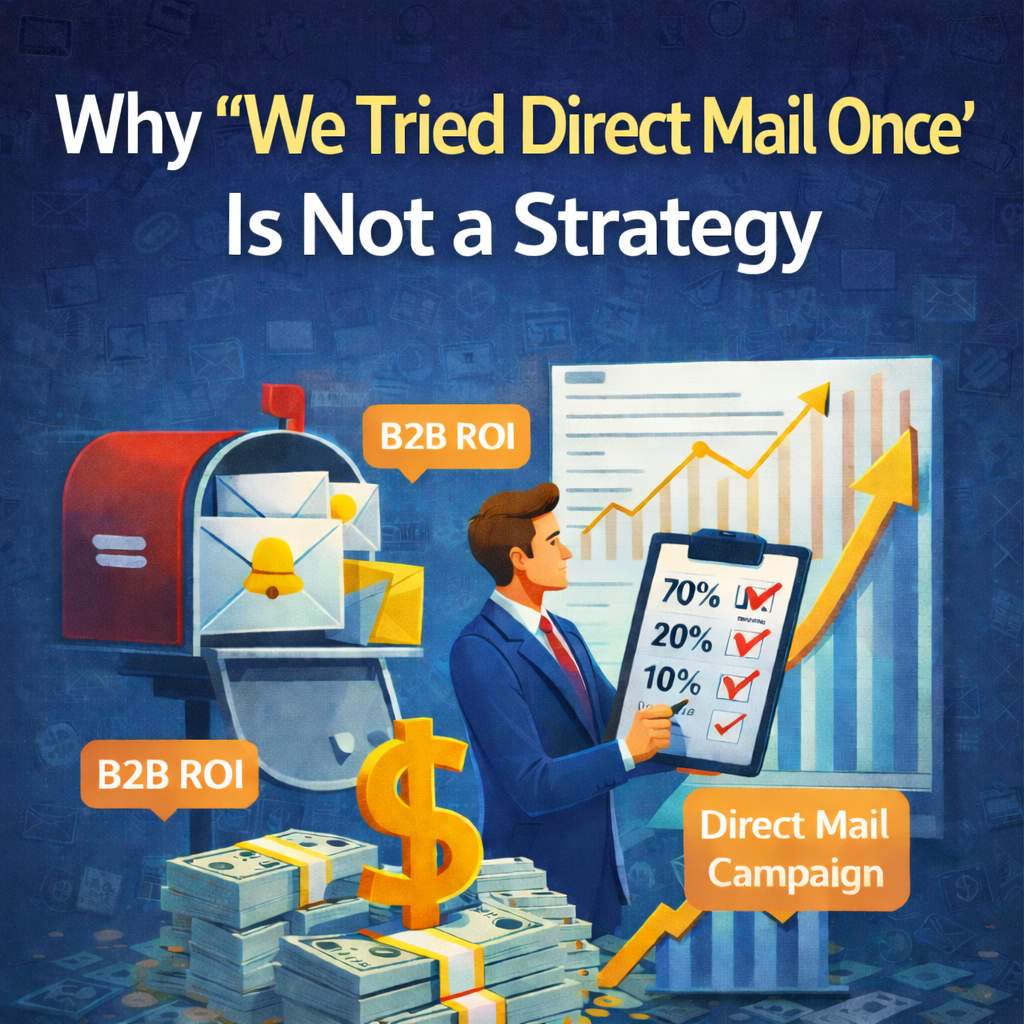
The Core Rule: 70/20/10 Drives Results
At Zairmail, we use a simple framework to guide every campaign:
70% list
20% offer
10% creative
The list determines who sees your message.
The offer determines whether it resonates.
The creative supports attention—but only when the first two are right.
When a mail campaign underperforms, it’s rarely because of format or design. It usually comes down to one of two issues: targeting the wrong audience, or presenting an offer that doesn’t align with buyer needs. No amount of creative can compensate for either.
Be Clear on the Goal of the Campaign
Marketing exists on a continuum—from brand advertising to direct response. Problems arise when these goals are mixed or misjudged.
Brand Mail: Build Recognition Over Time
Some direct mail campaigns are designed to build familiarity and credibility rather than prompt immediate action. Success looks like increased brand recognition, greater trust with key accounts, and stronger recall when a buying decision happens later.
In these cases, repetition is essential. Every touch builds brand memory and reduces friction over time.
Direct Response Mail: Measure ROI, Not Just Response
For B2B marketers, direct response mail isn’t about impulse behavior. It’s about creating measurable movement in the buying journey.
These campaigns often see the highest response on the first send, with response rates declining over time. That’s expected. What matters is return on investment, not raw response volume.
A campaign can remain profitable at lower response rates if margins are strong or lifetime customer value is high. Over time, lists may fatigue—but that doesn’t stop smart teams from testing, refining, and improving performance.
Why Direct Mail Still Breaks Through
In a digital-first world, physical mail has structural advantages. It’s tangible, harder to ignore, and free from inbox fatigue. When integrated with digital channels, direct mail reinforces messaging and improves overall campaign effectiveness.
Final Thought
Direct mail doesn’t fail because it “doesn’t work.”
It fails when it’s treated as a one-time experiment instead of a disciplined marketing channel.
When campaigns are built with the right audience, a compelling offer, and a clear objective—then measured, refined, and repeated—direct mail becomes a reliable driver of awareness, engagement, and revenue.
Saying “we tried mail once” isn’t a conclusion.
It’s an incomplete evaluation.
👉 Book on Calendly
Wilson Zehr is a Direct Mail Industry Expert, Direct Marketing Specialist, and CEO of Cendix (www.cendix.com), the leading provider of web-to-print solutions. He is also the founder of Zairmail (www.zairmail.com), responsible for many industry firsts in direct mail.